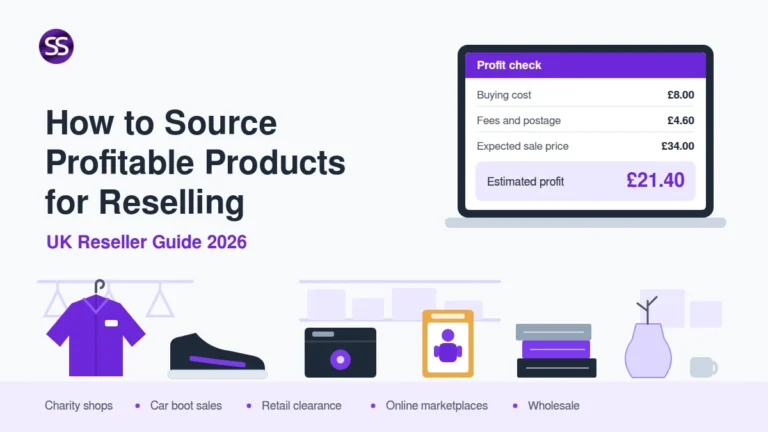
SELLERSTACK SOURCING GUIDE · UPDATED FOR 2026
How Much Should You Pay for Resale Stock?
Learn how to work backwards from a realistic selling price, account for selling costs, protect your target return and set a buying limit before committing money to stock.
UK Reseller Sourcing Guide
This guide explains how to assess what resale stock is worth to your business before you buy it.
Last reviewed: October 2026
How Much Should You Pay for Resale Stock?
Start with what the item can realistically sell for, then work backwards through the costs of completing the sale and the profit or return you want to make.
At its simplest:
Maximum Buy Price = Expected Selling Price − Selling Costs − Desired Profit
If an item should realistically sell for £80, selling and fulfilment costs are expected to total £19, and you require at least £25 profit:
£80 − £19 − £25 = £36 maximum buying price
Treat £36 as a ceiling rather than a target. Buying below it leaves more room for a lower selling price, unexpected costs, returns or a slower-than-expected sale.
Why the Purchase Price Matters So Much
Reselling profit starts before the item is listed.
Once stock has been purchased, you have limited control over several things that can affect the final result: buyer demand, competitor pricing, marketplace charges, returns and the eventual selling price.
The amount you agree to pay for the stock, however, is one of the decisions you control from the beginning.
Work Backwards From the Sale — Not Forwards From the Discount
An item is not a good sourcing opportunity simply because it looks cheap compared with its original retail price or the seller’s asking price.
What matters is whether the purchase price leaves enough room between your realistic resale value and your total costs.
Cheap Stock Is Not Automatically Profitable Stock
Low purchase prices can feel safe because less money is being spent. But a low-cost item can still be poor inventory if it produces very little cash profit, takes a long time to sell or requires too much work.
| Example | Buy Price | Expected Sale | Other Costs | Estimated Profit |
|---|---|---|---|---|
| Used DVD Player | £5 | £18 | £10 | £3 |
| Branded Coffee Machine | £30 | £95 | £31 | £34 |
The £5 item requires less capital, but under these assumptions it leaves only £3.
The coffee machine requires more money upfront but produces much more cash profit.
That still does not automatically make the coffee machine the better purchase. You also need to consider demand, condition, preparation time, storage, risk and how quickly your capital could return.
Step 1: Establish a Realistic Resale Value
Every buying-price calculation depends on the quality of your expected selling price.
If the resale estimate is unrealistic, the maximum buying price built from it will also be unreliable.
Use Sold Evidence Where It Is Available
Active listings show what sellers would like to receive. Completed sales provide stronger evidence of what buyers have actually been willing to pay.
When researching comparable products, check:
- Exact brand and model
- Condition
- Size, colour or specification
- Accessories and original packaging
- Recent completed prices
- How frequently comparable products appear to sell
- Current competition
- Whether prices are rising, stable or falling
Do Not Build the Deal Around the Highest Price You Can Find
One unusually high sale does not automatically represent the price your item is likely to achieve.
Look for a realistic cluster of comparable outcomes and adjust for condition, completeness and the market you intend to sell into.
Condition Can Change the Economics Completely
A product may have a strong resale value when complete and working but a much lower value when damaged, incomplete or untested.
Before paying a premium for stock, check whether:
- The item works as expected
- Important accessories are included
- Replacement parts are readily available
- Cosmetic damage affects buyer demand
- The item can be tested properly
- Any cleaning or repair cost is known
Step 2: Account for the Complete Cost of Selling
Purchase price is only one part of the money committed to a resale.
Depending on the product, marketplace and fulfilment method, your calculation may need to include:
Marketplace & Transaction Costs
- Marketplace fees
- Payment-processing charges
- Promoted listings or advertising
- Other transaction charges
Getting the Order to the Buyer
- Postage or courier cost
- Boxes or mailing bags
- Tape and labels
- Protective packaging
Making the Item Sale-Ready
- Cleaning materials
- Replacement parts
- Batteries or accessories
- Testing or repair costs
Costs That May Not Be Certain
- Returns
- Refunds
- Price reductions
- Unexpected preparation work
Small costs become important when they repeat across dozens or hundreds of transactions.
A sourcing decision that looks attractive after subtracting only the stock cost can look very different after postage, packaging, fees and preparation are included.
What About Fuel, Parking, Storage and Other Business Costs?
Not every business expense needs to be assigned precisely to one item, but wider operating costs still affect the economics of your reselling activity.
Regular sourcing trips may involve fuel, parking, travel time, storage, software and general supplies.
Your per-item buying calculation can focus on direct costs, while your wider business records should still tell you whether the operation remains worthwhile after overheads.
Step 3: Decide What Return Makes the Purchase Worthwhile
There is no universal profit or ROI target that suits every reseller and every item.
A useful buying decision normally considers at least three measures.
| Measure | What It Tells You | Main Question |
|---|---|---|
| Net Profit | Estimated cash left after the included costs | How many pounds could this sale make? |
| ROI | Profit relative to the purchase cost | How efficiently is my stock capital working? |
| Profit Margin | Profit relative to sales revenue | How much of the sale remains as profit? |
A High Percentage Can Still Produce Very Little Money
An item bought for £1 can produce an impressive percentage return while leaving only a few pounds of cash profit.
A more expensive purchase can produce a lower ROI while generating considerably more actual profit.
That is why profit, ROI and margin are more useful when considered together rather than optimising one number in isolation.
Check the Return Before You Buy
Use the Reseller ROI Calculator to compare purchase cost, estimated profit, margin, break-even price and return on invested stock capital.
Step 4: Consider How Long Your Money May Be Tied Up
Profitability on paper does not tell you how quickly the item will return cash to the business.
Consider two opportunities with the same purchase cost and the same projected profit.
If one typically sells within days while the other may sit for several months, the first opportunity returns your buying capital sooner and gives you the option to reinvest it again.
ROI Does Not Measure Selling Speed
A strong projected ROI is less attractive when the stock has weak demand, requires substantial storage or may remain unsold for a long period.
Consider return and likely turnover together.
Faster-Moving Stock
Can return capital sooner, reduce storage pressure and create more opportunities to reinvest.
Slower-Moving Stock
May still be worthwhile when the profit is strong enough to compensate for the longer holding period and additional risk.
Measure How Efficiently Your Stock Is Moving
Use the Stock Turnover Calculator when you want to assess how quickly inventory is moving through the wider business.
Step 5: Calculate Your Maximum Buying Price
Once you have established a realistic selling price, likely costs and the return you require, you can calculate a buying ceiling.
Simple Maximum Buy Price Formula
Expected Selling Price − Selling Costs − Required Profit = Maximum Buy Price
The number is useful because it changes the sourcing question from:
“Does £30 feel cheap?”
to:
“Does £30 fit the economics of this particular resale?”
Maximum Does Not Mean Recommended
Your maximum buy price is the highest amount supported by the assumptions and financial targets in your calculation.
It should not automatically become your opening offer or preferred purchase price.
Step 6: Build in a Safety Buffer
Every sourcing calculation contains assumptions.
The item may sell for less than expected, shipping may cost more, advertising may be needed, a repair may appear or the buyer may return the product.
Buying below your theoretical maximum gives you more room to absorb those changes.
Simple Safety-Buffer Approach
Recommended Buy Price = Maximum Buy Price × (1 − Safety Buffer %)
Maximum buying price: £36
Safety buffer: 10%
Recommended buying price:
£36 × 0.90 = £32.40
A conservative buffer cannot rescue a calculation built on an unrealistic selling price or missing costs.
Start with credible inputs first, then use the buffer as extra protection.
Calculate Your Buying Limit Before You Negotiate
The Maximum Buy Price Calculator works backwards from your expected sale, marketplace costs, fulfilment costs, minimum profit, target ROI, target margin and safety buffer.
Buy, Negotiate or Walk Away?
Once you know both your preferred purchase price and absolute ceiling, the seller’s asking price becomes much easier to assess.
| Asking Price | What It Means | Typical Response |
|---|---|---|
| Comfortably below recommended price | Good financial room remains | Verify condition and demand, then consider buying |
| Near recommended price | Deal may still fit your targets | Check assumptions carefully |
| Between recommended and maximum | Less protection against things going wrong | Negotiate where possible |
| Above maximum | Purchase no longer meets the targets entered | Walk away unless the price or evidence materially changes |
Decide Your Limit Before Negotiating
If your maximum is £30, knowing that before you speak to the seller makes it easier to stay disciplined when the asking price is £40.
You do not need to tell the seller your maximum. It is an internal decision limit, not your opening offer.
The Time You Have Already Spent Does Not Make a Bad Deal Better
Walking away can be difficult after you have researched an item, travelled to collect it or spent time negotiating.
But previous effort does not improve the economics of the purchase.
If the numbers no longer work, committing additional money simply adds more capital to a weak opportunity.
Different Sourcing Methods Need Different Risk Adjustments
The same financial principles apply wherever you source stock, but the type of uncertainty can change.
Condition & Completeness
Check missing accessories, damage, testing requirements and realistic resale value before buying simply because an item is inexpensive.
Check a Charity Shop Find →Negotiation & Testing Risk
Prices may be negotiable, but condition and testing can be less certain. Keep additional room when important information is unknown.
Ignore the Size of the Discount
“Was £100, now £25” does not tell you whether there is resale demand at £50. Value the stock from the current resale market, not the original RRP.
Use Your Limit to Negotiate
Facebook Marketplace and other local sources can allow direct negotiation, making a pre-calculated recommended price and walk-away figure especially useful.
Set the Bid Limit First
Competitive bidding can make it easy to pay more than planned. Decide the maximum before bidding begins and include any buyer fees or collection costs.
Judge the Whole Batch
A low unit cost can hide slow-moving or difficult inventory. Estimate how much of the batch is genuinely saleable and how much capital could remain tied up.
How to Source Profitable Products for Reselling in the UK
Explore charity shops, car boot sales, clearance, wholesalers, local marketplaces, auctions and online sourcing in the full SellerStack sourcing guide.
Worked Examples: What Should You Pay?
Branded Kitchen Appliance
| Expected selling price | £80 |
| Marketplace costs | £11 |
| Postage | £6 |
| Packaging | £2 |
| Required profit | £25 |
Maximum buying price:
£80 − £11 − £6 − £2 − £25 = £36
If the seller wants £30, the purchase sits £6 below the calculated maximum.
If the seller wants £45, the purchase no longer supports the same £25 target profit unless another assumption changes.
Fast-Moving Low-Cost Item
Imagine a product costs £8 and should sell for £30.
After selling, postage, packaging and preparation costs, the projected profit is £12.
That may look less exciting than a £40 profit on a higher-value item, but if the £8 product sells consistently within days while the higher-value product regularly takes months, the cheaper item may return buying capital more quickly.
The stronger purchase depends on your capital, workload, storage, repeatability and business strategy—not one number alone.
Retail Clearance With Multiple Units
A retailer reduces a product from £60 to £18 and has 15 units available.
Buying all 15 would require £270 of stock capital.
Before treating the 70% retail discount as an opportunity, ask:
- What are buyers currently paying?
- How many comparable units actually sell?
- How much competing stock is already available?
- Could the resale price fall once clearance stock reaches the market?
- How long could 15 units take to sell?
A profitable single-unit calculation does not automatically make a 15-unit purchase a good inventory decision.
Buying Decisions and Dead Stock Are Connected
Overpaying is not the only sourcing risk.
Stock can meet an attractive profit target on paper and still become a problem if demand is weak or you buy too many units.
Money tied up in unsold stock cannot be used for stronger sourcing opportunities.
When buying multiples, pay attention to likely demand, existing stock levels and how quickly the market can absorb the quantity you intend to purchase.
See How Much Capital Is Tied Up in Unsold Stock
Use the Dead Stock Calculator to measure ageing inventory and estimate how much capital may be recoverable.
Common Resale Stock Buying Mistakes
1. Using Asking Prices as Resale Evidence
What another seller wants does not automatically represent what buyers are currently paying.
2. Buying Because the Original RRP Looks High
Retail discounts do not create resale demand. Base the decision on the current resale market.
3. Forgetting Selling Fees
Marketplace, payment and advertising costs can materially reduce the profit left from a sale.
4. Underestimating Postage and Packaging
Heavy, bulky and fragile items can cost considerably more to fulfil than expected.
5. Ignoring Preparation Costs
Cleaning, testing, repairs, missing accessories and replacement parts all affect the real cost of getting stock ready to sell.
6. Focusing Only on ROI
A high percentage return may still produce too little cash profit to justify the work involved.
7. Ignoring Selling Speed
Capital tied up for months may be less useful than a slightly lower-return opportunity that sells consistently.
8. Buying Right at the Maximum
Paying your absolute ceiling leaves little protection if any assumption proves too optimistic.
9. Buying Too Many Units
A strong single-item profit calculation does not guarantee that the market can absorb a large quantity at the same price.
10. Refusing to Walk Away
Scarcity, excitement, travel time or negotiation effort should not persuade you to abandon a buying limit that was based on sound numbers.
Resale Stock Buying Checklist
- Have I researched a realistic selling price?
- Is there evidence that comparable items actually sell?
- Have I checked the item’s exact condition?
- Are important accessories or parts missing?
- Have I included marketplace and payment costs?
- Have I included postage and packaging?
- Does the item require cleaning, testing or repairs?
- Do I know the minimum cash profit I want?
- Have I considered ROI and margin as well?
- How quickly is the item likely to sell?
- How much stock capital will be tied up?
- Have I calculated a maximum buying price?
- Have I allowed a sensible safety buffer?
- Do I know my walk-away price before negotiating?
SellerStack Tools for Better Sourcing Decisions
Maximum Buy Price Calculator
Work backwards from your expected sale and financial targets to calculate a recommended and maximum purchase price.
Calculate Your Buying Limit →Reseller ROI Calculator
Compare estimated profit with the money invested in the stock.
Calculate ROI →Resale Profit Calculator
Calculate estimated profit and margin after stock and selling costs.
Calculate Reseller Profit →Stock Turnover Calculator
Measure how efficiently stock is moving through the business.
Check Stock Turnover →Recommended Free SellerStack Resource

Source Smarter. Protect Your Profit.
The difference between profitable resellers and struggling sellers isn’t luck—it’s having a repeatable system.
- Profit & ROI worksheets
- Marketplace fee cheat sheets
- Pricing checklist
- Sourcing checklist
- Shipping cost-saving guide
- Access to SellerStack calculators
Ready to Make Better Decisions?
Get the practical worksheets, checklists and reseller resources designed to help you source, price and sell with more confidence.
Get My FREE Toolkit →Free toolkit. Practical emails. Unsubscribe anytime.
How Much to Pay for Resale Stock: FAQs
How much should I pay for resale stock?
There is no single percentage that works for every item. Start with a realistic expected selling price, subtract the selling and fulfilment costs you expect to incur, then protect the profit or return required to make the purchase worthwhile. The resulting figure can be used as a maximum buying price.
What is a maximum buy price?
A maximum buy price is the highest purchase price supported by the selling-price, cost and profitability assumptions used in your calculation. Treat it as a ceiling rather than an ideal offer.
Should I always buy below my maximum price?
Buying below the maximum generally gives you more protection against a lower selling price, unexpected costs, returns or a longer selling period. How much room you need depends on the risk and certainty of the opportunity.
Should postage be included when deciding what to pay?
Include postage when it represents a cost to you. Also consider buyer postage income, packaging and other fulfilment costs so the full order economics are reflected.
Should I use active listings to value resale stock?
Active listings can provide useful information about competition, but they do not prove that buyers are willing to pay those prices. Where possible, compare them with recent completed sales and realistic demand evidence.
Is ROI more important than cash profit?
Neither measure is sufficient on its own. ROI shows how efficiently purchase capital may generate profit, while net profit shows the actual cash result expected from the sale. Selling speed, margin and workload also matter.
How much safety buffer should I use?
There is no universal percentage. Greater uncertainty around selling price, condition, returns, repair costs or selling speed may justify more room below your calculated maximum.
What if I cannot estimate the selling price confidently?
Treat that uncertainty as a sourcing risk. Research more, lower the price you are willing to pay or walk away until you have enough evidence to make a defensible estimate.
Should I buy all available units when one unit looks profitable?
Not automatically. Check whether demand is sufficient for the quantity, whether additional supply may push prices down and how much capital and storage the stock would require.
What should I do if the asking price is above my maximum?
Negotiate, wait for a reduction, reassess your assumptions if new evidence appears, or walk away. Do not increase the buying limit simply because you are worried about losing the deal.
Know What the Stock Is Worth to You Before You Buy It
Profitable sourcing is not about finding the cheapest item.
It is about understanding what a realistic sale could produce after fees, fulfilment, preparation and the return you require.
Research the resale value, understand demand, calculate the complete costs and establish both a preferred price and an absolute buying ceiling.
Then be prepared to walk away when the numbers no longer support the purchase.
Use Buying Calculations as a Decision Framework
The examples in this guide are illustrative and do not guarantee that an item will sell at the expected price or within a particular timeframe.
Marketplace fees, advertising charges, postage costs, buyer demand and product values can change.
SellerStack calculators produce planning estimates from the information entered. Always verify the current costs relevant to your marketplace, product and selling method before committing money to stock.
Last reviewed: October 2026
Build a More Disciplined Sourcing Process
Explore SellerStack guides and free tools for product research, maximum buying price, ROI, inventory and sourcing decisions.
Explore Sourcing Stock →