
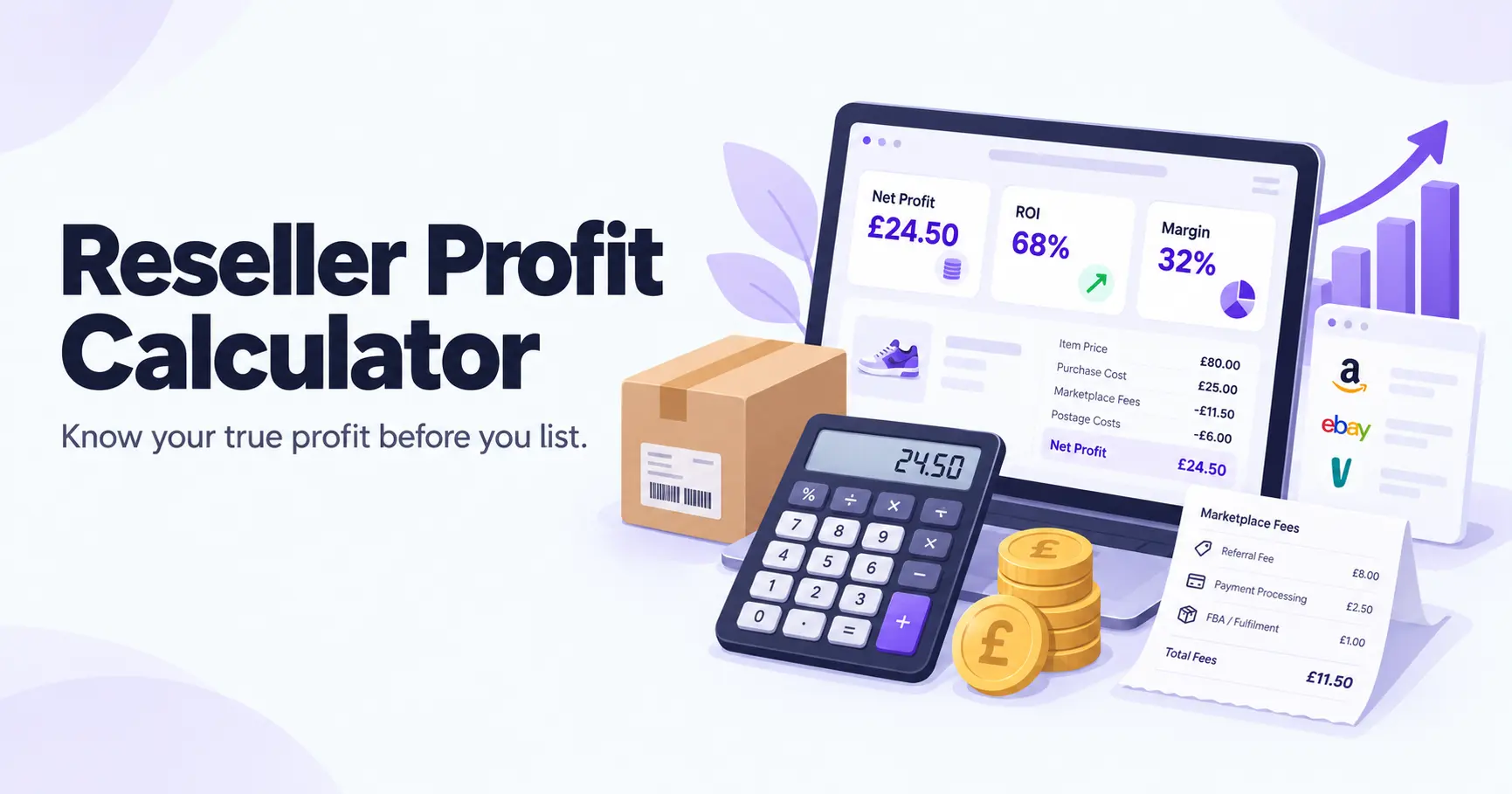
FREE UK RESELLER TOOL
Reseller Profit Calculator UK
Calculate your estimated net profit, profit margin and ROI after stock cost, marketplace fees, postage, packaging and other selling expenses.
Use realistic sale figures before you buy, list or accept an offer to see whether the potential return justifies the money, time and selling risk involved.
Reseller Profit Calculator
Calculate your estimated profit, margin and ROI after marketplace fees, stock and fulfilment costs.
Enter the expected selling price and any shipping or postage charged separately to the buyer.
Include the costs required to buy, prepare and deliver the item.
Enter the percentage and fixed fees that apply to the sale.
Use the dedicated eBay, Amazon FBA, Etsy, TikTok Shop, Vinted, Depop, Facebook Marketplace or Shopify calculator for more detailed platform-specific fee and profit analysis.
Want to compare marketplaces? Open the UK Marketplace Profit Comparison Calculator →
Enter Your Sale Figures
Complete your figures to see the amount you could keep after the entered costs.
Profit Health
How This Result Is Calculated
SellerStack adds the selling price and any buyer delivery charge, then subtracts marketplace fees, stock cost, shipping, packaging and other entered expenses to estimate your final profit.
What Does the Reseller Profit Calculator Tell You?
The SellerStack Reseller Profit Calculator estimates how much money could remain after the stock cost, marketplace fees, shipping, packaging and other selling costs you enter.
It also calculates profit margin, return on investment (ROI), break-even selling price and the approximate profit generated for every £1 invested in stock.
How the Reseller Profit Calculator Works
The calculator starts with the total revenue from the order and subtracts the costs you enter.
Basic reseller profit formula
                Total order revenue
                − marketplace fees
                − stock cost
                − fulfilment costs
                − other selling costs
                = estimated net profit
Total order revenue includes the selling price plus any postage or shipping amount charged separately to the buyer.
A £40 Resale With £17 Estimated Profit
Selling price: £40
Item purchase cost: £15
Selling and payment costs: £4
Postage and packaging: £4
Calculation: £40 − £15 − £4 − £4 = £17
Estimated net profit: £17
Understanding Your Profit Calculator Results
No single profitability number tells the whole story. SellerStack shows several measures because each one answers a different question.
💰 Net Profit
Net profit is the estimated amount remaining after the entered costs have been deducted from total order revenue.
This answers: “How much money could this sale actually make?”
📊 Profit Margin
Profit margin measures how much of the total order revenue remains as profit.
Net profit ÷ total revenue × 100
📈 Return on Investment
ROI compares the estimated profit with the amount invested in purchasing the stock.
Net profit ÷ item purchase cost × 100
⚖️ Break-Even Selling Price
This is the approximate selling price needed to cover the costs and fees entered into the calculator.
Selling below that figure would produce an estimated loss under the same assumptions.
💷 Profit per £1 Invested
This expresses the return on the stock purchase in a simple cash form.
For example, £1.80 profit per £1 invested means that each £1 spent acquiring the stock generates approximately £1.80 of estimated profit after the other entered costs.
🧾 Total Costs
Total costs bring together the purchase cost, selling fees, fulfilment costs and any additional selling expenses entered.
This helps expose the difference between a strong selling price and a genuinely profitable transaction.
Costs Every Reseller Should Consider
A profit calculation is only as useful as the figures entered. Small costs can materially change the result when they are repeated across many sales.
🛒 Item Purchase Cost
Enter the full amount paid to acquire the item.
If stock was bought as part of a bundle or multi-buy, allocate a realistic cost to each item before calculating the sale.
🧾 Marketplace & Payment Fees
Include the percentage and fixed transaction charges relevant to the sale you are analysing.
Platform fees can vary by category, seller status and optional services, so use a marketplace-specific SellerStack calculator when you need more detailed modelling.
🚚 Shipping Cost
Enter the amount you expect to pay to deliver the order.
If the buyer pays postage separately, record that as buyer postage revenue and enter your actual delivery expense separately.
📦 Packaging
Packaging can include mailing bags, boxes, tape, labels, bubble wrap, protective sleeves and void fill.
A small packaging cost may look insignificant on one sale, but becomes meaningful over hundreds of orders.
🧽 Preparation & Repairs
Include cleaning, repair parts, preparation, authentication or other costs required before the item can be sold.
📣 Advertising & Promotion
Include promoted-listing or advertising costs where they apply to the transaction.
Profit Margin vs ROI: What Is the Difference?
Margin and ROI are often confused, but they measure different parts of the transaction.
| Metric | What It Tells You |
|---|---|
| Net Profit | How much money the sale could make. |
| Profit Margin | How much of the order revenue remains as profit. |
| ROI | How efficiently the money invested in stock generates profit. |
| Break-Even Price | The approximate minimum selling price needed to cover the entered costs. |
More Cash Profit Does Not Always Mean Better ROI
Item A: £5 purchase cost and £10 net profit = 200% ROI.
Item B: £40 purchase cost and £20 net profit = 50% ROI.
Item B produces more cash profit, but Item A generates a much stronger return on the money invested.
Neither figure automatically makes one product the better purchase. Also consider demand, selling speed, workload, return risk, storage requirements and whether the deal can be repeated.
What Is a Good Reseller Profit?
There is no universal profit margin or ROI that every reseller should target.
A lower-margin product may still work well if it sells quickly, requires very little work and can be sourced repeatedly. A high-ROI item may be much less attractive if it takes months to sell or needs significant preparation.
Look Beyond One Percentage
Before committing money to stock, ask:
- How much cash profit could the item generate?
- How much money will be tied up in the purchase?
- How long could the item take to sell?
- How much preparation and selling work is involved?
- Is demand strong enough to support the expected price?
- Could the same type of deal be sourced repeatedly?
Use the Profit Calculator Before You Buy Stock
The calculator is useful before a sale happens, not only after an item has sold.
Suppose you find an item for £12 and expect to sell it for £40. The £28 difference can look attractive at first glance.
Once marketplace fees, shipping, packaging, preparation and other costs are included, the estimated profit may be substantially lower.
✅ Buy
The expected profit, margin and ROI meet the targets you have set for the opportunity.
🤝 Negotiate
The product could work, but only if the buying price can be reduced.
🚫 Walk Away
The return is too thin for the capital, work or risk involved.
If you already know the return you want, use the Maximum Buy Price Calculator to work backwards and estimate the highest purchase price the deal can support.
Reseller Profit Calculation Mistakes to Avoid
- Using revenue as profit. The selling price is not the amount you keep.
- Ignoring buyer postage. If postage is charged separately to the buyer, make sure both the income and your actual shipping cost are represented.
- Forgetting packaging and preparation. Small repeated costs can materially reduce profit.
- Using the wrong marketplace fee. Fee structures can differ by platform, category and seller account.
- Looking only at ROI. High ROI does not automatically mean enough cash profit.
- Looking only at cash profit. A larger profit may require much more capital to generate.
- Ignoring selling speed. A profitable item that takes months to sell can keep money tied up for a long time.
- Using optimistic selling prices. Base your estimate on realistic demand and comparable sales, not the highest asking price you can find.
Continue With the Numbers Behind the Sale
💷 Maximum Buy Price Calculator
Work backwards from your expected selling price and target return to estimate a buying ceiling.
⚖️ Break-Even Calculator
Find the approximate minimum selling price needed to cover the costs and fees you enter.
📈 Reseller ROI Calculator
Go deeper into the return generated by the money invested in the stock.
🏷️ Product Pricing Calculator
Work forwards from your costs and profit target to estimate an appropriate selling price.
Need a More Detailed Marketplace Calculation?
The general profit calculator is useful when you already know the fee assumptions you want to use. For platform-specific fee structures, use the dedicated SellerStack marketplace calculators.
🛒 eBay Fee & Profit Calculator
Model eBay-specific selling fees and profitability.
📦 Amazon FBA Profit Calculator
Analyse FBA selling costs, profit, margin and ROI.
🎨 Etsy Fee & Profit Calculator
Estimate Etsy-specific selling costs and profitability.
🛍️ Compare Marketplaces
Compare the same product across multiple selling platforms using one set of assumptions.
Profit Is Only One Part of Business Performance
Once individual sales are profitable, the next question is whether the wider reselling operation is using stock, cash and time efficiently.
📊 Stock Turnover Calculator
Measure how efficiently inventory is moving through the business.
⏱️ Reseller Hourly Earnings Calculator
Compare the profit generated with the working time required to produce it.
Profit Is More Than the Difference Between Buy Price and Sale Price
Profitable reselling comes from understanding the complete economics of the transaction. Purchase price matters, but so do marketplace fees, fulfilment costs, packaging and other expenses required to complete the sale.
Use the calculator before sourcing, pricing or accepting an offer so the decision is based on estimated profit rather than revenue alone.
Reseller Profit Calculator Methodology
The SellerStack Reseller Profit Calculator adds the expected selling price and any buyer postage entered, then deducts the marketplace fees, stock cost, shipping, packaging and other costs entered by the user.
Profit margin compares estimated net profit with total order revenue.
ROI compares estimated net profit with the item purchase cost. Where no purchase cost is entered, an ROI figure may not be meaningful.
Break-even selling price estimates the item price required to cover the entered costs under the fee assumptions supplied.
The calculator provides planning estimates rather than a live marketplace fee feed. Fees, shipping, taxes, returns and other transaction costs can differ from the assumptions entered.
Last reviewed: October 2026
Frequently Asked Questions
What should I enter as the marketplace fee?
Enter the percentage fee and any fixed charge that apply to the sale you are analysing. Marketplace fees can vary by platform, product category, seller status and optional services, so use a dedicated SellerStack marketplace calculator when you need more detailed modelling.
Does the Reseller Profit Calculator automatically include VAT?
No. The calculator works from the costs and fee assumptions you enter. If VAT or another charge applies to your own situation, reflect it in the appropriate fee or cost input or use a more specific calculator where available.
What is the difference between profit margin and ROI?
Profit margin compares estimated profit with total revenue. ROI compares estimated profit with the amount invested in buying the stock.
What does the break-even selling price mean?
It is the approximate selling price required to cover the costs and fees entered into the calculator. Selling below that figure would create an estimated loss under the same assumptions.
Should I always choose products with the highest ROI?
No. ROI is useful for measuring capital efficiency, but also consider cash profit, demand, selling speed, workload, competition and how easily the product can be sourced again.
How can I improve reseller profit?
Common opportunities include buying stock at better prices, improving selling prices, reducing unnecessary fulfilment costs, controlling selling and advertising fees, improving stock turnover and avoiding low-margin purchases before committing cash.
Can I use the calculator before buying stock?
Yes. Enter your expected selling price and estimated costs before purchasing the item to see whether the projected profit, margin and ROI meet your own sourcing targets.
Is the SellerStack Reseller Profit Calculator free?
Yes. The calculator is free to use and does not require a SellerStack account.