
FREE RESELLER PRICING TOOL
Product Pricing Calculator UK
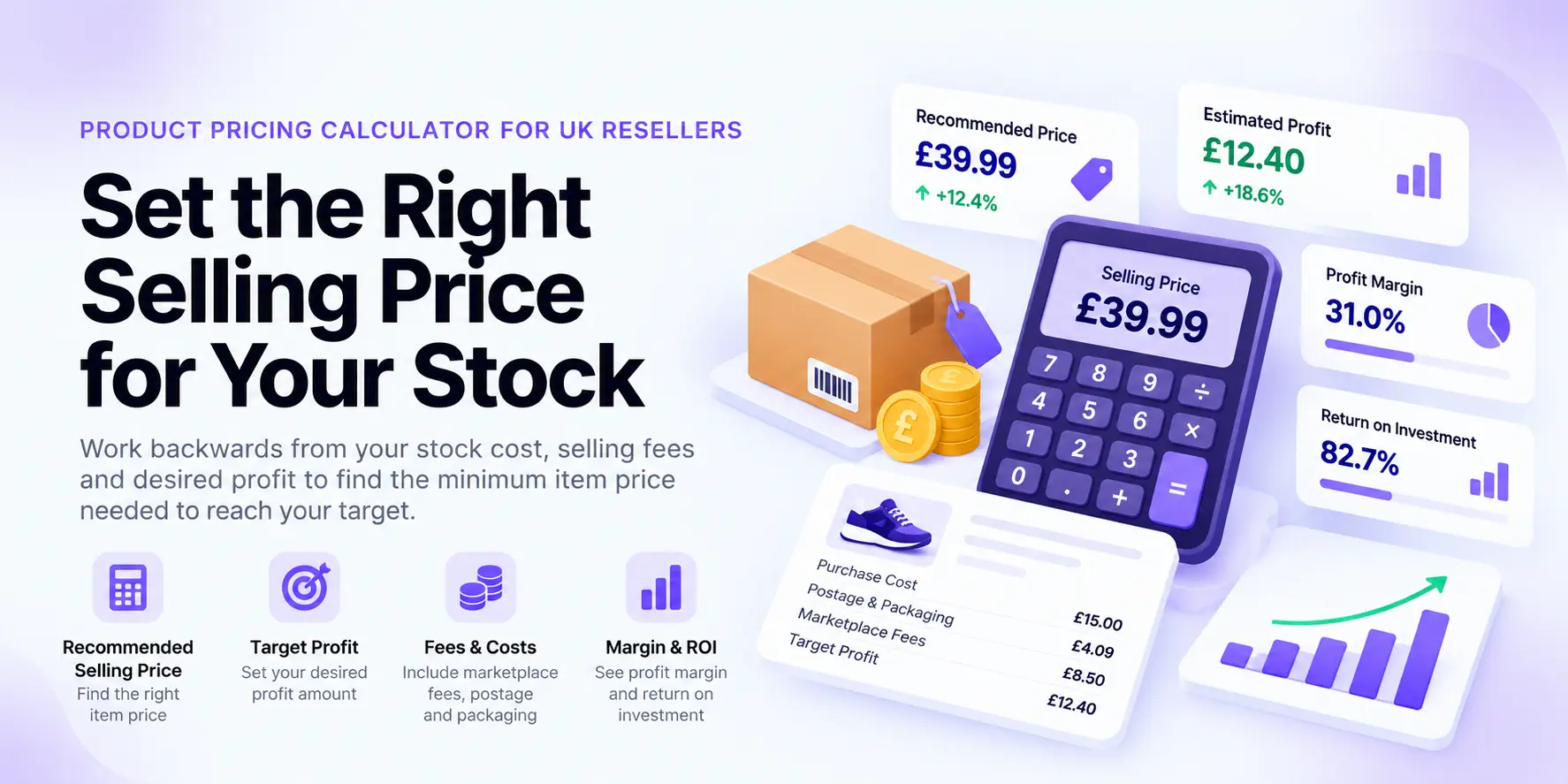
Work backwards from your stock cost, selling fees and desired profit to estimate the minimum item price needed to reach your pricing target.
Use the result alongside realistic sold prices and marketplace demand before buying stock, creating a listing or deciding whether a product can support the profit you want.
Enter Your Costs and Profit Goal
Add your buying costs, selling fees and desired profit to calculate the minimum price you should charge.
Recommended Selling Price
The estimated minimum price needed to cover your costs and reach your desired profit.
Your personalised pricing guidance will appear here after you calculate your selling price.
Can You Realistically Sell It for This Price?
Required revenue = (costs + fixed fee + desired profit) ÷ (1 − percentage fee)
What Does the Product Pricing Calculator Tell You?
The SellerStack Product Pricing Calculator estimates the minimum item price needed to cover the costs you enter and produce your desired profit.
It also shows the estimated net profit, selling fees, profit margin, ROI, total revenue and total costs produced by that pricing target.
How the Product Pricing Calculator Works
Instead of starting with a selling price and asking what profit remains, this calculator works backwards.
You enter the costs of the transaction, the selling fees and the profit you want to make. SellerStack then estimates the revenue needed to support that target.
Required revenue
                (stock and operating costs + fixed fee + target profit)
                ÷ (1 − percentage fee rate)
If you charge the buyer separately for postage, that amount forms part of the total revenue. The calculator therefore subtracts the buyer postage contribution when calculating the required item price. This matches how the live calculator currently models pricing. :chatgpt-content-reference{index=”2″}
Pricing a Resale Product for a £20 Profit Target
Item purchase cost: £15.00
Postage you pay: £3.49
Packaging: £0.60
Other costs: £0.00
Desired profit: £20.00
Percentage selling fee: 12.8%
Fixed fee: £0.30
The calculator works backwards through those figures to estimate the item price required to cover the costs and produce approximately the desired profit.
Understanding Your Pricing Calculator Results
🏷️ Recommended Selling Price
The estimated minimum item price needed to cover the costs entered and support your desired profit.
This is a financial target rather than a prediction of what buyers will actually pay.
💰 Expected Net Profit
The estimated amount remaining after the stock cost, fulfilment expenses and modelled selling fees have been deducted from total revenue.
🧾 Estimated Selling Fees
The approximate percentage and fixed selling charges generated by the pricing assumptions entered.
📊 Profit Margin
Profit margin measures estimated profit as a percentage of total order revenue.
Net profit ÷ total revenue × 100
📈 Return on Investment
ROI compares estimated profit with the amount invested in purchasing the item.
Net profit ÷ purchase cost × 100
💷 Total Revenue & Costs
These figures show the wider transaction behind the recommended item price, including any buyer postage entered.
Your Target Price Still Has to Match the Market
A mathematically profitable price does not automatically make the product commercially viable.
Before buying or listing stock, compare the calculator result with recent sold evidence for genuinely comparable items.
✅ Sold Prices Are Higher
Your financial target may be achievable and there may even be room for a stronger selling price.
⚖️ Sold Prices Are Similar
Your target may be realistic if condition, specification and demand are genuinely comparable.
⚠️ Sold Prices Are Lower
The economics may need to change. Consider a lower buying price, reduced costs, a smaller profit target or walking away from the opportunity.
Costs to Include When Pricing Resale Stock
Leaving costs out can make the recommended price look more profitable than it really is.
- Item purchase cost
- Postage or courier cost you pay
- Packaging materials
- Marketplace selling fees
- Fixed transaction charges
- Cleaning and preparation
- Repairs or replacement parts
- Relevant sourcing or inbound delivery costs
- Other direct per-item expenses
Free Shipping Still Has a Cost
Offering free delivery does not remove the postage expense. It simply means the item price has to recover that expense rather than collecting it separately from the buyer.
If you pay: £3.49 postage
and charge the buyer: £0 postage
the selling price still needs to cover the £3.49 delivery cost alongside the other entered expenses and your desired profit.
Should You Round the Recommended Price?
The calculator can round the minimum result upward to a customer-friendly price ending in .99.
Because the price is rounded upward rather than downward, the estimated profit may finish slightly above the target you entered.
How Much Profit Should You Aim For?
There is no single profit amount that every reseller should use.
A sensible target depends on the stock cost, likely selling speed, workload, risk, marketplace and how consistently the opportunity can be repeated.
Do Not Choose the Profit Target in Isolation
Ask whether the expected profit is enough for:
- the amount of money invested;
- the time needed to prepare and sell the product;
- the expected selling period;
- return or damage risk;
- the amount of storage required;
- the likelihood of having to discount later.
Recommended Price vs Break-Even Price
These two SellerStack tools answer different questions.
| Tool | Question It Answers |
|---|---|
| Product Pricing Calculator | What item price could cover my costs and produce the profit I want? |
| Break-Even Calculator | What is approximately the lowest price I can accept before the entered transaction starts losing money? |
Use the Break-Even Calculator when you need to establish your cost-recovery floor.
What If the Market Will Not Support Your Target Price?
If similar products regularly sell for less than the calculated target, increasing your listing price is unlikely to fix the underlying economics.
One of the strongest levers is often the amount paid for the stock.
Use the Maximum Buy Price Calculator to reverse the decision and estimate how much you could afford to pay while protecting your financial targets.
Do Not Ignore Selling Speed
The highest possible selling price is not always the most useful price.
A product that earns £15 quickly may sometimes be more useful than one that could earn £20 but keeps your money tied up for several months.
For wider inventory performance, use the Stock Turnover Calculator .
Product Pricing Mistakes to Avoid
- Pricing only from the purchase cost. Buying an item cheaply does not tell you what buyers will pay or what the transaction costs.
- Ignoring selling fees. Marketplace and payment charges reduce the amount you keep.
- Forgetting postage and packaging. Free delivery still has to be funded somewhere in the sale.
- Copying active listings. Other sellers’ asking prices are not proof of market value.
- Choosing an unrealistic profit target. If the target pushes the required price above realistic sold values, the deal may not work.
- Assuming a high price is always better. A slower sale can keep capital tied up and increase the risk of future discounting.
- Using outdated marketplace fees. Check the current charges that apply to your category, seller account and transaction.
Continue With the Numbers Behind Your Price
💰 Reseller Profit Calculator
Start with an expected selling price and see what could remain after the costs entered.
⚖️ Break-Even Calculator
Find the estimated minimum selling price required to recover your entered costs.
📈 Reseller ROI Calculator
Measure how efficiently your stock investment could generate profit.
💷 Maximum Buy Price Calculator
Establish the most you could pay before the opportunity stops meeting your targets.
For the wider pricing process, visit the SellerStack Pricing & Profit Hub .
Marketplace Fee Presets Are Planning Assumptions
UK mode includes marketplace presets to make it faster to start a calculation. Those figures should be treated as editable planning assumptions rather than a live fee feed.
Marketplace charges can vary by seller status, product category, programme, optional advertising and account-specific terms.
UK and US Calculator Modes
The calculator supports both UK and US pricing scenarios. Switching market changes the currency and terminology used by the tool.
Start With the Numbers. Finish With the Market.
A good pricing decision has to work financially and commercially.
Use the calculator to establish the price your costs and profit target require, then compare that result with realistic demand and sold evidence before buying or listing the product.
Product Pricing Calculator Methodology
The SellerStack Product Pricing Calculator adds the stock cost, postage paid, packaging, other entered expenses, fixed selling fee and desired profit, then works backwards through the percentage selling fee to estimate the required revenue.
Any separate postage amount charged to the buyer forms part of total revenue and is therefore deducted when estimating the required item price.
When customer-friendly price rounding is selected, SellerStack rounds the result upward rather than downward. The final estimated profit can therefore be slightly higher than the target entered.
Profit margin compares estimated profit with total revenue. ROI compares estimated profit with the item’s purchase cost.
Marketplace presets and entered fees are planning assumptions rather than a live fee feed. Always check the current fees applicable to your marketplace, category and seller account.
This calculator estimates a financially required selling price. It does not predict demand or guarantee that buyers will pay the recommended amount.
Frequently Asked Questions
How does the Product Pricing Calculator work?
It works backwards from your purchase cost, selling costs, marketplace fees and desired profit to estimate the item price required to support those assumptions.
Is the recommended selling price guaranteed to be achievable?
No. It is a financial target based on the numbers entered. Compare it with realistic sold prices, demand, condition and competition before deciding what to list the item for.
Should I include postage when pricing an item?
Yes. Enter the delivery cost you expect to pay and any postage amount charged separately to the buyer so the transaction is modelled more accurately.
What if I offer free delivery?
Enter £0 as postage charged to the buyer and include your actual expected postage expense under your postage cost.
Why is the calculated price higher than similar listings?
Your buying cost may be too high, your expenses may be higher than competing sellers or the desired profit may exceed what the market can support for that product.
Should I use active listings to set my price?
Active listings can provide useful context, but recently sold comparable products generally provide stronger evidence of prices buyers have actually accepted.
What is the difference between pricing and break-even?
The Product Pricing Calculator estimates the price needed to cover costs and achieve a desired profit. The Break-Even Calculator focuses on the approximate minimum price needed to recover the costs entered.
Can I use the calculator for UK and US selling?
Yes. The calculator supports UK and US modes. Values are not automatically converted between currencies, so use figures appropriate to the market selected.
Is the Product Pricing Calculator free?
Yes. The SellerStack Product Pricing Calculator is free to use and does not require a SellerStack account.