Facebook Marketplace is different from most online marketplaces because UK selling is still centred heavily around local discovery, direct conversations and collection rather than a platform-managed checkout.
That can make it particularly useful for furniture, bulky products, household items and other stock where local collection removes the cost or difficulty of parcel shipping.
But selling successfully still requires good photographs, realistic pricing, careful negotiation, safe payment and collection arrangements, and a clear understanding of what you actually make from each sale.
How Do You Sell on Facebook Marketplace UK?
Create a Marketplace listing with clear photographs, an accurate title, description, price and location. Interested buyers normally contact you through Messenger, where you can discuss the item, negotiate the price and arrange collection.
Before completing the sale, agree the payment and handover method, confirm that any electronic payment has genuinely reached your account, and record your actual costs so you know the profit from the transaction.
Is Facebook Marketplace the Right Place for Your Item?
Compare local selling with eBay, Vinted, Depop, Amazon, Etsy, TikTok Shop and other selling routes before choosing where to list.
1. Understand How Facebook Marketplace UK Works
Facebook Marketplace connects listings with people browsing in a chosen geographical area.
Unlike marketplaces built around platform checkout and integrated delivery, the current UK Marketplace experience is primarily designed around local transactions.
Local Discovery
Buyers can browse products around their selected location, making Marketplace particularly useful for items where collection makes practical sense.
Messenger Negotiation
Buyers can contact sellers directly to ask questions, make offers and discuss collection arrangements.
Buy & Sell Groups
Facebook also supports selling through relevant buy-and-sell groups, giving sellers another way to reach suitable local audiences where group rules allow it.
Direct Handover
The buyer and seller normally agree between themselves when and how the item will be collected and paid for.
Facebook Marketplace UK Does Not Currently Have Native Delivery Checkout
Meta’s current UK Help Centre states that selling with delivery on Marketplace is not available in the location.
That means UK sellers should not base their pricing or processes on Facebook-managed shipping labels, Marketplace payouts or an integrated UK “Buy Now” checkout unless Meta introduces those features in future.
2. Use a Seller Profile Buyers Can Evaluate
Facebook Marketplace is closely connected to Facebook profiles, so buyers may look at the seller’s Marketplace profile and available rating information before arranging a transaction.
- use accurate account information
- keep your Marketplace location accurate
- respond clearly to genuine questions
- mark completed listings as sold
- keep listings and messages consistent with the actual item
- follow Facebook’s Commerce Policies and Community Standards
Marketplace Access Can Be Restricted
Facebook can restrict Marketplace access or messaging where an account does not meet its requirements or where activity conflicts with its policies.
Do not create misleading listings or try to work around Marketplace restrictions with duplicate accounts.
3. Focus on Products That Suit Local Selling
Facebook Marketplace can work for many product types, but its local model can be particularly useful where parcel delivery would be expensive, awkward or unnecessary.
Furniture & Home
Sofas, tables, storage, shelving and other larger household items can benefit from local collection rather than courier shipping.
Tools, Garden & DIY
Larger tools, gardening equipment, materials and other practical products can suit location-based selling.
Electronics
Phones, laptops, consoles and household electronics can attract local interest, but higher-value products require particularly careful payment and handover arrangements.
Household & Family Items
Toys, children’s equipment, bundles, storage and general household items can be practical products for local collection.
Check the Commerce Policies Before Listing
Not every product is allowed on Facebook Marketplace. Restricted and prohibited products can change, so check Meta’s current Commerce Policies before listing unfamiliar categories.
4. Create a Facebook Marketplace Listing Buyers Can Understand
A good local listing should answer the obvious buyer questions before the Messenger conversation starts.
-
Use clear original photographs.
Show the actual product from several useful angles rather than relying on manufacturer or stock imagery. -
Write a specific title.
Include useful information such as brand, product type, model, size or colour where relevant. -
Describe the condition honestly.
Mention scratches, missing parts, repairs, wear or other defects that could affect a buyer’s decision. -
Include practical dimensions.
This is especially important for furniture, appliances and bulky items. -
Set the correct location.
Buyers need enough location information to judge whether collection is practical. -
Choose a realistic asking price.
Leave room for negotiation only if the numbers can support it.
Photograph the Fault as Clearly as the Best Feature
If the buyer discovers an obvious scratch or defect only after travelling to collect the item, the sale can quickly fall apart.
Clear condition photographs save time for both sides.
Improve Your Product Presentation
Work through photographs, titles, descriptions and buyer information across all of your selling platforms.
5. Price for Negotiation Without Losing Your Profit
Offers are normal on Facebook Marketplace.
That makes your minimum acceptable price just as important as your advertised asking price.
Local Marketplace Profit
Final buyer price − stock cost − preparation − delivery/travel − advertising − other expenses = estimated profit
Asking £80 Does Not Mean You Will Receive £80
Suppose you bought an item for £30 and listed it for £80.
A buyer offers £65. If you spent another £5 cleaning and preparing it, the simplified profit would be:
£65 − £30 − £5 = £30 estimated profit.
If your target was £40 profit, accepting the £65 offer would miss that target even though the item still sells above its purchase price.
Facebook Marketplace Profit & Offer Calculator
Enter your asking price, buyer offer, stock cost and other expenses to see estimated profit, margin, ROI, break-even and the minimum offer needed to reach your target profit.
For the wider pricing process, visit the Pricing & Profit Hub .
6. Understand Facebook Marketplace UK Fees
Facebook Marketplace UK works differently from marketplaces where the platform processes each order and automatically deducts a percentage commission.
Meta’s current UK Marketplace does not provide native Marketplace delivery checkout.
| Potential Cost | Typical UK Local Sale | What to Know |
|---|---|---|
| Marketplace listing | No normal insertion fee | Local Marketplace listings do not use an eBay-style listing-fee model. |
| Native Marketplace commission | No native checkout commission on a local sale | Payment for a normal UK local transaction is arranged between the buyer and seller rather than processed through Marketplace checkout. |
| Advertising / boosting | Optional | Paid promotion can create an advertising cost if you choose to use it. |
| Delivery or travel | Variable | Fuel, courier costs or your own delivery time can still reduce profit. |
| Payment provider | Depends on method used | Any external payment-provider charge should be included in your calculation. |
Ignore UK Guides Quoting a Facebook Marketplace Checkout Fee
Fee figures attached to Facebook’s shipping checkout in other markets should not automatically be applied to a normal UK local Marketplace transaction.
Meta currently states that selling with delivery through Marketplace is not available in the UK location.
7. Plan Payment and Collection Before the Buyer Arrives
The buyer and seller normally arrange the transaction directly, so clear communication is important.
-
Agree the final price.
Avoid uncertainty about whether further negotiation is expected at collection. -
Confirm the collection location.
Give only the information needed once you are comfortable proceeding with the buyer. -
Agree the payment method.
Make clear how payment will be completed before the item is handed over. -
Verify electronic payment yourself.
Check your own banking or payment-provider account rather than relying on a screenshot or message supplied by the buyer. -
Mark the listing as sold afterwards.
This prevents unnecessary messages and keeps your Marketplace activity organised.
Large Items Need a Collection Plan
For furniture and other heavy products, tell the buyer about dimensions, access, stairs, parking and how many people may be needed to move the item before they travel.
8. Treat Marketplace Safety as Part of the Sale
Direct person-to-person transactions create different risks from a marketplace-managed checkout.
- keep early communication inside Facebook or Messenger
- be cautious with unexpected links sent by buyers
- never provide passwords or authentication codes
- verify payments through your own account
- do not release goods because of a payment screenshot alone
- use an appropriate public meeting place for portable high-value items where practical
- consider having another person present for home collections
- report suspicious accounts or messages through Facebook
Be Cautious With “Courier Will Pay You” Messages
A common scam pattern involves a supposed courier, delivery company or payment service requiring the seller to follow an external link, pay a fee or enter banking information before collection.
Do not assume a message is legitimate simply because it contains the name or logo of a recognised courier.
9. Understand Facebook Marketplace Ratings
Facebook allows Marketplace users to rate people they have interacted with.
Meta currently states that a seller’s Marketplace rating becomes public once the seller has received five or more ratings.
Ratings Are Useful — but They Are Not Verified Purchases
Meta states that it does not verify whether the person leaving a Marketplace rating actually purchased the product or used the service.
Treat ratings as one trust signal rather than proof of a completed transaction history.
10. Source Local Stock With the Exit Price in Mind
Facebook Marketplace can be both a selling channel and a place where resellers discover potential stock.
But a low asking price does not automatically make an item a good flip.
Bulky Local Stock
Furniture and larger household items can sometimes be sourced cheaply because the seller prioritises fast collection over maximum price.
Items Needing Preparation
Cleaning or minor repair can add value, but include both the cost and time before deciding what you can afford to pay.
Collection Cost Matters
Fuel, mileage, van hire or delivery time can turn a cheap local item into an expensive piece of stock.
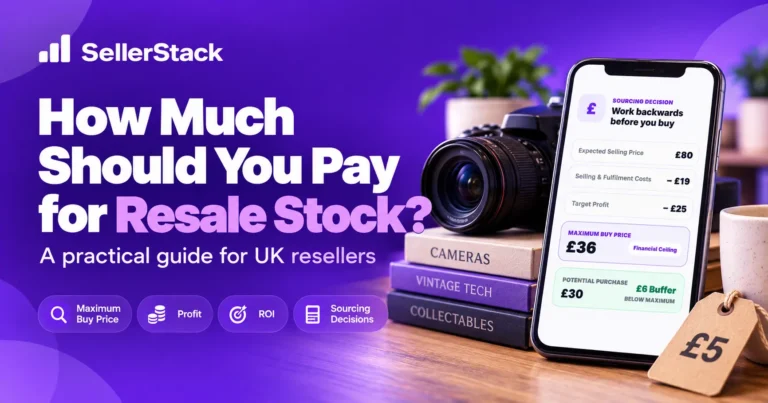
Know the Maximum Buy Price
Work backwards from a realistic resale value rather than deciding whether an item “feels cheap.”
Maximum Buy Price Calculator
Use the expected selling price, costs and target return to estimate the highest price you can afford to pay.
Continue into the Sourcing & Stock Hub for the wider buying process.
11. Separate Decluttering From Trading
Selling your own unwanted furniture, clothing or household possessions is not automatically the same as running a resale business.
Buying products specifically to sell for profit has much stronger characteristics of trading.
Personal Possessions
Selling unwanted items that you originally bought for personal use does not automatically create taxable trading income.
Reselling for Profit
Regularly sourcing products with the intention of reselling them for more money can amount to trading.
The £1,000 Trading Allowance Is Not a Marketplace Limit
HMRC’s £1,000 trading allowance concerns gross trading income across relevant activities. It is not a separate £1,000 allowance for Facebook Marketplace, eBay, Vinted or each selling platform.
If total gross trading income exceeds £1,000, you may need to tell HMRC and assess the appropriate tax treatment.
Platform Reporting and Tax Are Separate Questions
Digital-platform reporting rules do not determine whether a particular sale is taxable.
HMRC states that platform reporting does not automatically mean tax is owed. Your underlying activity and circumstances determine your tax position.
Check Important HMRC Thresholds
Tax, Records & Business
SellerStack provides general educational information, not individual tax, accounting or legal advice. Check current HMRC guidance where it applies to your circumstances.
Common Facebook Marketplace Selling Mistakes
Avoid These Marketplace Errors
- Using outdated UK shipping information. Facebook Marketplace currently does not offer its native Marketplace delivery checkout to UK sellers.
- Pricing without room for realistic negotiation. Know the minimum offer that still meets your target profit.
- Accepting an offer simply because it exceeds your stock cost. Preparation, travel, delivery and other expenses still matter.
- Using vague photographs. Show the actual product, condition and defects clearly.
- Leaving dimensions out of bulky listings. Buyers need to know whether the item will fit their vehicle and home.
- Trusting payment screenshots. Verify an electronic payment directly through your own account.
- Clicking unexpected payment or courier links. Treat requests for login details, card details or verification codes as a warning sign.
- Holding items indefinitely. Agree a clear collection time and decide your own policy on holds.
- Ignoring collection costs when sourcing. Fuel, mileage and transport can destroy the margin on a bulky flip.
- Mixing personal clear-outs with trading records. Keep enough information to understand which sales were personal and which formed part of your resale activity.
The SellerStack Facebook Marketplace Toolkit
Facebook Marketplace Profit & Offer Calculator
Analyse a buyer offer and see your estimated profit, margin, ROI, break-even point and minimum target offer.
Maximum Buy Price Calculator
Find the highest price you can afford to pay before collecting potential resale stock.
Product Pricing Calculator
Build an asking price around your costs and desired profit.
Resale Profit Calculator
Calculate net profit, margin and ROI after the wider costs of a resale.
When Does Facebook Marketplace Make Sense?
Facebook Marketplace can be particularly practical when the item is bulky, local demand matters or avoiding parcel fulfilment makes the sale easier.
But another marketplace may be more suitable when you need national checkout, integrated shipping, specialist buyer demand or a more structured seller workflow.
Compare Marketplace Options
Explore SellerStack’s platform guides and calculators before deciding where your stock fits.
Want Your Own Storefront?
Learn how an independent ecommerce store differs from a local Facebook Marketplace listing.
Frequently Asked Questions About Facebook Marketplace UK
Does Facebook Marketplace charge UK sellers a fee?
Facebook Marketplace UK currently operates primarily as a local listing service rather than a Meta-managed checkout system.
A normal local transaction does not have a native Marketplace percentage commission deducted by Meta. You can still incur your own costs such as advertising, transport, delivery or external payment charges.
Can I offer Facebook Marketplace shipping in the UK?
Meta’s current UK Help Centre states that selling with delivery on Marketplace is not available in the location.
Buyer and seller can separately agree their own arrangements, but that should not be confused with an integrated Facebook Marketplace shipping and checkout service.
What should I sell on Facebook Marketplace?
Marketplace can suit many product types, particularly products with useful local demand or items that are awkward or expensive to ship, such as furniture, larger household goods, tools and garden equipment.
Always check current Commerce Policies before listing restricted or unfamiliar products.
How should I handle low offers?
Decide your minimum acceptable selling price before negotiation. Base it on stock cost, preparation, collection or delivery costs and the profit you want to retain.
The SellerStack Facebook Marketplace Profit & Offer Calculator can show the minimum buyer offer needed to reach a chosen target profit.
How do Facebook Marketplace seller ratings work?
Facebook allows people who have interacted through Marketplace to leave ratings. Meta currently says a seller rating becomes public once the seller receives five or more ratings.
Meta also states that it does not verify that the reviewer actually purchased the item.
Is Facebook Marketplace safe for sellers?
Marketplace can be used safely, but direct person-to-person transactions require sensible precautions.
Keep initial communication on Facebook, avoid suspicious external payment links, verify electronic payments yourself and use an appropriate collection location for the item being sold.
Should I accept a bank transfer screenshot as proof of payment?
No. Check your own banking or payment-provider account and verify that the money has actually arrived before handing over the item.
Do I need to pay tax on Facebook Marketplace sales?
Selling your own unwanted possessions does not automatically mean the proceeds are taxable trading income.
If you buy or make goods specifically to sell for profit, the activity can amount to trading. HMRC’s £1,000 gross trading allowance and other rules may then become relevant depending on your circumstances.
Facebook Marketplace Works Best When Local Selling Is an Advantage
Facebook Marketplace does not need to compete with eBay, Vinted or Amazon on the same terms.
Its strength for many UK sellers is the ability to connect directly with nearby buyers, particularly for bulky products and stock where collection removes shipping from the equation.
Use clear listings, know your minimum acceptable offer, verify payment properly, plan collection safely and measure the final profit rather than judging the deal by the advertised price alone.
Facebook Marketplace Policies, Selling & Safety Information
Information about Facebook Marketplace availability, delivery features, ratings, Commerce Policies, advertising options and seller functionality can change over time.
This guide is provided for general educational and planning purposes. Before making selling or financial decisions, check current Marketplace features, policies and safety guidance directly with Meta. Tax obligations can vary depending on individual circumstances, so check current HMRC guidance or seek appropriate professional advice where necessary.
SellerStack is an independent resource and is not affiliated with or endorsed by Meta or Facebook.
Last reviewed: October 2026
Know the Deal Before You Accept the Offer
Get practical reseller worksheets, sourcing and pricing checklists, marketplace references and direct access to SellerStack calculators.
Check Your Facebook Marketplace Deal
Enter the buyer’s offer and your real costs before agreeing to the sale.