
FREE UK RESELLER TOOL
Dead Stock Calculator
Calculate how much money is tied up in ageing or unsold inventory and see what proportion of your stock may need attention.
Enter your inventory at cost, identify the stock that is no longer moving and estimate how much you could realistically recover through clearance, bundles, discounts or liquidation.
Dead Stock Calculator
Measure your exposure to ageing inventory and estimate how much value you may recover.
Enter the cost value of your inventory and identify the portion that is ageing, inactive or unlikely to sell normally.
We calculate your dead-stock percentage, active inventory, estimated recovery rate and potential unrecovered stock cost.
Stock may still have resale value even when it is ageing. Your recovery estimate helps compare the capital originally invested with what you may realistically get back.
Use these general planning ranges to put your result into context.
A slow seller is not automatically a bad buy. Check the item before cutting the price heavily.
- Check recent sold prices and current demand
- Review your title, photos and listing quality
- Consider seasonal or category-specific demand
- Check whether another marketplace is a better fit
- Compare the cost of holding stock with clearing it
Inventory Health & Recovery
See how much capital is tied up, what you may recover and where action could help.
Enter your inventory figures to calculate the percentage of your stock currently at risk.
Your inventory verdict will appear here
Calculate your results to see how significant your dead-stock exposure may be.
What Could You Recover?
Enter an expected recovery value to compare the original stock cost with the amount you may recover.
What Should You Review Next?
Your stock-age guidance will appear here after calculation.
Calculate your figures to receive general inventory action guidance based on your dead-stock exposure and stock age.
How Your Result Is Calculated
Dead stock can quietly lock up money that could otherwise be used to source better inventory. This guide explains how to measure dead-stock exposure, judge ageing inventory and decide what to review before discounting or clearing unsold items.
Dead stock is inventory that has stopped selling normally or has remained unsold long enough to need review. The SellerStack Dead Stock Calculator measures how much of your inventory cost is tied up in ageing stock and estimates how much of that capital you may recover.
What Is Dead Stock?
Dead stock is inventory that remains unsold and is no longer moving at the rate you originally expected. For a reseller, this could be an item that has received little interest for months, stock with falling demand, an unsuccessful bulk purchase or products that are difficult to sell at a worthwhile price.
However, an old item is not automatically dead stock. Some products naturally take longer to sell because they are seasonal, collectible, specialist or aimed at a smaller group of buyers.
The useful question is not simply, “How old is this stock?” It is whether continuing to hold the item is still a sensible use of your inventory capital.
How to Use the Dead Stock Calculator
The calculator uses four figures from your inventory records. Use cost values rather than expected selling prices so that the result measures the purchasing capital actually tied up in stock.
- Enter your total inventory value. Use the total cost value of the stock you currently hold.
- Enter your ageing or unsold stock value. Add the cost value of the inventory you currently consider slow, inactive or at risk.
- Enter the average age of that stock. Estimate how many days the affected inventory has remained unsold.
- Estimate the recovery value. Enter what you realistically believe you could recover if you repriced, bundled, cleared or otherwise sold the affected stock.
If an item cost you £20 and you hoped to sell it for £50, use £20 when valuing your inventory. The calculator is measuring purchasing capital tied up in stock, not potential sales revenue.
How Dead Stock Is Calculated
The main result compares the cost value of your ageing or unsold inventory with the cost value of all inventory currently held.
Dead Stock Value ÷ Total Inventory Value × 100
The calculator also estimates how much inventory remains outside the dead-stock amount:
Total Inventory Value − Dead Stock Value
If you enter an expected recovery value, SellerStack also calculates your estimated recovery rate:
Expected Recovery Value ÷ Dead Stock Value × 100
The difference between the original cost of the affected stock and the expected recovery value is shown as the potential unrecovered amount.
Dead Stock Calculator Example
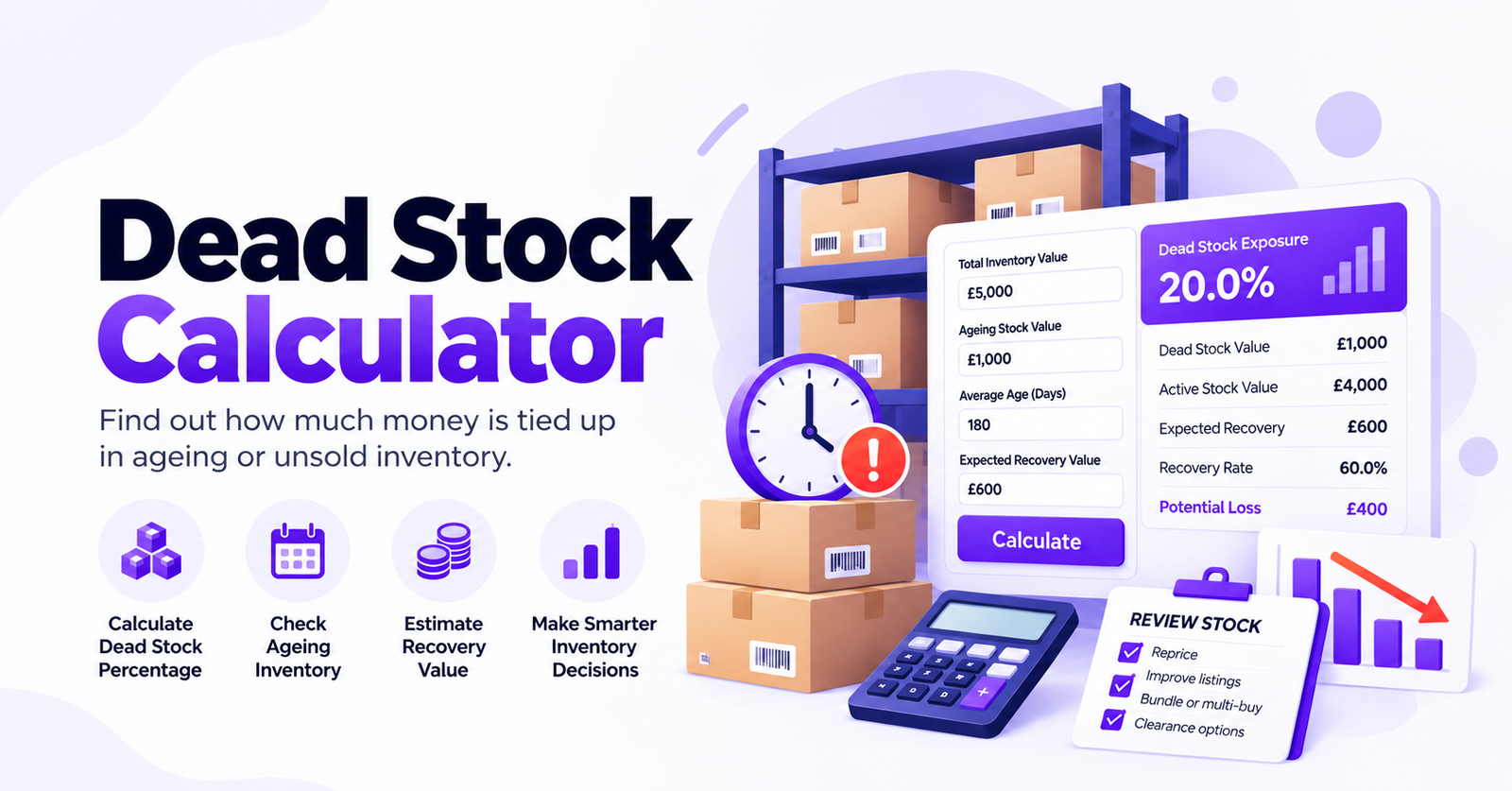
Imagine a reseller currently holds £5,000 of inventory at cost. £1,000 of that stock has been sitting for around 180 days and is now considered ageing inventory.
The reseller estimates that repricing, bundling or clearing the affected items could recover approximately £600.
The calculator would produce:
- Dead stock exposure: 20%
- Dead stock value: £1,000
- Active stock value: £4,000
- Expected recovery: £600
- Estimated recovery rate: 60%
- Potential unrecovered amount: £400
This does not automatically mean the reseller should immediately clear every affected item. It shows that a meaningful amount of purchasing capital deserves closer review.
What Is a Good Dead Stock Percentage?
There is no single dead-stock percentage that is right for every reseller. Product type, selling speed, seasonality, margins and sourcing strategy can all change what is reasonable.
SellerStack therefore uses the following ranges as general planning benchmarks rather than accounting or industry standards.
| Dead Stock Exposure | SellerStack Rating | General Interpretation |
|---|---|---|
| Under 5% | Low Dead Stock | A relatively small proportion of inventory capital is currently tied up in ageing stock. |
| 5%–9.9% | Manageable | Exposure is noticeable but may still be relatively contained. |
| 10%–19.9% | Needs Attention | A meaningful share of inventory may need closer review. |
| 20%–29.9% | High | A substantial amount of inventory capital may be tied up in stock that is not moving normally. |
| 30%+ | Critical | Consider a structured inventory review before committing significant additional capital to new stock. |
Treat the percentage as a signal to investigate rather than an automatic instruction to clear stock. A 15% result made up of seasonal products may require a very different response from a 15% result made up of items with declining demand and repeated price reductions.
How Long Before Stock Becomes Dead Stock?
There is no universal number of days after which inventory becomes dead stock. A reseller selling fast-moving everyday products may become concerned much sooner than someone selling rare collectables, specialist parts or seasonal goods.
| Approximate Age | Possible Interpretation | What to Review |
|---|---|---|
| Under 30 days | Usually still relatively new | Check whether the item is simply following its normal selling cycle. |
| 30–89 days | Beginning to age | Review price, listing quality, demand and marketplace. |
| 90–179 days | Meaningfully aged | Consider stronger listing, pricing or cross-listing action. |
| 180–364 days | Significantly aged | Review repricing, bundles, multi-buy offers and planned clearance options. |
| 365+ days | Long-held inventory | Decide whether continuing to hold the item is justified by demand, margin, seasonality or collectability. |
A winter product held through summer, a rare replacement part or a collectible waiting for the right buyer should not necessarily be treated in the same way as an ordinary item with consistently weak demand.
Why Dead Stock Matters for Resellers
Unsold inventory affects more than shelf space. The money used to buy that stock cannot easily be reused elsewhere until the item sells or is otherwise recovered.
Capital Gets Tied Up
Money sitting in weak inventory cannot be used to buy faster-moving or more profitable stock.
Storage Has a Cost
Physical stock consumes space and can create extra handling, organisation and storage requirements.
Markdown Risk Increases
The longer some products remain unsold, the more likely you may need to accept a lower selling price.
Sourcing Decisions Can Suffer
Without tracking slow inventory, it is easy to continue buying similar products even when existing stock is struggling to sell.
Recovering £600 from £1,000 of weak stock does not mean you have “made” £600. It means you may have converted part of previously committed inventory cost back into usable capital. Profit should be assessed separately.
What Can You Do With Dead Stock?
The right response depends on why the item has not sold. Start with the least destructive options before assuming that a large discount is the only solution.
- Check recent sold prices. Make sure your original pricing assumptions still reflect the current market.
- Improve the listing. Weak titles, photographs, descriptions or item specifics can make otherwise saleable inventory appear slow.
- Cross-list the item. A product that struggles on one marketplace may suit buyers on another.
- Reprice selectively. A modest price adjustment may be enough to restart demand without destroying the remaining margin.
- Create bundles or multi-buy offers. Combining compatible products can increase perceived value and help move multiple units.
- Use a planned clearance. For genuinely weak stock, accepting a lower recovery amount may be preferable to holding the inventory indefinitely.
- Consider other exit options. Depending on the item, donation, recycling or disposal may eventually be more sensible than continuing to store inventory with little realistic resale value.
Dead Stock vs Slow-Moving Stock
Dead stock and slow-moving stock are related, but they are not always the same thing.
| Slow-Moving Stock | Dead Stock | |
|---|---|---|
| Sales activity | Still selling, but more slowly than expected | Little or no meaningful sales activity |
| Typical response | Optimise listing, price or marketplace | Consider stronger recovery or exit action |
| Capital risk | Capital is turning slowly | Capital may remain tied up indefinitely |
| Decision | Improve selling speed | Decide whether continued holding still makes sense |
Dead-stock exposure shows how much inventory may need attention. Stock turnover measures how efficiently your inventory is moving overall. Looking at both gives you a clearer picture than either figure alone.
Common Dead Stock Mistakes
Valuing Stock at the Expected Selling Price
This can exaggerate how much purchasing capital is actually tied up. Use your inventory cost value when calculating dead-stock exposure.
Holding Every Item Indefinitely
Waiting for the original target price can sometimes cost more in lost opportunities than accepting a sensible recovery amount.
Discounting Too Quickly
An item may be slow because of a poor listing, temporary demand or the wrong marketplace rather than because the product itself is bad.
Ignoring Seasonality
Products can appear inactive simply because their strongest selling period has not arrived.
Continuing to Source Similar Stock
Existing dead stock can reveal weak buying decisions. Use the data to improve future sourcing rather than repeatedly adding similar inventory.
Related SellerStack Inventory & Profit Tools
Dead stock is only one part of inventory performance. These free SellerStack calculators can help you examine selling speed, profitability and return on capital from different angles.
Stock Turnover Calculator
Measure how quickly your inventory is moving and estimate how long purchasing capital is typically held in stock.
Calculate Stock TurnoverReseller Profit Calculator
Calculate expected profit after product cost, selling fees and other expenses.
Calculate Reseller ProfitROI Calculator
Measure the return generated relative to the money invested in your stock.
Calculate ROIBreak-Even Calculator
Work out the selling price or sales level required to cover your costs.
Calculate Break-EvenExplore More Free SellerStack Tools
Use our free UK reseller calculators for marketplace fees, profit, pricing, VAT, shipping, inventory and business planning.
Explore All Tools & CalculatorsDead Stock Calculator FAQs
What does dead stock mean in reselling?
Dead stock generally means inventory that has remained unsold and is no longer moving at the expected rate. It may still have resale value, so “dead” does not necessarily mean worthless.
How do I calculate my dead stock percentage?
Divide the cost value of your dead or ageing stock by your total inventory cost value and multiply the result by 100. For example, £1,000 of dead stock within £5,000 of total inventory represents 20% dead-stock exposure.
When should inventory be considered dead stock?
There is no universal time limit. Selling cycle, product type, seasonality, marketplace and demand all matter. Inventory that is old but still has a realistic reason to sell later may not genuinely be dead stock.
Should I discount dead stock?
Not automatically. First check current sold prices, listing quality, demand, seasonality and whether another marketplace may perform better. Discounting is one recovery option, not the only one.
Is dead stock the same as slow-moving stock?
Not necessarily. Slow-moving stock may still sell regularly but take longer than expected. Dead stock usually describes inventory with little or no meaningful movement that may require a stronger recovery or exit decision.
Does recovering money from dead stock count as profit?
No. Recovering money from ageing stock can return some of the capital previously invested in inventory, but profit depends on the selling price, original cost, fees and other expenses.
Want to Make Better Reselling Decisions?
Get the free UK Reseller Profit Toolkit and use SellerStack’s practical resources to improve pricing, margins and inventory decisions.
Get the Free UK Reseller Profit Toolkit