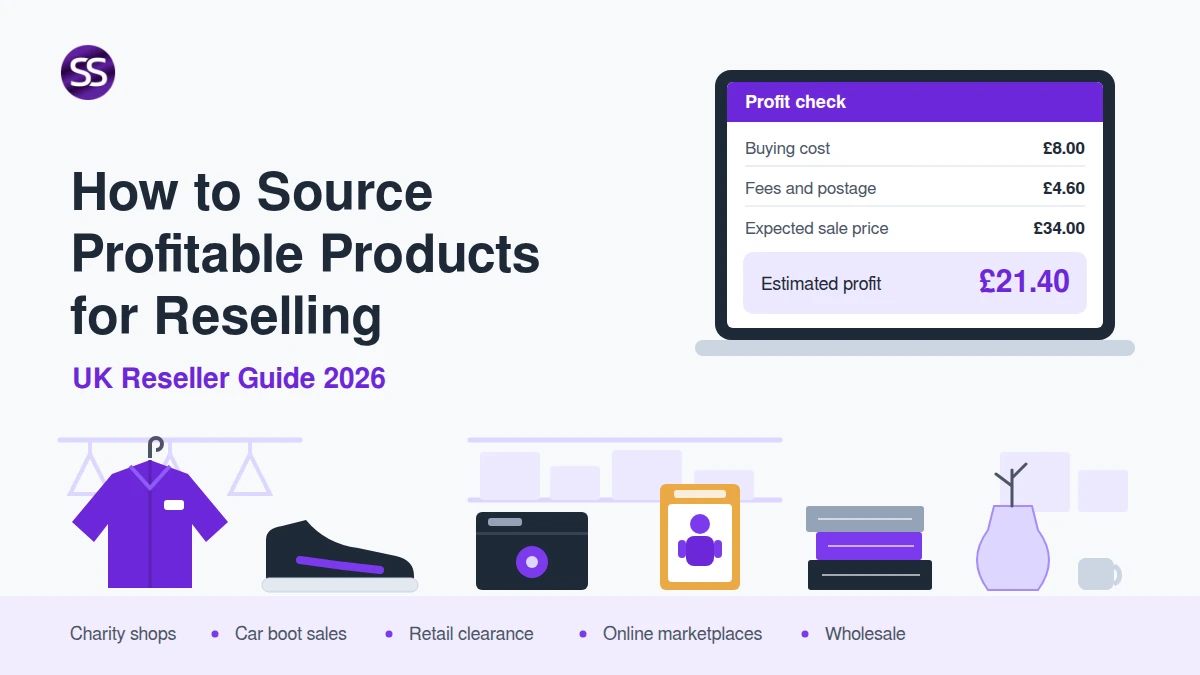
How to Source Profitable Products for Reselling in the UK (2026 Guide)
Finding products to resell is easy. Finding products that can actually leave you with worthwhile profit is much harder.
Charity shops, car boot sales, clearance aisles, online marketplaces, wholesalers and auctions can all produce good sourcing opportunities. But none of them automatically produce profitable stock.
The real skill is learning how to recognise the difference between:
a cheap product and a good resale opportunity.
Before buying anything, you need to think about demand, realistic selling price, competition, condition, selling costs, postage, risk and how much profit the item could realistically leave behind.
In this guide, we’ll walk through the main ways UK resellers can source stock, show you how to evaluate potential purchases and build a simple sourcing process that helps you avoid filling your home with products that looked profitable but never sold.
How Do You Source Profitable Products for Reselling?
Profitable sourcing starts by working backwards from the likely sale rather than forwards from the purchase price.
Before buying stock, ask:
- Is there evidence that people actually buy this product?
- What is a realistic selling price?
- How much competition already exists?
- What condition is the item in?
- What will selling, postage and preparation cost?
- How much profit could remain?
- How much can I afford to pay?
Only then should you decide whether the item is worth buying.
SellerStack principle: Source from the resale value backwards — not from the discount forwards.
What Makes a Product Worth Reselling?
A profitable resale item is not simply something you can buy cheaply.
A £2 item that nobody wants may be worse stock than a £30 item with strong demand and room for £25 profit.
When assessing a sourcing opportunity, think about six factors together.
1. Demand
Is there evidence that buyers actually want the product, brand, model, style or category?
2. Selling Price
What are comparable products realistically selling for — not simply being listed for?
3. Buying Cost
How much money must you put into the item before it has any chance of generating a return?
4. Selling Costs
Consider marketplace charges, payment costs, postage, packaging, preparation and optional advertising where relevant.
5. Risk
Could condition, authenticity, missing parts, safety issues or uncertain demand turn the purchase into dead stock?
6. Time
A product can be profitable on paper but still tie up your cash and storage space for months.
Don’t Let a Big Discount Make the Decision for You
“Was £100, now £20” tells you how far the retailer has reduced the product. It does not tell you whether anybody will pay £40, £50 or £60 for it on the resale market.
Research the current resale market, not just the original retail price.
The 7-Point Sourcing Check Before You Buy
Experienced sourcing is less about finding secret locations and more about asking better questions before handing over your money.
Before buying resale stock, check:
- Demand: Are comparable items actually selling?
- Realistic resale value: What could this specific item reasonably achieve?
- Competition: How many similar products are already available?
- Condition: Are there faults, stains, missing pieces, damage or wear?
- Costs: What will fees, postage, packaging and preparation add?
- Profit: Is the potential cash profit worth the work and risk?
- Maximum buy price: What is the highest amount you can pay while still meeting your target?
Know Your Buying Ceiling Before You Source
If you know the expected selling price, likely selling costs and the profit you want to make, work backwards to estimate the maximum amount you can afford to pay.
Use the Maximum Buy Price Calculator → Read the Resale Stock Buying Guide →A Simple Sourcing Example
Imagine you find a branded jacket in good condition while sourcing.
Should You Buy the Jacket?
| Estimate | Amount |
|---|---|
| Realistic selling price | £40 |
| Purchase price | £10 |
| Estimated selling, postage and packaging costs | £8 |
| Cleaning/preparation | £2 |
| Estimated profit | £20 |
On those assumptions:
£40 − £10 − £8 − £2 = £20 estimated profit.
That does not automatically mean you should buy it. You would still check demand, condition, competition and how confident you are in the £40 selling-price estimate.
But now you are making the decision from numbers rather than from the fact that “£10 sounds cheap”.
Where Can UK Resellers Source Stock?
There is no single best sourcing method.
Good resellers often build several sourcing channels over time so they are not dependent on one shop, supplier or marketplace.
| Sourcing Method | Typical Advantage | Main Risk | Good For |
|---|---|---|---|
| Charity shops | One-off finds and low entry cost | Inconsistent stock | Beginners and second-hand sellers |
| Car boot sales | Negotiation and low-cost opportunities | Condition and limited research time | Experienced bargain hunters |
| Retail clearance | New products and repeat quantities | Discount does not guarantee resale demand | Retail arbitrage |
| Local marketplaces | Bundles and collection-only deals | Condition and seller reliability | Bulky goods and job lots |
| Auctions/job lots | Potentially large quantities | Mixed quality and hidden costs | More experienced resellers |
| Wholesalers | Repeatable inventory | Higher capital commitment | Growing resale businesses |
| Online sourcing | Large searchable inventory | Competition and thinner margins | Research-driven sourcing |
1. Charity Shops
Charity shops are one of the easiest places for a beginner to practise sourcing because you can physically inspect most items before buying them.
Depending on the shop and location, you may find:
- branded clothing
- shoes and trainers
- books
- toys and games
- homeware
- collectables
- small electrical products
- vintage items
The challenge is consistency.
You may find several good items on one visit and nothing worth buying on the next.
How to Source Better in Charity Shops
Don’t rush directly towards the brands you already recognise.
Learn to check:
- model numbers
- materials
- labels and manufacturing details
- condition
- missing accessories
- size and measurements
- current resale demand
A lesser-known product with strong demand can be a better purchase than a famous brand with thousands of competing listings.
Research Before You Reach the Till
When possible, check comparable resale prices before buying. A few minutes of research can prevent months of dead stock.
Sourcing From Charity Shops?
Test the potential numbers before committing your budget.
Use the Charity Shop ROI Calculator →2. Car Boot Sales
Car boot sales can offer opportunities that are harder to find in fixed-price shops because sellers may be clearing large quantities of personal belongings and prices can sometimes be negotiated.
You may come across:
- tools
- toys
- games and consoles
- collectables
- clothing
- homeware
- small appliances
- job lots
But car boot sourcing creates a different pressure: you often have less time to research.
That makes product knowledge particularly valuable.
Set Your Maximum Price Before Negotiating
Negotiating can make a good purchase better, but it can also encourage you to buy simply because you “won” the negotiation.
If your numbers say an item is only worth paying £12 for, getting the seller down from £25 to £18 has not created a profitable deal.
Your maximum buy price should come from the economics of the item — not from the seller’s original asking price.
Checking a Car Boot Purchase?
Estimate potential profit before deciding whether the deal is actually worth taking.
Use the Car Boot Sale Profit Calculator →3. Retail Clearance and Reduced Stock
Retail clearance can look particularly attractive because the discount is visible immediately.
A product reduced from £80 to £25 feels like an obvious opportunity.
But there is an important question:
Why has the retailer reduced it?
Possible reasons include:
- end-of-season stock
- discontinued products
- damaged packaging
- store closures
- overstock
- weak demand
- an older model being replaced
Some of those situations can create excellent opportunities.
Others explain exactly why you may struggle to resell the product.
Don’t Calculate Profit From the RRP
If something originally retailed for £100 but the current resale market is £38, your opportunity should be calculated from roughly £38 — not £100.
Check Quantity Before Buying Deep
Finding one profitable clearance item does not automatically mean buying ten is sensible.
Ask whether the market can absorb the quantity you are considering.
Buying one unit is a product decision.
Buying twenty is also an inventory decision.
Found Discounted Retail Stock?
Compare the purchase price with a realistic resale value and estimated selling costs before buying multiple units.
Use the Retail Clearance Calculator →4. Facebook Marketplace and Other Local Selling Platforms
Local marketplaces can be useful for sourcing products that are awkward or expensive to post.
Examples might include:
- furniture
- larger electronics
- tools
- collections
- house-clearance bundles
- job lots
Collection-only listings can reduce the number of competing buyers, particularly when the seller wants the item gone quickly.
Bundles can also create opportunities.
A seller may price a group of ten items cheaply because they value convenience more than maximising the return from every individual product.
But Don’t Value the Bundle as One Number
Break it down.
Estimate:
- which items are genuinely saleable
- what each one could realistically achieve
- which items may need repair or cleaning
- what might need disposing of
- your total collection/travel cost
A £100 bundle containing £300 of theoretical stock can still be a bad purchase if most of that £300 is based on unrealistic asking prices.
5. Auctions, House Clearances and Job Lots
Auctions and job lots can give resellers access to larger quantities of stock, but the headline winning bid rarely tells you the full cost.
Depending on the auction or sale, you may also need to consider:
- buyer’s premiums
- VAT where applicable
- collection costs
- delivery charges
- storage
- untested or incomplete items
- stock that turns out to be unsellable
That makes auctions particularly dangerous for anyone who becomes emotionally invested in “winning”.
Never Let the Bid Replace the Calculation
Decide your maximum all-in purchase cost before bidding. Once the price moves beyond your number, the correct sourcing decision may simply be to stop.
Job lots can work well when you already understand the category and can quickly identify which products are likely to generate most of the value.
They are far riskier when you are buying a box of unfamiliar stock because it appears cheap.
6. Wholesalers and Trade Suppliers
Wholesale sourcing is different from finding individual second-hand bargains.
The main advantage is repeatability.
If a product works, you may be able to reorder it rather than spending hours searching for another one.
But wholesale can require more capital and exposes you to a different type of risk: buying too much inventory before proving demand.
Before Placing a Wholesale Order
- Verify the supplier.
- Understand whether prices include or exclude VAT.
- Check minimum order quantities.
- Include delivery and import costs where relevant.
- Research realistic resale prices.
- Check marketplace competition.
- Confirm you are permitted to resell the goods.
- Understand returns and damaged-stock policies.
- Test smaller quantities before committing heavily where possible.
Repeatable Doesn’t Automatically Mean Profitable
A reliable supplier solves the stock-availability problem. It does not solve weak demand, heavy competition or thin margins.
7. Online Sourcing
Resellers can also find stock without leaving home.
Potential sources can include online marketplaces, retailer clearance pages, specialist auction sites, supplier websites and other legitimate online sellers.
The advantage is scale: you can research far more products than you could physically inspect in a morning.
The disadvantage is that everyone else can often see the same opportunity.
That can push margins down quickly.
Look Beyond the Obvious Price Difference
Suppose you find an item online for £18 and see similar products listed elsewhere for £35.
That £17 difference is not your profit.
You still need to consider:
- whether the £35 listings are actually selling
- marketplace costs
- delivery to you
- delivery to the customer
- packaging
- returns
- competition
- whether more sellers are exploiting the same price difference
Online sourcing rewards fast research, but it still requires the same sourcing discipline as buying in person.
What Types of Products Can Be Good for Reselling?
Beginners often ask for a list of “the most profitable products”.
The problem is that profitable categories change.
A product that works well for one seller may perform poorly for another because of differences in sourcing cost, knowledge, location, marketplace, postage or competition.
Instead of looking for one magical product category, look for useful characteristics.
Recognisable Demand
Buyers regularly search for the brand, model, style or product type.
Researchable Value
You can find enough comparable information to estimate a realistic selling price.
Healthy Margin
There is enough room between purchase cost and expected revenue to absorb selling expenses and uncertainty.
Manageable Shipping
The item can be packaged and shipped without costs destroying the margin.
Easy Condition Check
You can reasonably inspect the product and understand what you are buying.
Knowledge Advantage
You understand something about the category that allows you to spot value other buyers or sellers may miss.
Build Product Knowledge Before Chasing More Stock
One of the biggest sourcing advantages is knowledge.
Someone who understands vintage clothing may notice an unusual label that most shoppers ignore.
Someone who knows tools may identify an expensive specialist part in a £10 box.
Someone familiar with collectables may immediately recognise which versions, editions or manufacturers matter.
You do not need to become an expert in everything.
In fact, trying to learn every category at once often makes sourcing harder.
Go Narrow Before You Go Wide
Start with a few categories you understand or genuinely want to learn.
Over time, build your own mental database of:
- brands worth checking
- models that hold value
- common faults
- typical selling prices
- seasonal patterns
- shipping requirements
- products you prefer to avoid
That knowledge can eventually make you faster and more selective when sourcing.
Demand Matters More Than the Number of Listings
Seeing lots of the same product for sale does not necessarily prove demand.
It may prove the opposite: lots of sellers have the item and buyers are not taking it.
Where marketplaces provide suitable data, look beyond active listings and examine actual completed or sold activity.
Ask:
- Are comparable products selling regularly?
- At what prices?
- How recently?
- In what condition?
- Are sales concentrated around a particular size, model or version?
- How much competing stock remains available?
Profit on Paper Is Not the Same as Sellability
An item with a theoretical £40 margin is not useful if there is little evidence of buyers wanting it.
Good sourcing requires both margin and demand.
Condition Can Turn a Great Find Into a Bad Buy
Never let the potential selling price distract you from the actual condition of the product in front of you.
Check carefully for:
- stains
- tears
- cracks
- missing parts
- broken zips or fasteners
- battery damage
- missing chargers
- unusual smells
- water damage
- alterations
- counterfeit indicators
Then ask whether the problem is:
easy to disclose, easy to repair, expensive to repair or impossible to verify.
Sometimes a damaged product can still be profitable.
But the damage should be part of your calculation before you buy it — not an unpleasant discovery when you get home.
Products to Approach With Extra Caution
Some categories deserve a much higher level of caution because mistakes can involve more than losing a few pounds.
Safety, Authenticity and Legality Matter
If you are selling consumer products as part of a business, you have responsibilities relating to product safety and consumer protection.
Be particularly cautious with:
- electrical goods you cannot properly assess
- products subject to safety recalls
- baby and child safety products
- items that appear counterfeit or whose authenticity cannot be reasonably established
- products with missing safety information or essential components
- restricted or prohibited marketplace categories
- products that have been modified in ways you do not understand
Check current marketplace rules and relevant UK product-safety guidance before sourcing unfamiliar or higher-risk products.
Official UK guidance advises particular caution when buying second-hand products where wear, modification or missing safety information could create risk.
The UK Intellectual Property Office also warns that selling counterfeit products can infringe intellectual-property rights and, in a business context, may carry criminal as well as civil consequences.
A potentially high margin is never a good reason to ignore uncertainty about safety or authenticity.
8 Common Reseller Sourcing Mistakes
1. Buying Because Something Is Cheap
Cheap stock that does not sell is still expensive because it consumes cash, storage space and time.
2. Using Asking Prices as Evidence of Value
Sellers can ask almost any price. Base your estimate on realistic market evidence rather than the most optimistic listing you can find.
3. Ignoring Selling Costs
A large gap between purchase price and selling price can disappear quickly once marketplace costs, postage, packaging and preparation are included.
4. Buying Too Much of an Untested Product
One successful sale does not prove you should immediately buy twenty units.
5. Ignoring Condition
Missing pieces, repairs, stains or faults can radically change both the selling price and the time required to prepare an item.
6. Buying Outside Your Knowledge Without Research
New categories are worth exploring, but unfamiliarity increases your risk of mispricing products, overlooking faults or misunderstanding demand.
7. Refusing to Walk Away
Time spent researching a product does not mean you need to buy it.
If the numbers stop working, walking away protects your capital.
8. Spending the Entire Sourcing Budget
A sourcing trip is not a challenge to return home with an empty wallet.
Cash you do not spend today remains available for a stronger opportunity tomorrow.
When Should You Walk Away From a Sourcing Opportunity?
Consider walking away when:
- you cannot establish a realistic selling price
- demand appears weak
- the seller wants more than your maximum buy price
- condition is worse than expected
- authenticity is uncertain
- shipping makes the margin unattractive
- the likely profit does not justify the work
- you are only buying because you do not want to leave empty-handed
A product you do not buy cannot become dead stock.
A Simple Sourcing Workflow for UK Resellers
You do not need a complicated spreadsheet open every time you enter a charity shop.
Build a repeatable decision process.
Step 1: Spot the Opportunity
Identify an item that may have resale value.
Step 2: Check the Item
Inspect brand, model, condition, completeness and anything that could affect value.
Step 3: Research the Market
Look for realistic comparable prices and evidence of demand.
Step 4: Estimate the Costs
Include purchase cost, selling costs, postage, packaging and preparation where relevant.
Step 5: Set Your Maximum Buy Price
Decide what you can afford to pay while preserving an acceptable potential profit.
Step 6: Buy or Walk Away
If the opportunity fits your criteria, buy it. If it does not, leave it.
Step 7: Record What Happens
Track what the product eventually sells for and use that information to improve future sourcing decisions.
What Should You Do After Buying Stock?
Sourcing is only the beginning.
Once you buy an item, move it through your selling process rather than allowing it to disappear into a growing pile of unlisted stock.
A simple workflow might be:
Buy → Record → Clean/Test → Photograph → List → Store → Sell → Record Result
The faster you can move sensible purchases from sourcing to active listings, the sooner your money has an opportunity to return to you.
Unlisted Stock Is Still Tied-Up Cash
A great purchase sitting in a bag for six weeks cannot generate a sale. Build listing time into your sourcing strategy, not just shopping time.
Use Your Own Sales Data to Improve Your Sourcing
Over time, your own results can become one of your most valuable sourcing tools.
Track:
- where you sourced the item
- what you paid
- what you expected it to sell for
- what it actually sold for
- selling costs
- profit
- how long it took to sell
Patterns will start to appear.
You may discover that one sourcing location consistently produces profitable clothing, while another produces cheap products that take months to move.
You may find that one product category creates excellent ROI but very little cash profit.
Or you may discover that a category you initially ignored becomes one of your strongest performers.
Your Best Sourcing List Should Come From Your Own Results
Generic “best products to resell” lists can give you ideas. Your own buying and selling history tells you what actually works for your sourcing locations, knowledge, capital and marketplaces.
Remember the Difference Between Decluttering and Trading
If you begin deliberately buying products with the intention of reselling them for profit, your activity is different from simply selling unwanted belongings from your own home.
HMRC says that if you buy or make goods to sell for profit, you are likely to be trading.
That means keeping sensible records becomes increasingly important as your reselling activity grows.
Marketplace reporting to HMRC does not automatically mean tax is due, but it also does not replace your responsibility to understand whether your activity needs to be declared.
You can also read our SellerStack guides covering HMRC rules for online sellers and use our HMRC threshold tools to help understand the basics.
SellerStack Tools for Smarter Sourcing
Once you’ve found a potential opportunity, these free SellerStack tools can help you examine it from different angles.
Maximum Buy Price Calculator
Work backwards from expected sale value, costs and desired profit to estimate your buying ceiling.
Calculate Maximum Buy Price →Reseller ROI Calculator
Compare the potential return with the amount you’re investing in stock.
Calculate ROI →Reseller Profit Calculator
Estimate what may remain after your purchase and selling costs.
Calculate Profit →Charity Shop ROI Calculator
Evaluate potential charity shop flips before buying.
Check a Charity Shop Find →Car Boot Sale Profit Calculator
Test the numbers on potential car boot purchases before negotiating.
Check Car Boot Profit →Retail Clearance Calculator
Assess whether discounted retail stock still makes sense at realistic resale prices.
Analyse Clearance Stock →How Much Should You Pay for Resale Stock?
Once you have found something worth researching, the next step is deciding exactly how much you can afford to pay while protecting your profit.
Read the Resale Stock Buying Guide →Reseller Sourcing FAQs
Where can I source products to resell in the UK?
Common sourcing options include charity shops, car boot sales, retail clearance sections, local marketplaces, auctions, job lots, wholesalers and online sourcing. There is no single best source. The right option depends on your budget, product knowledge, location and selling strategy.
What are the best products to buy for reselling?
There is no permanent list of the most profitable resale products. Look for items with evidence of buyer demand, a realistic resale value, manageable competition, acceptable condition and enough margin after your purchase and selling costs.
How do I know if an item will be profitable?
Estimate a realistic selling price and subtract the purchase price plus relevant selling, postage, packaging, preparation and other direct costs. Then consider whether the resulting profit is worth the time, capital and risk involved.
How much should I pay for an item I want to resell?
Work backwards from your expected selling price. Subtract likely selling costs and the profit you want to make. The remaining amount can help establish your maximum buying price. Treat that figure as a ceiling rather than a target.
Are charity shops good for reselling?
Charity shops can be useful sourcing locations because stock changes regularly and items can usually be inspected before purchase. However, prices and inventory vary considerably, so every product should still be researched individually.
Is retail clearance good for reselling?
Retail clearance can produce opportunities, but a large discount from the original retail price does not guarantee resale profit. Base your decision on current resale value, demand, competition and your total costs.
Should I buy multiple units when I find a profitable product?
Not automatically. First consider how strong the demand is, how much competing stock exists and how much capital you would tie up. Testing a smaller quantity can reduce the risk of being left with excess inventory.
Do I need to pay tax if I buy products to resell?
Buying goods with the intention of selling them for profit may mean you are trading for UK tax purposes. Whether tax is actually due depends on your circumstances, income and applicable allowances. Keep appropriate records and check current HMRC guidance if your activity is becoming regular or business-like.
Source Smarter. Protect Your Cash. Buy With a Reason.
Profitable sourcing is not about finding the cheapest products or filling your car with bargains.
It is about repeatedly making sensible buying decisions.
Research the demand. Estimate the realistic selling price. Understand the costs. Inspect the condition. Decide your maximum buy price.
And when the numbers do not work, walk away.
The strongest resellers are not simply good at finding products.
They are good at deciding which products deserve their money.
Sourcing, Marketplace & Safety Information
This guide provides general information for UK resellers and online sellers. It should not be treated as individual financial, tax, legal, product-safety or professional advice.
Product values, marketplace fees, seller policies, postage costs, demand and sourcing opportunities can change. Always verify current information and assess each potential purchase using your own circumstances and expected costs.
Sellers operating as a business may also have responsibilities relating to taxation, consumer protection, product safety, authenticity and marketplace rules.
Last reviewed: September 2026.
Source Smarter. Protect Your Profit.
Get practical worksheets, checklists and reseller resources designed to help you make better buying, pricing and selling decisions.
Ready to Make Better Decisions?
Get the practical worksheets, checklists and reseller resources designed to help you source, price and sell with more confidence.
Get My FREE Toolkit →Free toolkit. Practical emails. Unsubscribe anytime.