SELLERSTACK BEGINNER MONEY GUIDE · UPDATED FOR 2026
How Much Money Do You Need to Start Reselling?
Learn how much startup capital a reseller may need for stock, packaging, shipping and operating costs — and how to grow without putting unnecessary cash at risk.
UK Reselling Startup Cost Guide
This guide explains the different types of money a new reseller may need, including stock capital, packaging, shipping, marketplace costs, operating buffer and reinvestment.
The figures used are examples rather than fixed rules. Your actual starting requirement depends on what you sell, where you source, which marketplace you use and how quickly your stock converts back into cash.
Last reviewed: October 2026
How Much Money Do You Need to Start Reselling?
You can begin learning how to resell with very little fresh capital by selling unwanted items you already own.
Once you deliberately start buying stock to resell, you need enough money to cover:
- inventory purchases;
- packaging;
- postage or fulfilment;
- marketplace and payment costs;
- returns or refunds;
- basic record keeping;
- a small operating buffer.
For many beginners, a sensible approach is:
- £0 fresh stock budget: learn by selling suitable items from home;
- small controlled budget: begin sourcing a handful of researched products;
- larger budget: only after you understand demand, fees, pricing and inventory risk.
The objective is not to start with the biggest bankroll. It is to learn the complete selling process before putting more money at risk.
Learn the Selling Process Before You Fund the Business
Work through sourcing, marketplace choice, pricing, listings, shipping and records before committing significant money to inventory.
Startup Capital Is Not Just the Money You Spend on Stock
Beginners often ask:
“How much should I spend on inventory?”
But inventory is only one part of the startup requirement.
A more useful question is:
How Much Cash Do I Need to Complete the Full Selling Cycle?
You need enough capital not only to buy the product, but also to list, fulfil and manage the sale without being forced into poor decisions because all your cash is trapped in inventory.
Think About Three Separate Reselling Budgets
Stock Capital
The money used to purchase products you intend to resell.
Operating Costs
Packaging, postage, transport, marketplace costs, supplies and other expenses needed to complete sales.
Cash Buffer
Money left available for returns, refunds, replacement packaging, delayed payouts or unexpected costs.
Spending every available pound on stock can leave you with plenty of inventory but not enough flexible cash to run the business.
Path 1: Start With £0 of New Stock
The lowest-risk way to learn reselling is to start with suitable items you already own and no longer need.
This lets you practise:
- researching realistic selling prices;
- choosing a marketplace;
- taking product photographs;
- writing titles and descriptions;
- pricing;
- handling buyers;
- packaging;
- shipping;
- keeping transaction records.
What You May Already Have
You do not necessarily need to buy:
- a professional camera;
- a thermal printer;
- specialist lighting;
- paid research software;
- large quantities of packaging;
- a dedicated stock room.
A smartphone, suitable light, basic packaging and access to a delivery service can be enough to learn the process.
Starting with £0 of new stock does not mean every sale has zero cost. Packaging, postage, marketplace charges or other expenses may still apply depending on the transaction.
Path 2: Start With a Small Controlled Sourcing Budget
Once you have completed a few sales, you can begin deliberately buying products to resell.
There is no single correct amount.
For illustration, a beginner might decide to risk only £25–£100 initially.
The exact figure matters less than the rule:
Use an Amount You Can Afford to Leave Tied Up
Reselling inventory does not convert back into cash immediately. Never assume that money spent on stock will be available again next week.
A Small Budget Encourages Better Decisions
Limiting the first sourcing budget can force you to:
- research before buying;
- avoid unnecessary bulk purchases;
- compare opportunities;
- learn which categories actually sell;
- understand your true costs.
Use the UK Product Sourcing Guide to learn how to evaluate charity shops, car boot sales, clearance, wholesale and other sourcing channels.
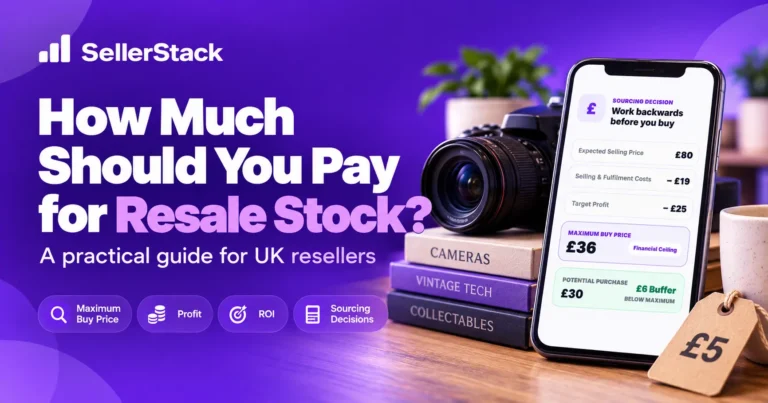
Know the Most You Can Pay for Each Item
Work backwards from expected selling price, selling costs and your required return rather than deciding what a product is worth from instinct.
Path 3: Move to a Larger Budget Only After the Model Works
A reseller who already understands demand, marketplace rules, pricing and fulfilment may decide to allocate several hundred pounds or more to stock.
That does not automatically make the business more advanced.
A larger inventory budget increases:
- the amount of cash at risk;
- the number of products that need monitoring;
- storage requirements;
- pricing exposure;
- dead-stock risk;
- working-capital pressure.
Increase stock capital because the previous level produced repeatable results — not because you feel you should look more “professional”.
What Should a Beginner Spend Money On First?
The order matters.
1. Viable Stock
Inventory with evidence of demand and enough room for a worthwhile return should normally take priority over optional equipment.
2. Safe Packaging
Buy or reuse suitable packaging that protects the actual products you sell.
3. Accurate Weighing and Measuring
A basic scale and measuring tape can become useful once you are shipping regularly.
4. Workflow Equipment
Thermal printers, storage systems and other equipment can make sense once sales volume is high enough to justify them.
5. Paid Software
Add subscriptions only when they solve a measurable problem or save enough time to justify the recurring cost.
Equipment does not create demand. A £150 setup around weak stock is still a weak business.
How Much of Your Budget Should Go Into Stock?
There is no universal percentage.
The right amount depends on:
- how quickly your stock sells;
- how much packaging and fulfilment costs;
- whether payouts are immediate or delayed;
- your return/refund exposure;
- whether you need transport for sourcing;
- how much emergency cash you want available.
A beginner should generally avoid putting every available pound into inventory.
£100 Available for the Reselling Project
One possible approach could be:
- £60–£70 available for carefully researched stock;
- £10–£15 for packaging or sourcing expenses;
- the remainder kept as an operating buffer.
This is an example, not a required allocation. A seller using bulky products, paid postage or different sourcing channels may need a very different split.
Why You Need an Operating Buffer
Imagine you spend every available pound on stock.
Then:
- a buyer returns an item;
- you need replacement packaging;
- a courier price is higher than expected;
- a marketplace payout is delayed;
- a strong sourcing opportunity appears.
Inventory value does not pay today’s bill.
Available cash does.
Do Not Confuse Stock Value With Cash Available
Until an item sells and the money becomes available to you, the capital tied up in that product cannot fund the next expense.
Do Not Use One Marketplace-Fee Percentage for Your Startup Budget
Marketplace costs vary significantly by:
- platform;
- seller type;
- category;
- fulfilment method;
- advertising;
- optional services;
- transaction value.
So a generic assumption such as “all marketplaces take 12–15%” is not reliable enough for planning.
Vinted, for example, currently states that standard sellers do not pay a fee to upload or sell an item, while other marketplaces use very different seller-side structures. :chatgpt-content-reference{index=”2″}
Learn What the Platform Actually Charges
Understand percentage fees, fixed charges, payment processing, fulfilment and optional selling costs before building them into your startup assumptions.
Shipping Can Require More Cash Than Beginners Expect
The buyer may pay postage, but that does not always mean you never need cash available for fulfilment.
Depending on the marketplace and shipping method, you may need to pay for:
- postage labels;
- boxes or mailers;
- tape;
- protective packaging;
- printer supplies;
- travel to collection or drop-off points.
Check Shipping Before Buying the Stock
Large, heavy or fragile inventory can need far more fulfilment capital than small clothing or accessories.
Revenue Is Not New Capital Until the Costs Are Accounted For
A common beginner mistake is:
“I bought £50 of stock and sold it for £150, so I now have £150 available to reinvest.”
That ignores:
- the original stock cost;
- marketplace charges;
- postage;
- packaging;
- advertising;
- other selling expenses.
Suppose:
- sale revenue = £30;
- stock cost = £8;
- selling and fulfilment costs = £7;
Estimated net profit:
£30 − £8 − £7 = £15
The £30 revenue contains both the recovery of your original capital and the profit generated by the transaction.
Know What the Sale Actually Adds to the Business
Calculate the full transaction rather than treating the buyer’s payment as profit.
How Much Profit Should You Reinvest?
Reinvestment can help a small reseller grow without repeatedly adding new personal money.
But reinvesting everything automatically is not always sensible.
First consider:
- upcoming shipping costs;
- returns exposure;
- tax obligations where relevant;
- packaging needs;
- unsold inventory;
- cash buffer;
- whether the next stock opportunity is actually good.
Reinvest because you have another evidence-backed sourcing opportunity — not merely because money has arrived in the account.
More Startup Money Does Not Automatically Produce Better Returns
Consider:
| Product A | Product B | |
|---|---|---|
| Stock Cost | £10 | £100 |
| Net Profit | £15 | £25 |
| Capital Required | Low | High |
Product B makes more pounds of profit.
Product A may be a much more efficient use of a small beginner bankroll.
Use the Reseller ROI Calculator when comparing opportunities that require very different amounts of stock capital.
Cash Flow Becomes More Important as You Scale
Once you own more inventory, the question changes from:
“Can I afford to buy this item?”
to:
“How much money can I safely keep tied up in unsold inventory?”
Watch:
- how much stock you hold;
- how long products take to sell;
- how quickly money returns to the business;
- how much cash remains available outside inventory.
As your operation grows, use the Stock Turnover Calculator to monitor how effectively inventory is converting into sales.
If old stock starts trapping significant cash, use the Dead Stock Calculator to assess whether holding the inventory still makes sense.
Your Starting Budget Depends on the Marketplace and Products
A seller starting with second-hand clothing may need a very different amount of capital from someone starting with Amazon FBA inventory or bulky local furniture.
| Model | Typical Capital Considerations |
|---|---|
| Sell Items From Home | Very little fresh stock capital; focus on packaging and fulfilment. |
| Charity Shop / Car Boot Reselling | Small stock purchases, transport and packaging. |
| Retail Clearance | Larger quantities can tie up capital quickly. |
| Amazon FBA | Inventory, inbound shipping, fulfilment, storage, account costs and potentially advertising. |
| Wholesale | Minimum order quantities and repeat inventory can require a larger working-capital reserve. |
| Local Bulky Goods | Lower platform costs may be possible, but transport and storage can become significant. |
Use the SellerStack Marketplaces Hub to understand how platform choice changes the economics of your stock.
Budget for Records and Tax Once You Start Trading
Selling unwanted personal possessions is different from deliberately buying goods with the intention of reselling them for profit.
Once your activity becomes trading, keep usable records from the beginning.
HMRC’s trading allowance can provide relief on up to £1,000 of relevant gross trading income, subject to the rules and your circumstances. HMRC defines gross income as income before expenses are deducted. :chatgpt-content-reference{index=”3″}
Understand the Thresholds as the Business Grows
Keep records of sales and costs and check which UK tax, reporting and business rules may apply to your activity.
For the wider business side, visit the Tax, Records & Business Hub .
Example Reselling Startup Budgets
These examples are designed to show different approaches, not tell you what you personally must spend.
£0 Fresh Inventory Budget
Sell a few suitable household items, reuse safe packaging where appropriate and learn the full transaction process.
Objective: gain experience before buying inventory.
£50 Available
Rather than spending the full £50 immediately, a seller could use part for carefully researched stock and keep part available for packaging, travel or unexpected costs.
Objective: learn whether sourced stock produces repeatable results.
£250 Available
A seller with previous sales experience might spread this between stock, operating costs and cash reserve rather than automatically spending £250 on inventory.
Objective: increase inventory without removing the business’s financial flexibility.
10 Startup Capital Mistakes New Resellers Make
1. Spending Everything on Stock
Inventory cannot pay unexpected operating expenses until it sells.
2. Buying Equipment Before Proving Demand
Printers, shelving and subscriptions do not repair weak inventory decisions.
3. Assuming Revenue Equals Profit
Sales revenue contains recovered capital as well as any profit.
4. Using One Marketplace Fee Assumption
Fee structures differ substantially between platforms, categories and seller types.
5. Ignoring Shipping Cash
Fulfilment and packaging may require money before or around the point of dispatch.
6. Starting With Bulk Stock
Larger quantities magnify pricing and demand mistakes.
7. Reinvesting Every Pound Automatically
Keep enough flexible cash to cover the operation.
8. Buying Without a Maximum Price
Decide the highest viable purchase cost before emotion takes over.
9. Ignoring Stock Turnover
A business can look profitable on paper while most of its cash remains trapped in slow inventory.
10. Comparing Yourself With Established Sellers
A seller with years of demand data and cash reserves can safely make inventory decisions that may be inappropriate for a beginner.
Before Adding More Money to Your Reselling Business
✓ Have I completed enough sales to understand the process?
✓ Do I know which products I want to source?
✓ Do I have evidence that buyers want them?
✓ Do I know the realistic selling price?
✓ Have I checked marketplace costs?
✓ Have I checked shipping and packaging?
✓ Do I know my maximum buying price?
✓ Does the expected profit justify the purchase?
✓ Does the ROI justify tying up this much cash?
✓ Will I still have an operating buffer after buying?
✓ Do I know what I will do if the stock does not sell?
✓ Am I increasing capital because the model works, rather than because I simply want more inventory?
Which SellerStack Tool Should You Use?
| Your Question | SellerStack Resource |
|---|---|
| How do I start the full reselling process? | Beginner Reselling Guide |
| Where should I source products? | UK Product Sourcing Guide |
| What is the most I can pay for stock? | Maximum Buy Price Calculator |
| How much profit could this sale leave? | Reseller Profit Calculator |
| How strong is the return on my stock money? | Reseller ROI Calculator |
| What is my minimum viable selling price? | Break-Even Calculator |
| How much should I pay for resale stock? | Resale Stock Buying Guide |
| Which marketplace fits my stock? | Marketplaces Hub |
Reselling Startup Cost FAQs
Can I start reselling with no money?
You can begin learning with no fresh inventory budget by selling suitable unwanted items you already own. You may still encounter packaging, postage or other transaction costs, so a completely zero-cost sale should not be assumed.
Is £50 enough to start reselling?
It can be enough to test a small number of sourcing opportunities, particularly if you already have suitable packaging and sell low-cost inventory. Do not assume the full £50 needs to be spent on stock. Keeping some operating cash can be more useful.
Is £100 enough to start a reselling business?
It can be enough to begin on a small scale, but the result depends on what you sell, how much each item costs, how quickly stock moves and what selling expenses apply. The quality of the buying decisions matters more than reaching a particular startup figure.
Do I need a thermal label printer?
No. A thermal printer can improve workflow once order volume makes it worthwhile, but it is not a prerequisite for learning how to resell. Beginners can usually start with simpler fulfilment methods and upgrade later.
Do I need expensive photography equipment?
No. A modern smartphone and suitable lighting can be enough for many resale listings. Clear, accurate photographs matter more than owning expensive camera equipment.
How much should I spend on my first sourcing trip?
Use an amount you can afford to have tied up in unsold stock and evaluate each item individually. Set a maximum buying price from realistic selling value, costs and required return rather than choosing a fixed amount you feel obliged to spend.
Should I reinvest all my reselling profit?
Not automatically. Reinvestment can support growth, but keep enough available cash for shipping, packaging, refunds, tax where relevant and other operating needs.
How much can a beginner make in the first month?
There is no reliable universal first-month income figure. Results depend on the number and quality of products listed, demand, pricing, marketplace choice, selling costs and how quickly the stock sells. Treat the first month primarily as a period for learning the process and collecting real data.
When should I increase my stock budget?
Increase it when your existing process is producing repeatable results and you understand demand, profit, ROI, selling speed and inventory risk. More capital should follow evidence rather than replace it.
Does the £1,000 HMRC trading allowance mean I can make £1,000 profit tax-free?
No. The trading allowance relates to qualifying gross trading income or receipts, before expenses are deducted, and the rules can depend on your circumstances. Check current HMRC guidance before relying on the allowance.
Start With the Smallest Amount That Lets You Learn Properly
You do not need a large bankroll to begin reselling.
Start with items you already own where possible, learn the full transaction process and then introduce fresh stock capital gradually.
Keep some cash outside inventory, calculate deals before buying and add equipment only when it solves a real operational problem.
As your experience grows, increase capital only when your stock is demonstrating acceptable demand, profit, ROI and selling speed.
The strongest beginner position is not “I have the most money to spend.” It is “I understand what I am buying, why it should sell and how much risk I am taking.”
Treat Startup Figures as Planning Examples, Not Guarantees
Inventory prices, marketplace fees, postage costs, supplier terms and product demand change over time.
SellerStack calculators and examples are planning tools and do not guarantee that an item will sell, achieve a particular profit or return your capital within a specific period.
Check current marketplace fees, shipping costs and HMRC guidance when making live business decisions.
Last reviewed: October 2026
Learn First. Fund What Works.
Start with a controlled amount of capital, check every buying decision and use SellerStack’s free tools to understand profit, ROI, pricing and inventory risk before you scale.
Explore Sourcing & Stock →