SELLERSTACK SOURCING PILLAR GUIDE · UPDATED FOR 2026
The Ultimate UK Product Sourcing Guide for Resellers
Learn how to find, research and evaluate resale stock using demand, realistic selling prices, complete costs, ROI, buying limits and inventory risk before you spend.
UK Product Sourcing Guide for Resellers
This guide explains how to find, research and evaluate resale inventory across second-hand, retail, wholesale and supplier channels.
The aim is not simply to find cheap products. It is to find stock where demand, achievable selling price, complete costs, selling speed and risk leave enough room for a worthwhile return.
Last reviewed: October 2026
Where Can UK Resellers Source Stock?
UK resellers can source products from their own homes, charity shops, car boot sales, local marketplaces, auctions, retail clearance, online arbitrage, wholesalers, liquidation suppliers and manufacturers.
The best sourcing channel depends on:
- your available capital;
- the marketplace you sell on;
- the categories you understand;
- how quickly the stock is likely to sell;
- the margin and ROI available;
- condition and authenticity risk;
- shipping and fulfilment requirements;
- how much inventory risk you can afford to carry.
A low buying price does not automatically make something a good sourcing opportunity.
Build the Buying Decision Before You Buy the Stock
Explore sourcing guides and tools for buying limits, ROI, inventory turnover, dead stock and resale profitability.
Sourcing Is a Buying Decision, Not a Treasure Hunt
Finding an item for £3 that once retailed for £80 can feel like a bargain.
But original retail price tells you very little about whether the item is a good resale purchase today.
Before buying, you need to know:
- whether buyers currently want it;
- what comparable items actually sell for;
- how much competition exists;
- what condition your item is in;
- what marketplace fits the product;
- what selling and fulfilment costs apply;
- how long your money may be tied up;
- what happens if your original assumptions are wrong.
Cheap Stock Can Still Be Expensive Inventory
A product that costs very little but takes a year to sell, needs expensive postage or repeatedly gets returned can be a weaker sourcing decision than a more expensive item with strong demand, predictable costs and fast turnover.
The SellerStack 8-Point Sourcing Check
Before you commit money to stock, work through these eight questions.
Is It Actually Selling?
Look for recent completed-sale evidence or other reliable demand signals rather than relying only on active listings.
What Is a Realistic Sale Value?
Compare the same model, condition, size, version and contents where possible.
What Will the Sale Cost?
Include marketplace fees, payment costs, shipping, packaging, advertising, preparation and other relevant expenses.
What Is the Most You Can Pay?
Work backwards from the realistic selling price and your required return.
How Long Could Your Cash Be Tied Up?
Consider demand, competition, seasonality and how often comparable items appear to sell.
What Could Go Wrong?
Check condition, authenticity, restrictions, compatibility, missing parts and returns risk.
Can You Ship It Economically?
Size, weight, fragility and packaging can completely change the economics of an apparently cheap item.
What Happens If It Does Not Sell?
Decide whether you could reduce the price, move it to another marketplace, bundle it, return it or exit the stock without damaging your cash flow.
Calculate Your Maximum Buying Price
Enter the expected selling price, fees, fulfilment costs and your required return to estimate the highest stock price the opportunity can support.
1. Start With Products You Already Own
For a beginner, the safest sourcing stock may initially be no sourcing at all.
Selling unwanted possessions from home lets you practise:
- product research;
- photography;
- listing titles;
- descriptions;
- pricing;
- buyer communication;
- packaging;
- shipping;
- record keeping.
That gives you real transaction experience before fresh money is tied up in resale inventory.
Complete a few ordinary sales before committing significant money to wholesale packs, pallets, bulk imports or complicated fulfilment models.
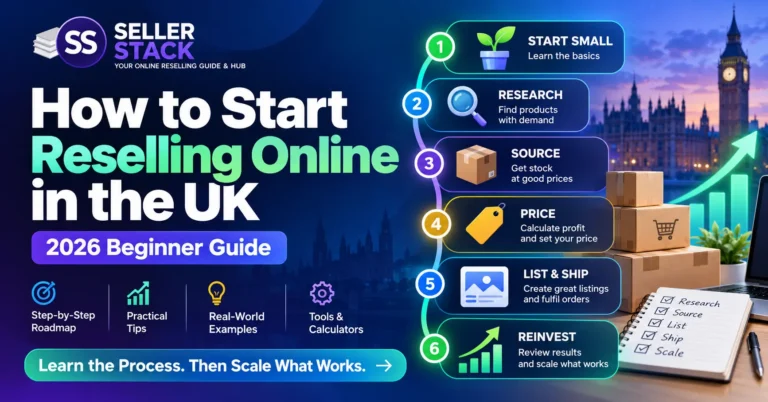
If you are new to the whole process, start with our complete beginner guide to reselling online .
Charity Shops
Charity shops can be useful for one-off second-hand inventory, particularly clothing, footwear, books, homeware, media and collectables.
But modern charity-shop sourcing should not be based on the idea that everything donated is automatically underpriced.
What to Check
- brand and exact product identification;
- material or specification;
- condition;
- missing components;
- realistic sold price;
- competition;
- marketplace fit;
- postage and packaging;
- your buying limit.
Condition Matters More Than the Label
A recognised brand can still be weak stock if the item has stains, excessive wear, damaged zips, missing parts or a poor resale history.
Equally, an unfamiliar brand can be worthwhile when material, construction, product type and actual demand support the purchase.
Check the Return Before You Leave the Shop
Model purchase price, realistic selling price and selling costs before assuming that a low ticket price means a strong deal.
Car Boot Sales
Car boot sales can provide low-cost stock because many sellers are clearing unwanted household items rather than operating a resale business.
The opportunity is not simply “arrive early and buy everything cheap”.
The strongest advantage is being able to inspect, research and negotiate individual items or sensible bundles before buying.
Useful Car Boot Tactics
- know a few categories well rather than scanning everything;
- carry enough phone battery for product research;
- inspect condition before discussing price;
- ask about missing accessories or faults;
- research uncertain products rather than buying from instinct;
- negotiate bundles only when the bundle itself makes sense;
- do not let a cheap price override weak demand.
Ten items for £10 are not automatically better than one item for £10. A bundle is only valuable when enough of its contents can realistically sell at a worthwhile return.
Check the Complete Flip Before Buying
Compare buying cost, selling price, fees, postage and estimated profit while you are evaluating the deal.
Facebook Marketplace, Gumtree and Local Classifieds
Local marketplaces can be particularly useful for:
- bundles;
- house clearances;
- furniture;
- exercise equipment;
- electronics;
- collections of books, toys or games;
- stock where collection avoids expensive postage.
Local Collection Can Create the Opportunity
Bulky products may be unattractive to national sellers because of shipping cost and damage risk.
If you can collect locally and later sell locally, that friction can sometimes become an advantage.
Do Not Skip Safety and Inspection
For collection purchases, confirm the product, price and meeting arrangements beforehand. Inspect higher-value goods before payment where practical and be cautious with authenticity-sensitive categories.
Retail Clearance
Retail clearance can create genuine resale opportunities when a retailer reduces products below the price available in the resale market.
But a large discount from RRP is not enough.
Compare the Clearance Price With the Resale Market — Not the RRP
A product reduced from £80 to £30 is a poor resale buy if buyers are currently paying only £34 online.
Check Before Buying Multiple Units
- current market price;
- how many comparable units are listed;
- how regularly they sell;
- marketplace restrictions;
- fees and advertising;
- shipping;
- whether the retailer is clearing the item because demand has collapsed;
- how much cash the quantity would tie up.
Test the Deal Before Buying Multiples
Estimate the result after product cost, selling expenses and fulfilment rather than relying on the markdown percentage.
Online Arbitrage
Online arbitrage means buying a product online at one price with the intention of reselling it at a higher price elsewhere.
It can make sourcing more scalable because research and purchasing can be done remotely, but it introduces different risks from inspecting stock in person.
Check More Than the Price Difference
- seller legitimacy;
- product authenticity;
- delivery cost to you;
- returns policy;
- marketplace eligibility;
- current resale price;
- selling velocity;
- quantity available;
- price volatility;
- the evidence you may need for authenticity or supply-chain checks.
Finding one profitable unit does not prove that buying twenty units is sensible. Additional supply can take longer to sell, while the resale price can fall before your stock clears.
Auctions, House Clearances and Job Lots
Auctions and clearance lots can provide access to inventory that never reaches ordinary retail channels.
They can also hide significant costs.
Include the Full Acquisition Cost
Depending on the auction, your real buying cost may include:
- hammer price;
- buyer’s premium;
- VAT where applicable;
- collection or delivery;
- travel;
- handling;
- untested or unsellable contents.
Do not value a mixed lot by adding together optimistic selling prices for every item. Some units may be damaged, incomplete, slow-moving or not worth listing individually.
UK Wholesale Suppliers
Wholesale changes the sourcing problem.
Instead of finding individual underpriced products, you are trying to find repeatable stock at a cost that leaves enough margin after larger quantities, storage and working-capital requirements are considered.
Wholesale Makes More Sense When You Already Know:
- which categories you understand;
- what the realistic selling price is;
- how quickly the product sells;
- how much competition exists;
- the marketplace restrictions;
- your expected return per unit;
- how many units you can safely hold.
Supplier Due Diligence
Before sending significant money to a new supplier, verify the business and the commercial terms.
Depending on the deal, check:
- business identity and contact details;
- company history where available;
- minimum order quantity;
- price breaks;
- VAT treatment;
- delivery terms;
- returns and defects;
- lead times;
- authenticity and supply-chain documentation;
- whether marketplace resale is permitted.
Repeatability Is Valuable — Until It Creates Too Much Stock
A repeatable product is useful only while demand is strong enough to absorb the inventory at a viable price.
Liquidation, Returns and Pallet Stock
Liquidation stock can look attractive because the headline purchase price may be far below original retail value.
It is also one of the easiest places for inexperienced resellers to underestimate risk.
Possible Problems Include:
- customer returns;
- missing accessories;
- damaged packaging;
- untested electronics;
- faulty units;
- obsolete models;
- mixed condition grades;
- slow-moving inventory;
- large disposal workload.
Do not make your first serious sourcing purchase an unmanifested pallet simply because the estimated retail value looks impressive. Learn how ordinary resale stock behaves before taking on large unknown-condition inventory.
Manufacturers and Private-Label Products
Buying directly from a manufacturer can reduce unit cost and make stock more repeatable, but it moves you away from ordinary flipping and toward product development and inventory planning.
Additional considerations can include:
- samples;
- minimum order quantities;
- product specification;
- quality control;
- branding;
- packaging;
- lead times;
- freight;
- import costs;
- product compliance;
- insurance;
- inventory cash flow.
A lower factory unit cost does not justify a large order if the product has not yet demonstrated that buyers want it at your required selling price.
Dropshipping Is a Fulfilment Model — Not a Risk-Free Shortcut
Dropshipping allows a supplier or fulfilment partner to dispatch the product rather than you holding and shipping the inventory yourself.
That reduces some inventory-handling requirements, but you still remain responsible for the customer experience and need to comply with the marketplace’s sourcing and fulfilment rules.
Marketplace Rules Matter
On eBay, dropshipping directly from a wholesale supplier is permitted, but listing a product and then buying it from another retailer or marketplace to ship directly to your eBay customer is not permitted.
Amazon also requires a dropshipping seller to remain the seller of record. Third-party retailer or supplier identities must not appear to the customer as though that third party were the seller, and the Amazon seller remains responsible for returns and customer service.
Supplier stock errors, price changes, poor packaging, slow dispatch and incorrect tracking can become your marketplace problem even when you never physically handle the product.
If dropshipping is part of your plan, check the exact policy of the marketplace you intend to use before building the business around a supplier.
Research the Product Before Researching the Profit
Profit calculations are only useful if the expected selling price is realistic.
Before entering a figure into a calculator, identify:
- the exact model or variation;
- condition;
- size or specification;
- included accessories;
- recent comparable sales;
- current competing supply.
Then use the market evidence to choose a realistic expected selling price.
Our reseller pricing strategy guide explains how to turn market evidence into a usable pricing range.
Calculate the Complete Sale Before Buying
The difference between buying price and selling price is not your profit.
Depending on the transaction, you may need to account for:
- marketplace fees;
- payment processing;
- advertising;
- shipping;
- packaging;
- repairs or cleaning;
- inbound delivery;
- storage;
- other selling expenses.
If you are unsure how the marketplaces calculate their charges, use our guide to calculating marketplace fees .
Calculate Profit Before the Money Leaves Your Account
Model the realistic sale price, stock cost, fees, shipping and other relevant expenses before committing to the inventory.
Work Backwards to Your Maximum Buying Price
One of the strongest sourcing habits is deciding the maximum buying price before negotiating.
A simplified model is:
Maximum Buy Price = Expected Revenue − Selling Costs − Required Profit
The real calculation should use the costs and marketplace structure that apply to the transaction you are considering.
Example
Imagine you reasonably expect an item to produce £40 of sale revenue.
Your estimated marketplace, fulfilment and packaging costs total £8, and you require at least £15 profit.
Your approximate maximum purchase price would be:
£40 − £8 − £15 = £17
If the seller wants £25, the numbers do not meet your target.
That does not mean the item is bad.
It means it may be a bad deal for your required return.
For the deeper decision process, read How Much Should You Pay for Resale Stock?
Do Not Judge Sourcing Opportunities by Cash Profit Alone
Consider these two hypothetical products:
| Product A | Product B | |
|---|---|---|
| Stock Cost | £10 | £100 |
| Net Profit | £15 | £25 |
| Capital Required | Low | High |
Product B makes more cash profit.
Product A may generate a much stronger return on the money invested.
Compare the Return on Your Stock Money
Use ROI alongside profit when comparing sourcing opportunities that require very different amounts of capital.
Know Where You Will Sell the Product Before You Buy It
A sourcing opportunity can look very different depending on the marketplace.
| Stock Type | Marketplace Questions |
|---|---|
| One-off used items | Where are buyers already searching for this exact type of stock? |
| Clothing & fashion | Do eBay, Vinted or Depop buyers support the expected price and selling speed? |
| Repeatable new stock | Are Amazon, eBay, TikTok Shop or your own store viable after fees and fulfilment? |
| Bulky local stock | Could Facebook Marketplace or another local channel remove the shipping problem? |
| Vintage / specialist items | Which marketplace has the strongest buyer intent for the niche? |
Use the SellerStack Marketplaces Hub to compare platform fit before committing stock.
Shipping Can Turn a Good Buy Into a Bad Buy
Large, heavy, fragile and unusually shaped products deserve a shipping check before purchase.
Consider:
- finished parcel size;
- weight;
- packaging required;
- insurance or compensation limits;
- fragility;
- collection options;
- return shipping risk.
Check Delivery Before Buying Bulky Stock
Compare likely shipping scenarios before assuming the margin can absorb delivery.
Products That Need Extra Caution
Some inventory categories carry more risk than their apparent margin suggests.
Authenticity-Sensitive Brands
High-value fashion, footwear, watches, collectables and electronics can create counterfeit and proof-of-supply risk.
Untested Electronics
A large apparent margin can disappear when batteries, ports, screens or internal components fail.
Incomplete Products
Missing chargers, remotes, game pieces, manuals or proprietary components can materially reduce value.
Restricted Categories
A product may be legal to own but restricted, gated or subject to special listing requirements on a marketplace.
Oversized or Fragile Goods
Delivery cost, packaging time and damage risk can overwhelm an otherwise attractive margin.
Trend-Dependent Stock
Products that depend heavily on short-lived demand can fall in value before a large quantity sells through.
A Simple Buy-or-Pass Checklist
✓ Can I identify the exact product?
✓ Is there evidence of current demand?
✓ Do I have a realistic expected selling price?
✓ Have I checked the condition properly?
✓ Do I know which marketplace I would use?
✓ Have I included marketplace fees?
✓ Have I checked shipping and packaging?
✓ Do I know my maximum buying price?
✓ Does the deal meet my required profit?
✓ Does the ROI justify the capital?
✓ Could I exit the stock if the first plan fails?
✓ Am I buying because the evidence works — not simply because the product looks cheap?
Scale the Sourcing Channel Only After the Product Works
One profitable sale proves very little.
Before increasing order quantity, look for evidence that the result is repeatable.
Track:
- average selling price;
- average net profit;
- ROI;
- days to sell;
- return rate;
- defect rate;
- price changes;
- competition;
- cash tied up in remaining units.
As inventory grows, sourcing stops being only a question of “Can I make money on this unit?”
It also becomes: “How efficiently is this inventory using my cash?”
Measure Stock Turnover
Track how effectively inventory is converting back into sales rather than sitting indefinitely.
Check Stock Turnover →Identify Dead Stock
Assess products that are trapping cash, space and attention without producing useful sales.
Check Dead Stock →Buying Products to Resell Can Mean You Are Trading
Selling personal possessions you no longer want is not the same as deliberately buying goods with the intention of reselling them for profit.
HMRC says that if you buy or make goods to sell at a profit, you are likely to be trading.
The UK trading allowance can apply to up to £1,000 of gross trading income in a tax year. If your gross trading income is above £1,000, HMRC generally requires registration for Self Assessment, although individual circumstances and exceptions can affect the position.
Understand the Business Side Before You Scale
Review trading, records, marketplace reporting and relevant thresholds once sourcing becomes a deliberate resale activity.
12 Common Product Sourcing Mistakes
1. Buying Because the Item Is Cheap
A low purchase price cannot repair weak demand.
2. Using RRP as the Resale Value
What a retailer once charged is not the same as what buyers will pay today.
3. Checking Active Listings Instead of Demand
Sellers can ask any price. Look for evidence of actual buyer activity.
4. Ignoring Condition
Small defects can materially change value and return risk.
5. Forgetting Marketplace Costs
Different marketplaces and seller types produce different economics.
6. Forgetting Shipping
Heavy, fragile or oversized products can destroy an apparent margin.
7. Using a Universal “Double Your Money” Rule
Profit, ROI, selling speed and risk matter more than one fixed markup rule.
8. Buying Too Many Units Too Early
One successful sale does not prove the market can absorb a large quantity at the same price.
9. Ignoring Marketplace Restrictions
Check whether the product, brand or category can actually be listed under your account and selling model.
10. Buying Without an Exit Plan
Know what you would do if demand falls or the product does not sell as expected.
11. Scaling Slow Stock
High margin means little if large amounts of capital remain trapped in inventory.
12. Treating a Supplier as Proof of Demand
A supplier being willing to sell you 500 units does not mean customers are waiting to buy them.
Which SellerStack Tool Should You Use While Sourcing?
| Your Question | SellerStack Resource |
|---|---|
| What is the most I can afford to pay? | Maximum Buy Price Calculator |
| How much profit could the deal leave? | Reseller Profit Calculator |
| What return could the stock money generate? | Reseller ROI Calculator |
| What should I pay for resale stock? | Resale Stock Buying Guide |
| What will marketplace fees do to the deal? | Marketplace Fees Guide |
| Which marketplace fits the product? | Marketplaces Hub |
| How quickly is inventory moving? | Stock Turnover Calculator |
| Is old stock trapping cash? | Dead Stock Calculator |
UK Product Sourcing FAQs
Where is the best place to source products for reselling in the UK?
There is no single best sourcing channel. Beginners can learn with items from home, charity shops, car boot sales and local marketplaces. More experienced sellers may add retail clearance, online arbitrage, wholesale, liquidation or direct supplier relationships. The best option depends on product demand, buying price, selling costs, capital and risk.
How do I know if an item is worth buying to resell?
Check realistic demand and selling price first, then subtract marketplace costs, fulfilment, packaging and your required profit. Also consider condition, selling speed, competition, restrictions and how long the stock may tie up your money.
What profit margin should I aim for when sourcing?
There is no universal margin that is correct for every resale product. A lower-margin product that sells quickly and reliably can outperform a higher-margin product that sits for months. Compare profit, margin, ROI, selling speed and risk together.
Should I always aim to double my money?
No. Doubling your purchase cost is only a markup rule and does not account for marketplace fees, shipping, other selling costs or how quickly the product sells. Calculate the actual transaction and the return on the capital invested.
Is wholesale better than charity shops or car boot sales?
Wholesale can provide repeatable stock, while charity shops and car boot sales often provide one-off opportunities. Neither is automatically better. Wholesale requires stronger demand validation and usually commits more capital to multiple units.
Are liquidation pallets good for beginners?
They can carry significant condition, testing and dead-stock risk. Beginners are usually better served learning ordinary product research, pricing and fulfilment before committing a large amount of capital to mixed or unmanifested inventory.
Can I dropship products on eBay?
eBay permits dropshipping when orders are fulfilled directly from a wholesale supplier, but it does not permit listing an item and then purchasing it from another retailer or marketplace to have that retailer send it directly to the eBay buyer. You remain responsible for delivery and buyer satisfaction.
Can I dropship on Amazon UK?
Amazon permits third-party fulfilment only when you remain clearly identified as the seller of record and comply with Amazon’s dropshipping requirements. You remain responsible for customer service and returns.
Do I need a business account if I buy products specifically to resell?
Marketplace requirements differ. For example, eBay states that sellers who buy items to resell need to register as business sellers. Check the current rules of every platform you use.
Do I need to tell HMRC if I buy goods to resell?
HMRC says that buying or making goods with the intention of selling them for profit is likely to constitute trading. The £1,000 trading allowance applies to gross trading income, and income above that level generally creates a Self Assessment registration requirement, subject to the applicable rules and your circumstances.
Should I buy more units when the first one sells?
Not automatically. Check whether the selling price, demand, competition, profit and selling speed appear repeatable. Scale gradually rather than assuming one sale proves unlimited demand.
Buy From Evidence, Not Excitement
Strong sourcing is not about finding the cheapest possible stock.
It is about identifying products where buyer demand, realistic selling price, complete costs and your required return all work together.
Start small. Learn a few categories. Research before buying. Know your maximum buying price. Check the marketplace and fulfilment before committing money.
As you scale, add another question: how quickly will this inventory return the cash you invested?
The strongest sourcing operation does not simply buy more stock. It repeatedly buys the right stock, at the right price, for the right selling channel, with an acceptable level of risk.
Verify Current Marketplace, Supplier and Tax Rules
Marketplace selling rules, restricted products, dropshipping policies, fees, supplier terms and tax guidance can change.
SellerStack reviews this guide periodically, but current marketplace policies and official government guidance should take priority when making an important sourcing decision.
Useful official references:
- eBay UK Dropshipping Policy
- eBay UK Business Seller Policy
- Amazon UK Dropshipping Policy
- HMRC Guidance for Online Sellers
- HMRC Trading Allowance Guidance
Last reviewed: October 2026
Find Stock. Check the Numbers. Protect Your Capital.
Use SellerStack sourcing guides and calculators to evaluate demand, buying price, profit, ROI, inventory risk and selling costs before you commit money to stock.
Explore Sourcing & Stock →