SELLERSTACK BEGINNER GUIDE · UPDATED FOR 2026
10 Beginner Reseller Mistakes to Avoid
Avoid the buying, pricing, listing, shipping and inventory mistakes that cost new resellers money — and build a repeatable process before you scale.
Beginner Reseller Mistakes UK
This guide explains the most common mistakes new UK resellers make when sourcing stock, calculating profit, choosing marketplaces, pricing products, creating listings, shipping orders and managing inventory.
Marketplace fees, seller policies, delivery programmes and UK tax rules change over time. SellerStack periodically reviews important platform and HMRC information.
Last reviewed: October 2026
What Are the Biggest Beginner Reseller Mistakes?
Most beginner mistakes happen before the sale rather than after it.
New resellers often:
- buy products without checking demand;
- pay too much for stock;
- confuse revenue with profit;
- ignore marketplace and fulfilment costs;
- choose the wrong marketplace or seller setup;
- price from asking prices rather than real market evidence;
- create weak or incomplete listings;
- underestimate shipping and returns;
- buy stock faster than they can list and sell it;
- fail to keep usable business records.
The solution is not to find a secret product or marketplace. It is to build a repeatable process: research → buy → price → list → fulfil → record → review.
Learn the Complete Reselling Process First
Work through sourcing, pricing, marketplaces, listings, shipping and records before committing significant money to inventory.
Beginner Resellers Usually Lose Money Through Decisions, Not Bad Luck
Reselling looks simple from the outside.
Buy an item cheaply, list it online and sell it for more.
But the difference between the buying price and selling price is not automatically profit.
Between those two numbers sit:
- market demand;
- marketplace costs;
- advertising;
- shipping;
- packaging;
- returns;
- stock ageing;
- seller obligations;
- time;
- cash tied up in inventory.
That is why a £40 sale can be a good deal, a poor deal or even a loss depending on how the item was bought and sold.
A Good Reseller Process Starts Before You Buy
The strongest time to protect your margin is while deciding whether to purchase the stock — not after the listing has already gone live.
Mistake 1: Buying Products Before Checking Demand
One of the easiest beginner traps is buying something because it looks valuable.
You may recognise the brand.
The original retail price may be high.
The charity-shop sticker may look cheap.
None of those things prove that somebody currently wants to buy the product at a profitable resale price.
Research the Market Before the Purchase
Look for evidence such as:
- recent comparable sales;
- realistic selling prices;
- how much competing stock is available;
- product condition;
- size, variation or model;
- seasonality;
- how quickly similar stock appears to move.
An active listing is evidence of what another seller wants. It is not proof that a buyer will pay that amount.
For the complete buying process, use the UK Product Sourcing Guide .
Mistake 2: Paying Too Much for Stock
Knowing that an item sells for £50 does not tell you whether paying £10, £20 or £35 for it makes sense.
Your maximum buying price depends on:
- realistic selling value;
- marketplace costs;
- shipping;
- packaging;
- advertising;
- other selling costs;
- the profit you require;
- the return you require on the money invested.
Same Selling Price. Very Different Deal.
Suppose two items could each realistically sell for £40.
- Item A costs you £8.
- Item B costs you £28.
The selling price is identical, but the amount of margin, capital at risk and potential ROI can be completely different.
Set Your Maximum Buying Price
Work backwards from selling price, costs and your required return instead of deciding what you can afford to pay while standing at the checkout.
For a deeper explanation, read How Much Should You Pay for Resale Stock?
Mistake 3: Confusing Revenue With Profit
This is one of the most important lessons for a new reseller.
If a buyer pays £50, you have not necessarily made £50.
You need to account for the costs attached to producing that sale.
Imagine:
- Selling price: £50
- Stock cost: £15
- Marketplace / advertising costs: £5
- Shipping and packaging: £6
Estimated profit:
£50 − £15 − £5 − £6 = £24
The £50 is revenue. The £24 is the estimated profit left after those example costs.
Profit Margin and ROI Are Different Too
Profit tells you how many pounds the transaction may leave.
Margin shows profit relative to revenue.
ROI helps show the return generated by the money invested in stock.
Each answers a different question.
Mistake 4: Using One Generic Marketplace-Fee Percentage
There is no universal marketplace fee that applies to every resale transaction.
Your costs can depend on:
- marketplace;
- seller type;
- product category;
- transaction value;
- advertising;
- fulfilment;
- international selling;
- optional services.
Even within a single marketplace, private and business sellers can have substantially different economics.
For example, eligible UK-based eBay private sellers currently do not pay standard final value or regulatory operating fees on most domestic categories, while eBay business sellers use a different fee structure.
That is why an old rule such as “assume every marketplace takes 15%” is not a reliable pricing system.
Check the Marketplace Before You Calculate Profit
Learn how percentage charges, fixed costs, seller type, advertising and fulfilment can affect the final transaction.
Mistake 5: Choosing a Marketplace by Habit Instead of Product Fit
There is no marketplace that is automatically best for every resale product.
The strongest option depends on:
- what you are selling;
- where the likely buyer is;
- real selling prices;
- competition;
- fee structure;
- delivery requirements;
- seller obligations;
- how quickly you want the stock to move.
Do Not Turn Marketplace Stereotypes Into Rules
It can be useful to understand that different platforms attract different buyer behaviour.
But statements such as:
- “all clothing belongs on Vinted”;
- “all collectables belong on eBay”;
- “Facebook is only for furniture”;
are too simplistic.
Research the actual product and compare the transaction economics.
Match the Stock to the Selling Channel
Compare SellerStack guides and calculators for eBay, Amazon, Vinted, Depop, Etsy, TikTok Shop, Facebook Marketplace and Shopify.
Seller Type Matters Too
Selling your own unwanted possessions is different from deliberately buying goods to resell.
Marketplace rules can reflect that distinction.
On eBay, for example, its current Business Seller Policy says sellers must register as a business when activities include buying items to resell or making products to sell.
Do not choose a private seller setup simply because the fee structure appears cheaper.
Mistake 6: Pricing From What Other Sellers Are Asking
Suppose you search for your product and see:
- £80;
- £95;
- £110;
- £125.
That does not prove the item is worth £100.
Those listings are still available precisely because they have not necessarily sold.
Build a Price From Evidence
Compare:
- completed comparable sales where available;
- condition;
- size or variation;
- included accessories;
- current competition;
- seasonality;
- delivery cost;
- the return you need.
The correct selling price is not automatically the highest price the market has ever produced. It needs to make sense for the current product, market and your own economics.
Use the Reseller Pricing Strategy Guide to work through market value, break-even, target return and stock age.
Set a Selling Price From the Numbers
Work from product cost, marketplace costs and your desired return rather than choosing a price from instinct.
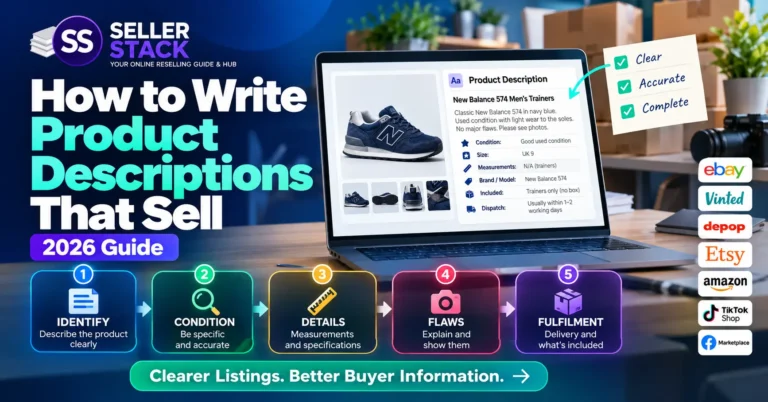
Mistake 7: Treating the Listing as an Afterthought
A good sourcing decision can still underperform if the buyer cannot identify, evaluate or trust the product.
Your Listing Needs to Answer Four Questions
What Exactly Is It?
Use a clear title with useful brand, model, type, size, colour and other product identifiers.
What Does It Look Like?
Use clear photographs showing the item, important details and relevant flaws.
What Is the Condition?
Describe wear, measurements, specifications, included parts and missing components accurately.
What Does the Buyer Need to Know?
Make delivery, condition and other important transaction information clear.
Avoid Listing “Hacks”
Do not depend on:
- stuffing titles with promotional words;
- adding irrelevant keywords;
- hiding flaws in photographs;
- copying another seller’s description without checking accuracy;
- using AI-generated product facts you have not verified.
Mistake 8: Planning Shipping After the Item Sells
Do not wait until an order arrives before asking:
“How am I going to send this?”
Shipping should be part of the buying and listing decision.
Before Listing, Check:
- the finished parcel size;
- packed weight;
- fragility;
- carrier limits;
- restricted or prohibited goods;
- insurance or compensation limits where relevant;
- tracking;
- packaging cost;
- who pays the delivery cost.
The dimensions of the product are not necessarily the dimensions the carrier will use. Packaging can move an order into a different size or weight band.
For the wider process, visit the Shipping & Fulfilment Hub .
Do Not Hide Condition Problems to Avoid Losing the Sale
A scratch, stain, repair, missing component or damaged box does not automatically make an item unsellable.
Hiding it is usually the bigger problem.
Photograph important defects and describe them accurately.
Your buyer should not need to discover significant condition information for the first time after delivery.
Accurate condition information may reduce the number of buyers willing to purchase at a particular price, but it also helps the buyer decide whether the product is actually suitable for them.
Mistake 9: Buying Stock Faster Than You Can Process It
Sourcing feels productive.
But buying ten more products while twenty are sitting unphotographed and unlisted is not necessarily growth.
It may simply mean more cash has moved from your bank account into inactive inventory.
The Real Cost of an Unlisted Stock Pile
- capital remains tied up;
- storage pressure increases;
- products can become harder to locate;
- seasonal opportunities can pass;
- market prices can change;
- your sourcing records can become incomplete;
- listing work continues to accumulate.
Sourced Stock Is Not Productive Stock Until It Is Ready to Sell
A product sitting in a sourcing bag is not creating visibility, buyer interest or cash flow.
Build a Simple Stock Workflow
1. Source
Record the item and purchase cost.
2. Prepare
Clean, test or inspect it where appropriate.
3. Photograph
Capture the product and relevant condition details.
4. List
Get the inventory live while your research is current.
5. Store
Give the item a location you can find after the sale.
6. Review
Track how long it remains unsold and reassess when needed.
Mistake 10: Treating Records and Tax as Something to Fix Later
You do not need an elaborate accounting system for your first few sales.
You do need usable records.
Keep Evidence of:
- purchase dates;
- stock costs;
- sales income;
- marketplace charges;
- advertising costs;
- postage;
- packaging and other relevant expenses;
- returns and refunds;
- supporting receipts or records.
Selling Personal Possessions and Trading Are Not the Same Thing
HMRC says people selling unwanted personal possessions are unlikely to be trading simply because they use an online marketplace.
Buying or making goods with the intention of selling them for profit is much more likely to be trading activity.
Understand the £1,000 Trading Allowance Correctly
The trading allowance relates to qualifying gross trading income, before expenses are deducted.
If annual gross trading income is £1,000 or less, you may not need to tell HMRC, but there are exceptions and circumstances where a return or registration may still be required.
Do not interpret it as:
“I can make £1,000 profit before tax matters.”
Digital platforms may be required to report information about sellers to HMRC under platform-reporting rules.
A platform reporting your information does not automatically mean that tax is due. Your tax position depends on the nature and amount of your income and your circumstances.
Check Sales and Trading Thresholds
Use SellerStack’s checker as a planning aid, then verify your position against current HMRC guidance when needed.
For record keeping, tax and business guidance, visit the Tax, Records & Business Hub .
Another Beginner Mistake: Thinking More Money Will Fix the Process
Increasing your sourcing budget does not automatically improve:
- demand research;
- buying decisions;
- pricing;
- listing quality;
- shipping accuracy;
- stock turnover.
It can simply make the same mistakes larger.
Add more capital when the existing process is producing repeatable results and you understand where the money is going.
Read How Much Money Do You Need to Start Reselling? before assuming that a larger bankroll is the next step.
The SellerStack Beginner Reseller Framework
Instead of trying to memorise hundreds of reseller tips, build every product around the same decision sequence.
1. Research
Is there evidence that buyers want the product?
2. Buy
Is the purchase price low enough to support the required return?
3. Price
What is the realistic market value, break-even point and target selling price?
4. List
Can the buyer identify the product, understand its condition and evaluate it confidently?
5. Fulfil
Can you pack and deliver it safely within the economics of the transaction?
6. Record
Have you recorded the income, stock cost and relevant selling expenses?
7. Review
What did the final profit, ROI and selling speed tell you about the decision?
Research → Buy → Price → List → Fulfil → Record → Review
Each completed sale should give you information that improves the next buying decision.
A Better First-Month Reselling Approach
| Stage | Priority |
|---|---|
| Start | Sell suitable unwanted items from home and learn the transaction process. |
| Research | Study comparable sales and identify products with genuine demand. |
| Source | Test a small number of deliberately purchased items. |
| Measure | Record stock cost, selling price, expenses, profit and selling speed. |
| Review | Identify which categories and sourcing decisions actually worked. |
| Reinvest | Put additional capital into evidence-backed opportunities rather than simply buying more stock. |
Beginner Reseller Checklist
✓ I checked real demand before buying.
✓ I know the realistic selling-price range.
✓ I know my maximum buying price.
✓ I understand the marketplace costs that apply to me.
✓ I checked shipping before listing.
✓ I know my estimated profit and break-even point.
✓ I chose the marketplace based on product fit.
✓ My title identifies the product clearly.
✓ My photos show condition accurately.
✓ My description explains important flaws and details.
✓ I have a storage location for the stock.
✓ I recorded the purchase cost.
✓ I know what I will do if the stock does not sell.
✓ I am learning from completed sales before increasing my budget.
Which SellerStack Resource Solves the Problem?
| Beginner Problem | SellerStack Resource |
|---|---|
| I do not know where to start | Start Reselling Guide |
| I do not know what stock to buy | Product Sourcing Guide |
| I do not know how much I can pay | Maximum Buy Price Calculator |
| I do not understand selling costs | Marketplace Fees Guide |
| I do not know my true profit | Reseller Profit Calculator |
| I need a selling price | Product Pricing Calculator |
| My stock is not moving | Stock Turnover Calculator |
| I have old unsold inventory | Dead Stock Calculator |
| I am unsure about seller tax thresholds | HMRC Sales & Tax Threshold Checker |
Beginner Reselling Mistakes: FAQs
What is the biggest mistake new resellers make?
Buying stock without enough evidence of demand is one of the most damaging mistakes because it creates several later problems at once: tied-up cash, difficult pricing, slow stock and pressure to discount. Research the product before deciding what you are willing to pay.
Should beginners start by buying lots of stock?
Usually not. A small test inventory gives you a chance to learn sourcing, listings, shipping, buyer communication and records without putting unnecessary capital at risk. Increase the stock budget when you have evidence that the process is working.
How do I know whether an item is worth reselling?
Check realistic selling prices, buyer demand, competition, condition, selling costs, shipping, maximum buying price, expected profit, ROI and likely selling speed. A high selling price alone does not make an item a good resale opportunity.
Should I use the same profit margin for every product?
Not necessarily. Different products can have different selling speeds, return risk, capital requirements, labour and fulfilment costs. Use profit, margin and ROI together rather than forcing every product into one universal percentage rule.
Is the cheapest marketplace always the best one?
No. Marketplace fees matter, but so do buyer demand, achievable selling price, competition, fulfilment, selling speed and product fit. A higher-cost marketplace can still produce the stronger overall transaction.
Can I use a private seller account if I buy products to resell?
Check the rules of the marketplace you use. On eBay UK, for example, eBay says sellers must register as a business when their activities include buying items to resell or making items to sell. Seller type can also affect your obligations and fee structure.
Does the £1,000 HMRC trading allowance mean £1,000 profit?
No. The trading allowance relates to qualifying gross trading income before expenses are deducted. HMRC rules and reporting requirements depend on your circumstances, so check current guidance rather than treating £1,000 as a universal profit threshold.
Does being reported to HMRC by a marketplace mean I owe tax?
No. HMRC states that digital-platform reporting does not automatically mean tax is due. Whether you need to tell HMRC or pay tax depends on your underlying activity, income and circumstances.
Do I need expensive equipment to start reselling?
No. A smartphone, suitable light, basic measuring equipment and appropriate packaging can be enough to learn the process. Add specialist equipment when your sales volume creates a real operational reason for it.
What should I do with stock that will not sell?
Recheck demand, current selling prices, listing quality, marketplace fit and stock age. Depending on the evidence, you may reprice, improve the listing, cross-list, bundle, clear or otherwise release the capital rather than holding the item indefinitely.
Your First Goal Is Not to Avoid Every Mistake
Every new reseller will make some poor buying, pricing or operational decisions.
The important part is making those mistakes small enough that you can learn from them.
Research before buying.
Know your maximum purchase price.
Calculate the complete transaction.
Create accurate listings.
Plan fulfilment before the sale.
Keep records.
Then review what actually happened and use that information to improve the next sourcing decision.
Marketplace and UK Seller Rules Change
Marketplace fees, private and business seller policies, delivery programmes, advertising systems and reporting requirements can change.
Tax treatment also depends on individual circumstances. SellerStack provides educational information and planning tools, not individual tax or accounting advice.
Useful official references:
- HMRC Trading Allowance Guidance
- HMRC Digital Platform Seller Guidance
- Check If You Need to Tell HMRC About Online Income
- eBay Business Seller Policy
Last reviewed: October 2026
Build the Process Before You Scale the Stock
Use SellerStack’s free guides and calculators to research products, set buying limits, calculate profit, plan pricing and understand inventory risk before committing more money.
Follow the Beginner Reselling Guide →