SELLERSTACK MARKETPLACE COST GUIDE · UPDATED FOR 2026
Amazon FBA vs eBay Fees UK 2026
Compare Amazon FBA and eBay using the costs that actually determine profit — marketplace fees, fulfilment, storage, shipping, advertising, selling price and inventory speed.
Comparing Amazon FBA with eBay is not as simple as placing two marketplace fee percentages beside each other.
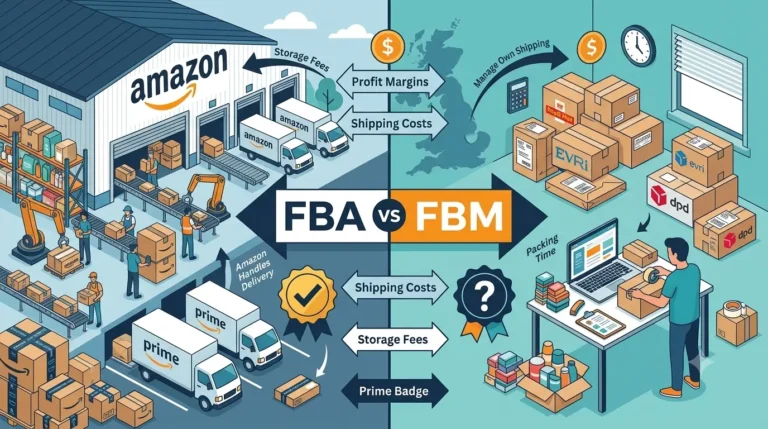
Amazon FBA combines marketplace access with a fulfilment service. Amazon can store inventory, pick and pack customer orders, dispatch them and handle significant parts of the customer-service and returns process.
An eBay business seller normally retains much more responsibility for storage, packing and delivery.
That means an Amazon FBA fee and an eBay final value fee are not charges for the same service.
The old version of this guide framed the comparison as “Amazon FBA vs eBay Managed Payments”. That wording no longer describes the decision particularly well.
eBay now presents its business transaction cost primarily through its final value fee structure, while sellers do not separately arrange a third-party payment-processing fee for normal eBay transactions.
The more useful question for a reseller in 2026 is:
If the same stock could sell through Amazon FBA or eBay, which route leaves the strongest real profit after every relevant cost?
Is Amazon FBA or eBay Cheaper for UK Sellers?
There is no universal cheaper platform.
Amazon FBA can carry more fulfilment and inventory-related charges because Amazon is performing more of the logistics. For a compact, fast-moving product, that service can still produce strong economics.
eBay can have a lower marketplace-fee burden for some categories, but the seller normally needs to add postage, packaging, storage, fulfilment labour and other operating costs before comparing the result fairly.
Selling price also matters. If the same product can command a materially different price on one marketplace, that difference may outweigh a small fee advantage elsewhere.
Compare: selling price → marketplace fees → fulfilment → inventory costs → net profit → sales velocity.
Important: Compare Business Selling With Business Selling
This guide uses the eBay business seller structure as the relevant comparison for commercial reselling.
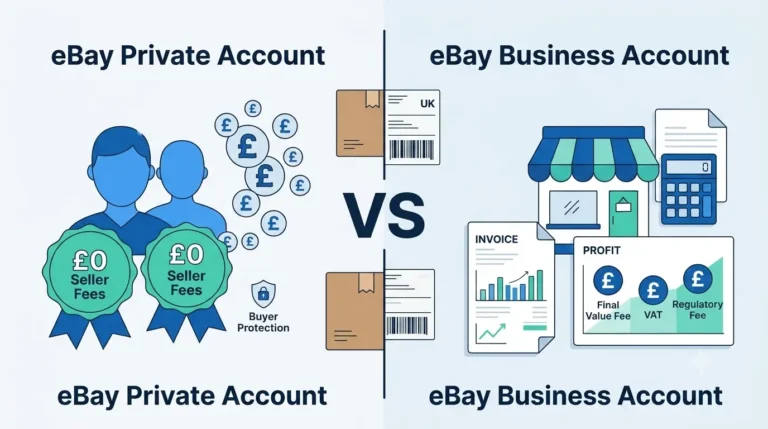
UK private sellers currently operate under a different fee structure, but someone buying or making products specifically to resell should not model a commercial operation using private seller fees simply because they are lower.
If you are unsure which eBay account applies to your activity, read our eBay Private vs Business Account UK guide first.
Compare the Same Product Across Amazon FBA and eBay
Use the UK Marketplace Profit Comparison Calculator to enter one product scenario and compare estimated marketplace fees, profit, margin and ROI across Amazon FBA, eBay and other major UK marketplaces.
1. Amazon FBA Fees and eBay Fees Are Not Like-for-Like
The first mistake in this comparison is assuming both platforms charge different percentages for essentially the same service.
They do not.
Amazon FBA
Amazon charges for access to the marketplace and, separately, for the fulfilment services associated with FBA.
Depending on the product and inventory position, the cost stack can include:
- referral fee
- selling-plan cost
- Digital Services Fee
- FBA fulfilment fee
- FBA storage
- inventory-related surcharges
- inbound preparation and transport
- optional advertising
eBay Business Seller
eBay charges marketplace selling fees, but the seller normally remains responsible for fulfilling the physical customer order.
The full cost can therefore include:
- final value fee
- per-order fee
- Regulatory Operating Fee
- VAT on applicable eBay business fees
- postage
- packaging
- fulfilment labour
- optional advertising
The Fair Comparison
Amazon marketplace + FBA fulfilment
versus
eBay marketplace + your fulfilment operation
2. Amazon FBA vs eBay Cost Structure at a Glance
| Cost area | Amazon FBA | eBay Business Seller |
|---|---|---|
| Core marketplace fee | Category-based referral fee | Category-based final value fee |
| Seller plan | Individual or Professional plan | Shop optional |
| Per-order / per-item charge | Individual plan charges per unit | Business per-order fee applies |
| Platform regulatory / digital charge | Digital Services Fee can apply | Regulatory Operating Fee |
| Pick & pack | Included through FBA fee structure | Seller responsibility |
| Customer delivery | Handled through FBA | Seller normally arranges carrier |
| Amazon/eBay warehouse storage | FBA storage fees apply | No equivalent eBay warehouse fee |
| Own storage cost | Can still exist before FBA inbound | Normally seller responsibility |
| Advertising | Optional Amazon Ads | Optional Promoted Listings |
| Inventory ageing exposure | Can create additional FBA charges | No FBA ageing fee, but capital remains tied up |
| Operational workload | Lower customer-order fulfilment workload | More fulfilment work remains with seller |
Marketplace Fee and Fulfilment Cost Are Different Things
A platform with a lower transaction fee can still produce a higher total cost once the customer order is fulfilled.
3. Costs You Should Include on Both Sides
Some expenses are not unique to Amazon or eBay.
If you remove them from one side of the comparison but leave them on the other, the result becomes misleading.
Stock Cost
The purchase or manufacturing cost of the product exists whichever marketplace you choose.
Returns Risk
Customer returns can affect margin on either marketplace, even though the process and fee treatment may differ.
Advertising
Paid visibility is optional on both platforms and should be added only where you genuinely expect to use it.
Tax & VAT Position
Your business tax and VAT position does not disappear simply because you change marketplace.
SellerStack Tip: Compare the Costs That Actually Change
When one expense is identical under both scenarios, keep it on both sides.
The useful comparison is the combination of price, marketplace cost, fulfilment cost and operational differences.
4. Amazon Selling Fees Before You Add FBA
FBA is only one layer of the Amazon cost structure.
Start with the costs associated with selling through Amazon itself.
Amazon Referral Fee
Amazon charges a referral fee when an item sells.
The percentage depends on the product category and, for some categories, the selling-price band.
Amazon currently says that most referral fees fall between 8% and 15%, but there are exceptions outside that range.
That is why using one generic Amazon percentage for every sourcing decision is unreliable.
Individual Selling Plan
Amazon’s current Individual plan costs £0.75 per unit sold, excluding VAT, in addition to other applicable selling fees.
Professional Selling Plan
Amazon’s Professional plan currently costs £25 per month, excluding VAT, with referral and other applicable fees charged separately.
Amazon Digital Services Fee
Amazon also operates a separate Digital Services Fee.
For a business established in the UK selling through the UK Amazon store, the current fee is a 2% increase applied to relevant Selling on Amazon and FBA fees.
That distinction matters:
it is not simply another 2% of the product’s selling price.
Do Not Use “15.3% Amazon Fee” as a Universal Rule
Amazon’s current referral structure is category dependent, and the Digital Services Fee is applied to relevant Amazon fees rather than being a universal percentage of every sale.
Need the Detailed Amazon Calculation?
Use the SellerStack Amazon FBA & FBM Fee & Profit Calculator when you need to model the Amazon side in more detail using your product’s own price and costs.
5. What Does Amazon FBA Add to the Cost?
Once the Amazon marketplace fees are understood, add the FBA fulfilment and inventory layer.
FBA Fulfilment Fee
FBA charges a per-unit fulfilment fee based on the applicable product size, weight and programme structure.
The fee pays for Amazon to perform services that the eBay seller would normally need to perform or arrange themselves.
2026 Fuel and Logistics-Related Surcharge
From 17 April 2026, Amazon applies a 1.5% fuel and logistics-related surcharge to FBA fulfilment fees in the UK.
Monthly Storage
Inventory held inside Amazon fulfilment centres can generate monthly storage fees based on the space it occupies.
Base storage costs are only part of the inventory picture. Additional inventory-related charges can apply where stock remains too long or storage utilisation becomes inefficient.
Inbound Costs
The finished customer-order fulfilment fee does not necessarily include every cost of getting inventory ready for Amazon.
Depending on your setup, allow for:
- shipping stock into Amazon’s network
- labelling
- prep materials
- cartons
- inspection or preparation labour
Simplified Amazon FBA Cost Stack
                referral fee
                +
                plan allocation
                +
                Digital Services Fee
                +
                FBA fulfilment
                +
                storage
                +
                inbound costs
                +
                optional advertising
Storage Can Change the Result for Slow Inventory
Our Amazon FBA Storage Fees UK guide explains monthly storage, Q4 rates, storage utilisation, aged inventory charges and the decisions sellers should make as stock gets older.
Low-Price FBA Can Change the Economics
Amazon expanded its Low-Price FBA structure in 2026.
Most qualifying products priced at or below £20 can now access reduced Low-Price FBA fulfilment rates, subject to the relevant category, size, weight and programme conditions.
That means an older comparison based on standard FBA rates can overstate the cost of fulfilment for an eligible low-priced product.
6. eBay Business Seller Fees UK 2026
The eBay side should also be calculated product by product.
There is no single universal eBay business final value percentage.
Final Value Fee
eBay’s business final value fee is based on the relevant product category.
Some categories use a single percentage while others use tiered percentages above particular transaction values.
Per-Order Fee
The current standard business per-order charge is:
| Order value | Per-order fee |
|---|---|
| £10 or less | £0.30 |
| Above £10 | £0.40 |
Regulatory Operating Fee
eBay currently charges UK business sellers a 0.35% Regulatory Operating Fee calculated on the total amount of the sale.
VAT on eBay Business Fees
eBay states that the fees displayed on its UK business seller fee page are exclusive of VAT.
That needs to be reflected when estimating the real amount charged to your business.
Do Not Use “13.45% + 30p” as a Default eBay Business Fee
The current eBay business fee structure varies significantly by product category, and orders above £10 now normally carry a 40p per-order fee.
Need the Detailed eBay Calculation?
Use the SellerStack eBay Fee & Profit Calculator to estimate marketplace costs, profit, margin and ROI using the fee settings relevant to your product.
7. The Cost Missing From a Simple eBay Fee Comparison: Fulfilment
eBay’s final value fee does not normally pick your product from a shelf, put it in packaging and deliver it to the customer.
Those costs remain inside your business.
Postage
Royal Mail, Evri, DPD or another carrier still needs to move the parcel to the customer.
Packaging
Mailers, boxes, tape, labels and protective materials form part of the order cost.
Fulfilment Labour
Picking, checking, packing, labelling and dispatching every order takes time.
Storage
Stock held in your own home, unit or warehouse does not create an eBay storage invoice, but the space still has capacity and potentially a financial cost.
Returns Processing
Customer returns require inspection, communication, repacking and often another inventory decision.
Operational Equipment
Scales, printers, shelving, shipping software and packing equipment can become meaningful as volume grows.
Realistic eBay Fulfilment Cost
                postage
                +
                packaging
                +
                fulfilment labour
                +
                storage allocation
                +
                operational overhead
Put a Real Delivery Cost Into the eBay Side
Use the SellerStack UK Shipping Cost Comparison Calculator to compare parcel options rather than relying on a generic shipping estimate.
8. Selling Price Can Matter More Than a Small Fee Difference
Comparing both marketplaces at an identical selling price is useful for understanding the mechanics.
But real marketplace economics do not always work that way.
The same product might realistically sell for:
- a higher price on Amazon
- a higher price on eBay
- roughly the same price on both
Demand, product condition, competition, catalogue structure, Prime availability and buyer expectations can all affect the achievable price.
A £3 Fee Advantage Can Disappear With a £7 Price Difference
Suppose Marketplace A costs £3 less to use.
But realistic market demand means the product sells for £7 less there than on Marketplace B.
Looking only at the platform fee would point you towards the wrong conclusion.
Compare expected profit using the price customers actually appear willing to pay on each marketplace.
Fees Are Only One Part of Choosing Between eBay and Amazon
Our wider eBay vs Amazon UK guide compares product fit, demand, competition, fulfilment, capital requirements and inventory risk as well as fees.
9. Three Products Can Produce Three Different Answers
There is no useful universal statement that Amazon FBA always costs more or eBay always leaves more profit.
Product characteristics can change the result substantially.
Compact, Fast-Moving Product
The item sells consistently, occupies little FBA space and fits an economical fulfilment tier.
High sales volume would create substantial daily packing work if fulfilled manually.
Amazon FBA can remain competitive even where its visible fee stack appears higher because the stock turns quickly and Amazon performs much of the fulfilment work.
Bulky, Slow-Moving Product
The product takes substantial warehouse space and may sit for several months before selling.
The seller already has economical storage and an efficient parcel contract.
eBay can deserve closer analysis because FBA storage and inventory exposure may weaken the Amazon result.
Low-Price Compact Product
The product sells for under £20 and meets the relevant Low-Price FBA eligibility conditions.
Using an old standard FBA fee assumption could make Amazon appear less competitive than it really is.
Check current Low-Price FBA eligibility before deciding.
Used or Condition-Sensitive Item
Each unit varies in condition and may need individual photographs and descriptions.
Even if the fee maths is close, eBay’s individual-listing structure may fit the stock more naturally.
Product fit can matter alongside the fee calculation.
10. Sales Velocity Changes the Profit Decision
Net profit per unit is important, but it is not the only useful measure.
Consider two products:
one produces £10 profit but takes four months to sell; another produces £8 but reliably sells every two weeks.
The higher-margin unit does not automatically create the stronger business outcome.
Profit Should Be Considered Alongside Time
                profit per unit
                +
                sales velocity
                +
                capital turnover
                =
                stronger marketplace decision
This becomes particularly important with FBA because slow inventory can generate ongoing warehouse costs.
But slow-moving eBay stock is not economically harmless either. It still occupies space and ties up working capital.
Measure More Than Profit per Unit
Use the SellerStack Stock Turnover Calculator when you want to assess how efficiently inventory is moving through the business rather than looking only at the margin on one sale.
11. Amazon Ads vs eBay Promoted Listings
A platform can look profitable before advertising and much weaker after it.
Advertising should therefore be included only where it forms part of the actual selling strategy — but when it does, include it on the correct side of the comparison.
Amazon Advertising
Sponsored advertising can create an additional acquisition cost on top of referral, fulfilment and inventory expenses.
The effect depends on campaign structure, click cost, conversion and the product’s organic position.
eBay Promoted Listings
Promoted Listings can add advertising cost on top of normal eBay business seller fees.
The impact depends on the campaign strategy, ad rate or click cost and attribution.
Do Not Compare Organic Amazon With Advertised eBay — or Vice Versa
Use realistic assumptions for how the product is actually likely to be sold on each marketplace.
See What an eBay Ad Rate Does to Margin
Use the SellerStack eBay Promoted Listings Calculator to test how an additional advertising percentage changes estimated profit and margin.
12. What if Amazon Is the Right Marketplace but FBA Is Too Expensive?
Amazon does not automatically mean FBA.
If Amazon appears to offer stronger demand or selling-price potential but the FBA economics do not work, compare Fulfilled by Merchant (FBM).
FBM keeps the customer-order fulfilment responsibility with the seller rather than placing the inventory into Amazon’s FBA network.
That can produce a very different result for bulky, specialist or slow-moving products.
Amazon Marketplace Does Not Automatically Mean FBA
Read our Amazon FBA vs FBM UK guide to compare fulfilment cost, sales velocity, product fit and operational workload.
13. The SellerStack Marketplace Profit Decision
Compare the product in this order.
Price → Fees → Fulfilment → Velocity → Profit
-
Estimate the realistic selling price.
Do not assume customers will pay exactly the same amount on Amazon and eBay. -
Calculate the marketplace fees.
Use the actual Amazon category and eBay business category rather than generic percentages. -
Add the complete fulfilment cost.
For Amazon FBA, include relevant fulfilment and inventory charges. For eBay, include postage, packaging, labour and storage. -
Estimate realistic sales velocity.
Ask how quickly the stock is likely to convert back into cash. -
Compare net profit and operational workload.
The stronger route should produce acceptable economics without creating an unsuitable fulfilment model.
Marketplace Profit Is More Than the Fee Percentage
                achievable selling price
                -
                stock cost
                -
                marketplace costs
                -
                fulfilment costs
                -
                other selling costs
                =
                real projected profit
14. When Can Amazon FBA Produce the Stronger Result?
Amazon FBA deserves closer consideration where several of these conditions are present.
- the product is compact relative to its selling value
- sales velocity is strong and predictable
- the same SKU can be replenished repeatedly
- Amazon supports a stronger achievable selling price
- Prime fulfilment is commercially valuable
- high order volume would create significant manual packing work
- FBA storage exposure remains controlled
- the product qualifies for favourable FBA rates
- the margin comfortably supports Amazon’s complete cost stack
A Higher Fee Can Still Buy Valuable Work
If FBA removes hundreds of monthly pick, pack and dispatch tasks, the comparison should recognise the operational value being transferred to Amazon.
15. When Can eBay Produce the Stronger Result?
eBay deserves closer analysis where the inventory fits a more seller-controlled fulfilment and listing model.
- the item is used, unique or condition-sensitive
- each unit benefits from individual photographs and description
- the product is bulky relative to its value
- sales velocity is slow or unpredictable
- you already have economical storage
- you have competitive courier rates
- you can fulfil orders efficiently yourself
- eBay supports an equal or stronger selling price
- the eBay category fee produces acceptable margin
“No eBay Storage Fee” Does Not Mean Storage Costs £0
A garage, spare room or warehouse can still become full.
As the business grows, storage capacity and fulfilment labour become real constraints even if eBay never sends you a warehouse invoice.
16. When Does Selling on Both Amazon and eBay Make Sense?
A profitable product does not always need one permanent marketplace.
Some inventory can work on both.
Use Amazon for Repeatable Volume
Amazon may be useful where a standardised SKU has reliable demand and can be replenished consistently.
Use eBay for Additional Demand
eBay can create another route to market, particularly where you retain stock outside FBA or have separate inventory available to fulfil directly.
A Multi-Channel Strategy Still Needs Stock Control
Listing the same physical units across multiple channels can create overselling risk unless inventory is managed properly.
Multi-channel selling therefore becomes an inventory and systems decision as well as a marketplace decision.
Compare the Wider Marketplace Options
Explore SellerStack’s Marketplace Hub for marketplace guides, fee calculators and comparisons across eBay, Amazon, Vinted, Depop, Etsy, TikTok Shop and other selling routes.
Need Tools for Demand, Competition or Marketplace Research?
Our Recommended Seller Tools guide separates free SellerStack tools from external research, automation and marketplace software so you can choose tools for a specific job rather than adding software without a clear purpose.
17. Common Amazon FBA vs eBay Fee Comparison Mistakes
Eight Ways Sellers Distort the Comparison
-
Comparing FBA fulfilment with the eBay final value fee only.
Add the seller’s eBay postage, packaging and fulfilment costs. -
Using one generic Amazon referral percentage.
Amazon referral fees vary by category and sometimes by price band. -
Using one generic eBay business percentage.
eBay final value fees are also category dependent. -
Using private eBay fees for commercial resale stock.
Compare the seller-account structure that actually applies to your activity. -
Treating home storage and packing time as free.
They may not produce a direct invoice today, but they consume capacity. -
Assuming the selling price will be identical.
Market demand can support different achievable prices. -
Ignoring sales velocity.
A slightly higher per-unit profit can still produce weaker capital turnover. -
Copying an old worked example.
Marketplace fees and fulfilment programmes change. Use current category and transaction-specific figures.
18. SellerStack Amazon FBA vs eBay Profit Checklist
Before deciding where a product should be listed, check each of these inputs.
- Estimate a realistic Amazon selling price.
- Estimate a realistic eBay selling price.
- Use the correct Amazon referral category.
- Include the relevant Amazon selling-plan cost.
- Include the applicable Amazon Digital Services Fee.
- Use the correct FBA fulfilment tier.
- Check Low-Price FBA eligibility where relevant.
- Include FBA storage where meaningful.
- Include inbound FBA preparation and transport.
- Use the correct eBay business category rate.
- Include the eBay per-order fee.
- Include the Regulatory Operating Fee.
- Allow for VAT on applicable eBay business fees.
- Add realistic eBay postage.
- Add packaging.
- Allow for fulfilment labour where it matters.
- Include advertising only where you realistically expect to use it.
- Consider returns on both platforms.
- Estimate expected sales velocity.
- Consider the amount of capital tied up in stock.
- Compare profit, margin and ROI rather than marketplace fees alone.
Which Situation Sounds Most Like Your Product?
Compact product with strong repeat Amazon demand:
Model Amazon FBA carefully. The complete cost may be justified
by fulfilment scale, Prime and stock velocity.
Bulky product selling a few times each month:
Compare eBay closely, particularly if you already have affordable
storage and efficient shipping.
Product sells for materially more on Amazon:
Do not reject Amazon because the fee stack appears larger.
Calculate the final profit at the achievable Amazon price.
Product sells for materially more on eBay:
The stronger selling price may outweigh a fulfilment or
marketplace-fee disadvantage.
Used, graded or one-off stock:
eBay may fit the inventory model more naturally even before
the final fee calculation.
Standardised replenishable stock with high order volume:
Amazon FBA deserves serious analysis because fulfilment workload
becomes increasingly valuable at scale.
Both platforms show healthy demand and margin:
Consider a controlled multi-channel strategy rather than forcing
the product into one marketplace permanently.
Know the Lowest Price the Deal Can Tolerate
Use the SellerStack Break-Even Calculator to see how marketplace, fulfilment and stock costs affect the price floor below which the product stops producing profit.
Frequently Asked Questions
Is Amazon FBA more expensive than eBay?
Not automatically. Amazon FBA can include marketplace, fulfilment and storage costs, while an eBay business seller normally pays marketplace fees and then handles or pays for their own fulfilment. Compare the complete cost of delivering the product to the customer.
Is eBay cheaper than Amazon for UK sellers?
It depends on the product category, selling price, seller type, shipping cost, fulfilment workload and other selling expenses. A lower headline marketplace fee does not guarantee higher final profit.
Does Amazon always charge a 15% referral fee?
No. Amazon says most referral fees are currently between 8% and 15%, but actual rates vary by category and some categories use price bands or rates outside that range.
What does Amazon’s Individual plan cost?
Amazon’s UK Individual selling plan currently costs 75p per unit sold excluding VAT, with referral and other applicable fees charged separately.
What does Amazon’s Professional plan cost?
Amazon currently charges £25 per month excluding VAT for the Professional selling plan, with referral and other applicable fees separate.
What is Amazon’s Digital Services Fee?
Amazon uses the Digital Services Fee to account for relevant government digital-services taxes. For a UK-established business selling in the UK store, the current rate is a 2% increase applied to relevant Selling on Amazon and FBA fees, rather than simply 2% of the sale price.
Does Amazon FBA charge extra for fuel in 2026?
Amazon applies a 1.5% fuel and logistics-related surcharge to UK FBA fulfilment fees from 17 April 2026.
Does Amazon have cheaper FBA fees for low-priced products?
Yes. Amazon expanded Low-Price FBA eligibility during 2026, and most qualifying products priced at or below £20 can access reduced fulfilment rates subject to the relevant eligibility rules.
What are the main eBay business seller fees?
eBay business selling can include a category-based final value fee, a per-order charge, the Regulatory Operating Fee and other applicable costs such as listing upgrades, advertising or international fees.
What is the eBay business per-order fee?
The current standard charge is 30p for orders of £10 or less and 40p for orders above £10, subject to relevant category exceptions.
What is eBay’s Regulatory Operating Fee?
eBay currently charges UK business sellers a Regulatory Operating Fee of 0.35% of the total amount of the sale.
Do eBay business seller fees include VAT?
eBay states that the fees shown on its UK business seller fee page are exclusive of VAT.
Does eBay charge a separate payment processing fee?
eBay’s current business fee guidance says sellers pay one final value fee when an item sells and do not need to arrange a separate third-party payment-processing fee for the transaction.
Do eBay sellers have storage costs?
eBay does not normally charge business sellers an FBA-style warehouse storage fee. However, sellers still need somewhere to store inventory, and that space can have a real financial or capacity cost.
Should I compare Amazon and eBay at the same selling price?
It is useful as a controlled comparison, but you should also calculate the result at the realistic selling price available on each marketplace.
Can I sell the same product on Amazon and eBay?
Yes, where the product and marketplace rules allow it. You need reliable inventory control so the same physical stock is not sold twice across different channels.
What if Amazon works but FBA is too expensive?
Compare Amazon FBM. Amazon marketplace choice and FBA fulfilment are separate decisions, and a product can sometimes work on Amazon without being suited to FBA.
The Lowest Headline Fee Is Not Necessarily the Most Profitable Marketplace
Amazon FBA and eBay business selling should not be compared as though they provide exactly the same service for two different percentages.
FBA can cost more because Amazon is taking over substantial parts of storage and customer-order fulfilment.
eBay can give the seller more direct control, but that means postage, packing, storage and fulfilment capacity need to be included in the economics.
Selling price and stock velocity can then change the result again.
The correct comparison is:
Price → Fees → Fulfilment → Velocity → Profit.
Run that calculation with the numbers from the actual product.
Then choose Amazon FBA, eBay — or both.
Compare the Same Product Across Amazon FBA and eBay
Enter one product scenario into the SellerStack UK Marketplace Profit Comparison Calculator and compare estimated marketplace fees, profit, margin and ROI before deciding where the stock should be listed.
Compare Marketplace Profit →Official Sources and Important Information
The fee structures and marketplace information in this guide were reviewed against current official information, including:
- Amazon UK — Pricing and Referral Fees
- Amazon UK — Fulfilment by Amazon
- Amazon UK — Low-Price FBA Rates
- Amazon Seller Central — Digital Services Fee
- Amazon UK — 2026 FBA Fee Information
- eBay UK — Fees for Business Sellers
- eBay UK — Regulatory Operating Fee
- eBay UK — Business Seller Fee Categories
Marketplace Fee Accuracy & Important Information
Last reviewed: October 2026.
Amazon and eBay can change referral fees, final value fees, fulfilment rates, storage charges, regulatory fees, seller-plan pricing, advertising programmes and marketplace policies.
SellerStack reviews this content periodically, but you should check current Amazon, Seller Central and eBay information before making an important sourcing, pricing, fulfilment or marketplace decision.
Actual costs depend on factors including seller account, product category, selling price, dimensions, weight, fulfilment method, storage duration, advertising, tax position and the services used.
SellerStack calculators provide planning estimates rather than guaranteed marketplace charges or returns.
SellerStack is independent and is not affiliated with or endorsed by Amazon or eBay.