SELLERSTACK VINTED TAX GUIDE · UPDATED FOR 2026
Vinted & HMRC Tax Rules UK 2026
Understand when Vinted sales may be reported to HMRC, the difference between selling personal possessions and trading, how the £1,000 Trading Allowance works and when you may need to take action.
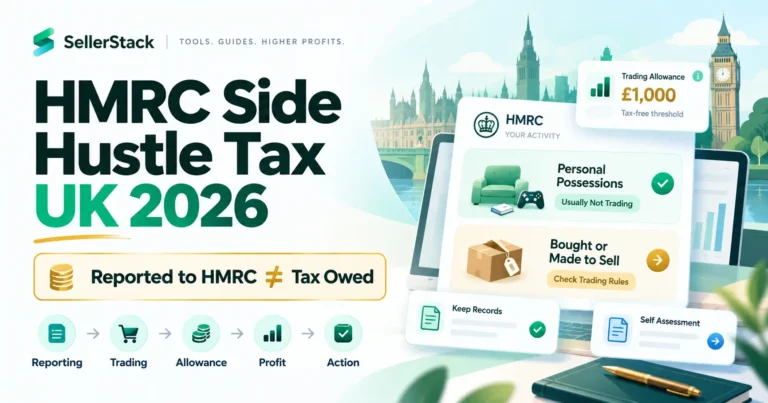
Selling on Vinted does not automatically make you a trader, and Vinted sharing information with HMRC does not automatically mean you owe tax.
The confusion usually comes from mixing together three completely different things: platform reporting rules, trading status and tax liability.
Someone clearing unwanted clothes from their wardrobe can make many Vinted sales without necessarily carrying on a trade. Someone who regularly buys clothes specifically to resell for profit can be in a very different tax position — even if they use exactly the same marketplace.
This guide explains the difference in plain English and shows how the £1,000 Trading Allowance, Vinted’s HMRC reporting, personal possessions and commercial reselling fit together.
Do You Have to Pay Tax When Selling on Vinted?
Not simply because you use Vinted.
If you are selling ordinary personal possessions that you originally bought or received for your own use, you will normally be in a very different position from someone buying stock specifically to resell for profit.
HMRC says you are probably trading if you sell goods that you bought intending to sell for a profit or goods that you made to sell.
If you are trading, your gross trading income becomes relevant to the £1,000 Trading Allowance and your potential obligation to tell HMRC.
Important: This Is General Tax Information
Your tax position depends on your individual circumstances. This guide explains general UK rules and should not be treated as personalised tax, accounting or legal advice.
If your activity is substantial, unusual or difficult to classify, check current HMRC guidance or speak to a suitably qualified UK tax professional.
Check the HMRC Thresholds That May Apply to You
Use the SellerStack HMRC Sales & Tax Threshold Checker to understand which UK seller thresholds may need closer attention based on your activity.
1. The Three Vinted Tax Rules People Commonly Confuse
Before looking at individual thresholds, separate these three questions.
1. Platform Reporting
Does Vinted have to collect and report information about your account to HMRC?
This is primarily a data-reporting question.
2. Are You Trading?
Are you merely disposing of personal belongings, or are you buying or making goods with the intention of selling them for profit?
This is a tax-status question.
3. Do You Need to Tell HMRC?
If you are trading, how much gross trading income have you received and what tax rules or allowances apply?
This is a tax-reporting question.
The key distinction
                Platform reported you
                ≠
                HMRC automatically considers you a trader
                ≠
                tax is automatically due
Understanding that one distinction removes much of the fear around Vinted and HMRC.
2. What Changed With Vinted and HMRC Reporting?
The UK introduced digital-platform reporting rules from 1 January 2024.
Digital platforms can be required to collect information about sellers and send qualifying information to HMRC.
That can include identifying information and details relating to sales made through the platform.
SellerStack Insight: This Did Not Create a New Vinted Tax
The reporting rules changed the information digital platforms may have to collect and share. They did not create a separate new tax that automatically applies whenever somebody sells something on Vinted.
Calendar Year vs UK Tax Year
Another source of confusion is that platform reporting and UK tax calculations do not necessarily use the same period.
| Rule | Period |
|---|---|
| Digital platform reporting | 1 January to 31 December |
| UK tax year | 6 April to 5 April |
So a figure appearing on a platform’s annual seller report cannot necessarily be copied directly into a tax calculation without considering the correct tax-year period.
3. What Do the 30 Sales and €2,000 Figures Mean?
These figures relate to the digital-platform reporting rules. They are not Vinted tax-free allowances.
Under HMRC’s guidance for sellers of goods, your details are not reported under this particular rule where you:
- make fewer than 30 sales of goods during the calendar year; and
- receive less than €2,000 for those sales.
Both Conditions Matter
The exclusion requires both conditions to be satisfied. The familiar “30 sales” figure should therefore not be treated as a standalone tax threshold.
| Number or rule | What it relates to | Does crossing it automatically mean tax is due? |
|---|---|---|
| 30 sales | Digital-platform reporting exclusion | No |
| €2,000 | Digital-platform reporting exclusion | No |
| £1,000 | Trading and miscellaneous income allowance | Not by itself |
| £6,000+ | Possible Capital Gains Tax consideration for certain personal possessions | Not automatically |
SellerStack Tip: Do Not Call €2,000 the “Vinted Tax Threshold”
It is a platform-reporting figure. Whether you owe tax depends on the nature of your activity and the relevant tax rules.
You Sell 35 Pieces of Your Family’s Old Clothing
Imagine you clear wardrobes belonging to your household and make 35 Vinted sales.
The number of sales could affect whether your information falls within the platform-reporting rules.
But the fact that 35 transactions took place does not automatically turn those personal possessions into trading stock.
The reporting question and the trading question are separate.
4. Selling Your Own Clothes Is Usually Different From Trading
HMRC describes personal possessions as items that belong to you for your own use.
Examples can include:
- clothes you previously wore
- shoes you no longer use
- children’s outgrown clothing
- an old phone after upgrading
- household items you no longer need
- gifts or possessions originally acquired for personal use
If you are simply disposing of those items, that is very different from deliberately sourcing inventory for resale.
HMRC’s Own Example Is Helpful
HMRC gives the example of someone clearing unwanted possessions from an attic. Where none of the items is worth more than £6,000, HMRC says it is unlikely that the person would need to tell HMRC about the income or pay tax, regardless of the number of items sold.
Selling a Jacket You Previously Wore
You bought a jacket three years ago for £180 because you wanted to wear it.
You later decide you no longer want it and sell it on Vinted for £60.
You did not acquire the jacket as resale inventory. You acquired it for personal use and are now disposing of it.
That points away from ordinary trading activity.
High-Value Personal Possessions Can Be Different
Saying that ordinary wardrobe clear-outs are usually not trading does not mean every possible personal-item sale is automatically tax-free.
Separate Capital Gains Tax rules can apply to certain personal possessions where the disposal proceeds exceed £6,000.
This is more likely to matter for valuable items such as some jewellery, artwork, antiques or collectables than ordinary second-hand clothing.
5. When Does Vinted Selling Start to Look Like Trading?
HMRC’s online-platform guidance gives a straightforward starting point:
You are probably trading if you sell goods that you have bought intending to sell for a profit or goods that you have made to sell.
For Vinted sellers, that can include activity such as:
- visiting charity shops specifically to find resale stock
- buying clothing bundles specifically to split and resell
- sourcing items from car boot sales for resale
- buying wholesale clothing to sell online
- repeatedly buying underpriced products to flip for profit
Buying Charity-Shop Jackets to Flip on Vinted
Imagine you visit charity shops every weekend looking for branded jackets.
You buy ten jackets for £10 each because you believe you can resell them for around £30 each.
You repeat that process, track margins and reinvest money into more stock.
That activity has much stronger characteristics of trading than selling clothing you previously owned for personal use.
Casual Vinted Selling vs Reselling for Profit
| Activity | More like personal disposal | More like trading |
|---|---|---|
| Sell clothes you previously wore | ✓ | |
| Sell children’s outgrown clothes | ✓ | |
| Sell an old phone after upgrading | ✓ | |
| Clear unwanted household possessions | ✓ | |
| Buy clothes specifically to flip | ✓ | |
| Regularly source charity-shop inventory | ✓ | |
| Buy wholesale inventory for resale | ✓ | |
| Systematically reinvest into new stock | ✓ |
This table is a practical guide rather than a definitive legal test. HMRC can consider the overall facts and circumstances.
Start With Why You Acquired the Item
Work through these questions in order:
-
Why did I originally acquire the item?
Personal use points towards disposal of a possession. Buying specifically to resell points more strongly towards trading. -
Am I actually carrying on trading activity?
Do not jump straight to the £1,000 allowance before answering this question. -
If I am trading, what is my total gross trading
income?
Consider your relevant trading activities, not simply one marketplace in isolation. -
Has the platform reported information about me?
Remember that platform reporting is separate from whether tax is actually due.
6. How the £1,000 Trading Allowance Really Works
The £1,000 Trading Allowance is another rule that is regularly misunderstood on social media.
The key word is trading.
HMRC says that where your total income from relevant trading activities is more than the £1,000 Trading Allowance for the tax year, you will generally need to tell HMRC about it.
Gross trading income
                Gross trading income
                = trading receipts before deducting expenses
It is therefore incorrect to say:
“Anyone who sells more than £1,000 on Vinted must pay tax.”
The first question remains whether the receipts are actually from trading activity.
You Sell £1,400 of Old Clothes From Your Wardrobe
The clothing was originally purchased for you and your family to wear.
You are now clearing items you no longer need.
The fact that total Vinted proceeds exceed £1,000 does not automatically turn those personal-possession sales into trading income.
The £1,000 Trading Allowance should not be treated as a universal annual limit on selling your own belongings.
You Receive £1,600 From Stock Bought for Resale
You deliberately buy clothing from charity shops and car boot sales with the intention of reselling it for profit.
If that activity amounts to trading, the £1,600 is relevant when considering your gross trading income and the £1,000 Trading Allowance.
The fact that your actual cash profit may be less than £1,000 does not mean the gross-income test should be ignored.
The Trading Allowance Is Optional
Where relevant, using the allowance may not always be the best approach. HMRC permits qualifying individuals to use normal expenses instead in appropriate circumstances.
For example, a trade with substantial allowable expenses or a trading loss may need a different calculation.
7. What Are HMRC’s Badges of Trade?
The intention behind acquiring an item is a strong practical starting point, but tax classification can involve more than one factor.
HMRC’s guidance refers to a number of traditional factors known as the Badges of Trade.
These can include:
Profit-Seeking Motive
Did you acquire the item with the intention of making a profit?
Number of Transactions
Are transactions systematic and repeated rather than isolated?
Nature of the Asset
Does the type and quantity of product look more like stock than something held for personal enjoyment?
Changes to the Item
Was it repaired, altered or prepared specifically to improve its resale value?
How the Sale Is Conducted
Is the activity organised and carried out in a way that resembles commercial selling?
Time Between Purchase and Sale
Was the product bought and quickly resold rather than held for personal use?
No Single Badge Decides the Answer
HMRC’s guidance says individual badges are unlikely to be conclusive on their own. The overall impression created by the facts is what matters.
8. Vinted HMRC Examples
Wardrobe Clear-Out
You sell 45 pieces of old family clothing for £1,300 during the year.
The number or value of sales may be relevant to platform reporting, but the items were originally acquired for personal use.
Reporting does not automatically make this trading.
Charity-Shop Reseller
You deliberately buy branded clothes for £600 and receive £1,700 from reselling them.
The products were acquired specifically with resale and profit in mind.
This has much stronger characteristics of trading.
One Expensive Personal Item
You sell a personal possession that you previously used yourself for more than £6,000.
This may not be trading, but separate Capital Gains Tax rules for personal possessions may need checking.
Mixed Personal and Resale Activity
You sell your own old clothing but also begin buying charity-shop items specifically to flip.
The two types of activity should not automatically be treated as identical simply because both occur through Vinted.
9. What If You Sell on Vinted, eBay and Depop?
Moving between marketplaces does not give you a fresh £1,000 Trading Allowance on each platform.
If you are carrying on relevant trading activities, HMRC says the relevant income from different trading activities may need to be considered together when applying the Trading Allowance.
Trading Across Three Marketplaces
Imagine qualifying trading receipts of:
- Vinted: £550
- eBay: £400
- Depop: £350
Treating those as three separate £1,000 allowances would miss the point.
The combined relevant trading receipts in this simplified example are £1,300.
SellerStack Tip: Track the Activity, Not Just the App
Your marketplace accounts are sales channels. They are not necessarily separate businesses for Trading Allowance purposes.
Selling Across More Than Vinted?
Read the broader SellerStack HMRC Side Hustle Tax guide for Vinted, eBay and other online selling activity.
10. What Records Should Vinted Sellers Keep?
The amount of bookkeeping you need should reflect what you are actually doing.
If You Are Clearing Personal Possessions
You do not need to turn a wardrobe clear-out into a complicated business accounting system merely because you use Vinted.
Sensible information to retain can include:
- Vinted transaction history
- copies of annual seller information supplied by the platform
- details of unusually valuable items sold
- original purchase evidence for high-value items where available
- notes where the personal nature of an item may not be obvious
If You Are Buying Stock to Resell
Once your activity becomes commercial, stronger records become much more important.
- date stock was purchased
- purchase price
- supplier or sourcing location
- selling date
- selling price
- marketplace costs
- postage and packaging
- refunds and returns
- other relevant business expenses
- records of income across other marketplaces
Platform Reports Do Not Replace Your Records
HMRC specifically notes that information supplied by digital platforms does not replace normal business records or your own tax calculations.
Build Better Records as Your Reselling Activity Grows
Explore SellerStack guidance covering HMRC, records, thresholds and the business side of UK reselling.
11. What Should You Do If HMRC Contacts You?
Receiving a letter or message from HMRC does not, by itself, prove that you have done anything wrong.
If HMRC asks about online marketplace activity:
-
Read exactly what HMRC is asking for.
Do not assume every contact is making the same enquiry. -
Check the deadline.
Make sure any required response is provided on time. -
Gather relevant records.
This might include platform statements, transaction records, purchase information and evidence about the nature of the items. -
Describe your activity accurately.
If you were selling personal possessions, say so. If you were sourcing products for resale, do not describe them as ordinary wardrobe-clearout items. -
Get professional help if appropriate.
If significant amounts are involved or the position is unclear, consider speaking to HMRC or a suitably qualified tax adviser.
Do Not Ignore HMRC Correspondence
Even if you believe no tax is due, respond appropriately to genuine HMRC correspondence rather than assuming marketplace reporting can simply be ignored.
12. Common Vinted HMRC Mistakes
Six Tax Rules Sellers Regularly Mix Up
-
Thinking 30 sales means tax is due.
The sales count forms part of the platform-reporting rules, not an automatic Income Tax test. -
Calling €2,000 the Vinted tax-free allowance.
It relates to digital-platform reporting. -
Thinking £1,000 means everyone can only sell £1,000
of possessions tax-free.
The Trading Allowance concerns relevant trading income. -
Looking only at profit when testing the £1,000
threshold.
The allowance uses gross relevant income, not simply the profit left after expenses. -
Treating each marketplace as a separate allowance.
Relevant trading income may need to be considered across your trading activities. -
Assuming every personal-possession sale is exempt from
every possible tax.
Certain high-value personal possessions can raise separate Capital Gains Tax considerations.
13. SellerStack Checklist for Vinted Sellers
If you are worried about Vinted and HMRC, work through this in order:
- Ask why you originally acquired the items you are selling.
- Separate personal possessions from products deliberately bought for resale.
- Check your Vinted transaction history.
- Do not confuse platform reporting with tax liability.
- Do not confuse 30 sales / €2,000 with the £1,000 Trading Allowance.
- If you are trading, calculate gross relevant trading income for the correct UK tax year.
- Include relevant trading activity across marketplaces where appropriate.
- Keep records that match the scale and commercial nature of your activity.
- Check separate rules before selling unusually valuable personal possessions.
- Seek professional advice where your circumstances are unclear.
Which Situation Sounds Most Like You?
I am clearing my own wardrobe:
Platform reporting may still occur, but ordinary disposal of
personal possessions is fundamentally different from buying
stock to trade.
I have started buying items specifically to flip:
Treat the activity more seriously. Track gross trading income,
costs and records and check your HMRC obligations.
I do both:
Separate the personal-disposal activity from the stock bought
specifically for resale rather than assuming every transaction
has the same character.
Want the Full Vinted Selling Process?
Learn how listings, pricing, offers, shipping and the wider Vinted selling workflow fit together.
Frequently Asked Questions
Will HMRC tax me if I sell 30 items on Vinted?
Not automatically. The number of sales forms part of the digital-platform reporting rules. It does not automatically determine whether you are trading or whether Income Tax is due.
Can I sell more than £1,000 of my old clothes?
Selling more than £1,000 of unwanted personal possessions does not automatically mean those proceeds are trading income. The £1,000 Trading Allowance applies to relevant trading and miscellaneous income, not simply everything sold through Vinted.
What is the £1,700 Vinted threshold?
HMRC describes the €2,000 digital-platform reporting figure as approximately £1,700. It forms part of the reporting exclusion for sellers of goods and is not an Income Tax allowance.
Does Vinted reporting me mean HMRC is investigating me?
No. Platforms have administrative reporting obligations. Information being supplied to HMRC does not, by itself, mean a tax investigation has been opened.
Is the £1,000 Trading Allowance based on profit?
No. HMRC describes gross income as the amount before allowances or expenses are deducted. That distinction matters when applying the Trading Allowance.
What if I sell on Vinted and eBay?
Using more than one marketplace does not automatically make you a trader. But if you are carrying on relevant trading activities, income may need to be considered across those activities rather than applying a separate £1,000 allowance to each platform.
Do I need receipts for every old item in my wardrobe?
HMRC’s online-platform guidance does not say that somebody clearing ordinary personal possessions must hold an original receipt for every old item. Sensible records can still be useful, particularly for high-value items or where the nature of a transaction may not be obvious.
What if I sell clothing I bought specifically to resell?
HMRC says people who buy goods intending to sell them for a profit are probably trading. If that describes your activity, you should consider your total gross trading income and the relevant tax and record-keeping rules.
Can personal possessions ever create a tax bill?
Potentially. Separate Capital Gains Tax rules can apply to certain personal possessions, particularly where an individual item is sold for more than £6,000. Ordinary second-hand wardrobe sales are usually far removed from that situation, but the exception should not be ignored.
Reporting to HMRC Is Not the Same as Owing Tax
This is the most important point for UK Vinted sellers.
You can cross a digital-platform reporting threshold without automatically becoming a trader.
You can sell more than £1,000 of unwanted personal belongings without those proceeds automatically becoming trading income.
And Vinted providing information to HMRC does not automatically mean you are under investigation or owe tax.
What matters is the nature of the activity.
Clearing possessions originally acquired for personal use is fundamentally different from repeatedly buying products with the intention of reselling them for profit.
Once you start deliberately sourcing stock, the £1,000 Trading Allowance, gross trading income, record-keeping and potential Self Assessment obligations deserve much closer attention.
Check Which HMRC Seller Thresholds May Apply to You
Use the SellerStack HMRC Sales & Tax Threshold Checker to work through the key UK marketplace-selling thresholds in one place.
Open HMRC Threshold Checker →Official Sources and Important Information
The rules and explanations in this guide were reviewed against current HMRC guidance, including:
- Selling goods or services on a digital platform
- Check if you need to tell HMRC about income from online platforms
- Tax-free allowances on property and trading income
- HMRC Business Income Manual — Badges of Trade
- Personal possessions and Capital Gains Tax guidance
Tax Accuracy & Important Information
Last reviewed: October 2026.
Tax rules, thresholds and HMRC guidance can change. SellerStack reviews this content periodically, but you should check current HMRC guidance before making a tax decision.
This article explains general principles for UK online sellers. It does not determine whether a particular individual’s activity constitutes trading and is not personalised tax, accounting or legal advice.