
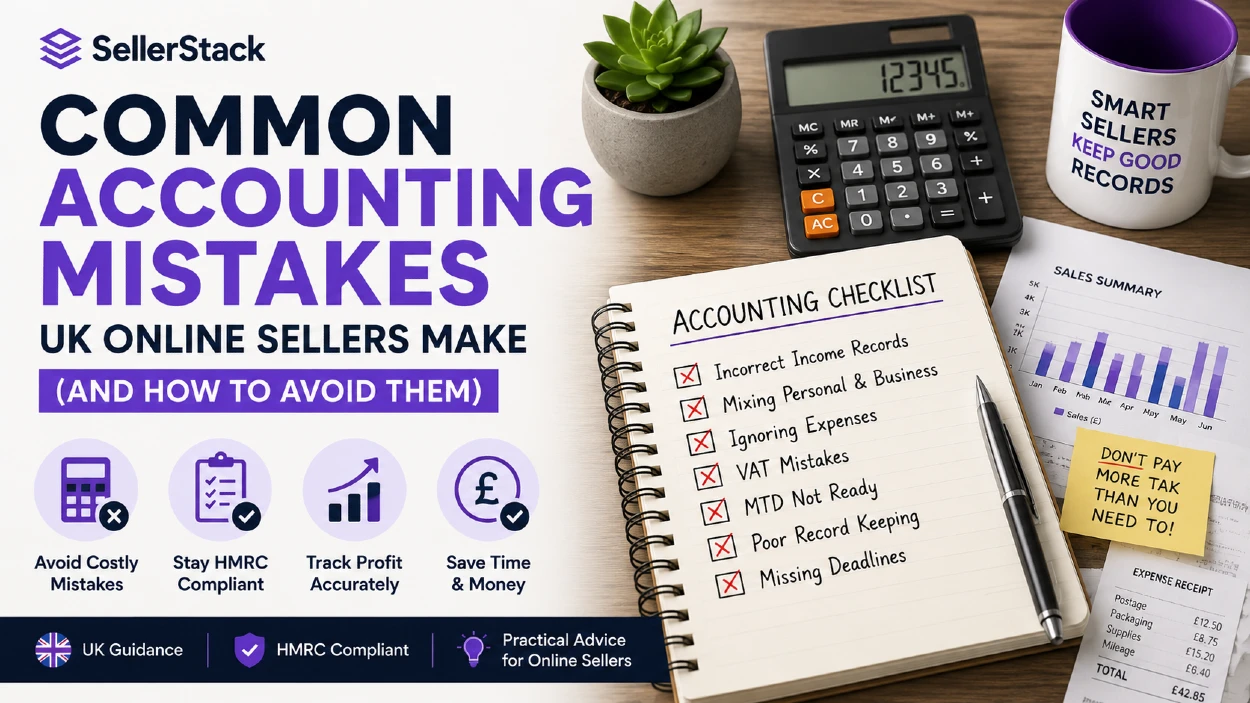
Selling £3,000 worth of products online doesn’t mean you’ve made £3,000 in profit — and the amount eBay, Amazon, Etsy or another marketplace transfers into your bank account doesn’t necessarily tell you how well your business is performing.
For UK online sellers, accurate bookkeeping means being able to separate sales income, marketplace fees, stock costs, postage, operating expenses and actual profit.
Those records become increasingly important as your selling activity grows. The £1,000 trading allowance, Self Assessment, Making Tax Digital for Income Tax and the £90,000 VAT registration threshold can all become relevant at different stages of a seller’s journey.
Marketplace reporting adds another reason to keep accurate records. Digital platforms may be required to collect and report certain seller and transaction information to HMRC under the UK’s digital platform reporting rules. That does not mean everyone selling unwanted possessions suddenly owes tax, but it does make it increasingly important for genuine traders to understand their numbers and maintain reliable records.
In this guide, we’ll break down seven common accounting mistakes UK online sellers make, explain how to avoid them and show you which figures are worth tracking as your reselling business grows.
What This Guide Covers
- Marketplace payouts vs sales income: Why the amount arriving in your bank account can be different from the sales figures you need for your bookkeeping.
- The £1,000 Trading Allowance: What the allowance actually applies to, why gross trading income matters and why £1,000 of sales does not mean £1,000 of profit.
- Allowable business expenses: Why missing stock invoices, postage receipts, packaging costs and marketplace charges can leave you with an inaccurate picture of your business finances.
- Personal vs business transactions: Why separating your selling activity from everyday personal spending can make bookkeeping and reconciliation considerably easier.
- Making Tax Digital: Which sole traders are being brought into MTD for Income Tax from April 2026, 2027 and 2028, and why digital record-keeping matters before you reach the relevant threshold.
- The VAT registration threshold: Why growing sellers need to monitor taxable turnover rather than waiting until the end of the tax year to check whether VAT registration may be required.
- Profit, cash flow and inventory: Why a profitable-looking reseller business can still run short of cash when too much money is tied up in unsold stock.
7 Accounting Mistakes UK Online Sellers Should Avoid
Good bookkeeping isn’t just about preparing a tax return. It helps you understand whether your reselling business is actually making money, how much cash is tied up in stock and whether you’re approaching important HMRC thresholds.
Here are seven mistakes worth watching for:
| Accounting mistake | Why it matters | Better approach |
|---|---|---|
| 1. Using marketplace payouts as your sales figure | Fees and other deductions can mean the amount deposited into your bank is lower than the underlying sale amount. | Record your sales and marketplace deductions separately. |
| 2. Misunderstanding the £1,000 Trading Allowance | The allowance relates to gross trading income, not simply your profit. | Track gross trading income across your selling activity. |
| 3. Missing allowable business expenses | Poor records can make it harder to calculate your taxable profit accurately. | Keep evidence of relevant stock, postage, packaging, fees and other business costs. |
| 4. Mixing personal and business transactions | Reconciliation becomes much harder when everything passes through the same account. | Keep your selling transactions clearly separated and categorised. |
| 5. Leaving MTD preparation too late | MTD for Income Tax is being introduced in phases for qualifying individuals. | Start maintaining reliable digital records before the rules apply to you. |
| 6. Not monitoring VAT turnover | VAT registration can depend on taxable turnover over a rolling period, not simply your year-end profit. | Monitor taxable turnover regularly as your business grows. |
| 7. Confusing profit with available cash | A business can be profitable on paper while large amounts of money remain tied up in stock. | Track profit, cash flow and inventory investment separately. |
A marketplace dashboard, bank balance and tax return answer different questions. Your marketplace tells you what sold, your bank tells you what cash moved, and your bookkeeping should show what the business actually earned and spent.
Three Numbers to Know
There are several important figures UK online sellers encounter, but they do not all measure the same thing.
Relates to annual gross trading income. If exceeded, you may need to register for Self Assessment. Don’t confuse this with profit.
Mandatory from 6 April 2026 for qualifying income over £50k. Threshold expands to £30k (2027) & £20k (2028).
Required when VAT-taxable turnover exceeds £90,000 over a rolling 12-month period or next 30 days.
Turnover Is Not Profit
A reseller could generate £40,000 in sales and make a much smaller profit after stock costs, marketplace fees, postage and other expenses. Revenue, profit and HMRC thresholds should be tracked as separate figures.
Check Your Position Before You Guess
Not sure whether your selling activity is approaching an important threshold?
Use the SellerStack HMRC Sales & Tax Threshold Checker to get a quick indication based on your trading figures, then verify your position against current HMRC guidance.
Check Your HMRC Thresholds →1. Confusing Marketplace Payouts With Sales Income
One of the easiest bookkeeping mistakes to make is treating the amount that arrives in your bank account as the value of your sales.
Those two figures can be different.
When you sell through a marketplace, the platform may deduct fees or other charges before transferring money to you. Depending on the marketplace and transaction, these could include selling fees, payment processing charges, advertising fees, fulfilment costs or other deductions.
That means a bank deposit tells you how much cash was paid out to you. It doesn’t necessarily give you a complete breakdown of the underlying transaction.
For accurate bookkeeping, sellers should be able to reconcile the original sale with the deductions associated with it rather than recording only the final marketplace payout.
A Simple Marketplace Sale
Imagine an item sells for £100, and the marketplace deducts £15 in applicable fees before paying you.
| Transaction | Amount |
|---|---|
| Customer sale | £100 |
| Marketplace fees | −£15 |
| Marketplace payout | £85 |
If you look only at your bank statement, you might see: £85 received
But the transaction records tell a fuller story: £100 sale → £15 marketplace deductions → £85 payout
And that still doesn’t tell you whether you made a profit.
Suppose the item originally cost £40, and you spent another £5 on postage and packaging:
| Profit calculation | Amount |
|---|---|
| Sales revenue | £100 |
| Marketplace fees | −£15 |
| Stock cost | −£40 |
| Postage & packaging | −£5 |
| Estimated profit | £40 |
So this one transaction produces three different figures:
- £100 sale
- £85 marketplace payout
- £40 estimated profit
They each describe something different.
Sales, payouts and profit are not interchangeable. Your sales records show what you sold. Marketplace statements show the fees and other deductions applied to those transactions. Your bank account shows the cash that actually moved. Your bookkeeping brings those records together so you can understand the financial performance of the business.
Why This Matters More When You Sell on Multiple Marketplaces
The problem becomes more noticeable when you’re selling simultaneously through eBay, Amazon, Etsy, Depop, Vinted or TikTok Shop.
Each marketplace can handle fees, shipping, refunds, advertising and payouts differently.
If you simply add together the deposits reaching your bank account, it becomes difficult to answer basic business questions such as:
- How much did I actually sell this month?
- How much did marketplace fees cost me?
- Which marketplace produced the strongest margins?
- How much did I spend fulfilling those orders?
- What was my actual profit?
- Do my bookkeeping records reconcile with my marketplace statements?
This is why marketplace statements and transaction reports should form part of your bookkeeping process rather than relying solely on bank deposits.
Are Marketplace Fees Hiding Your Real Profit?
A £100 sale can look attractive until you account for the stock cost, marketplace charges, packaging and shipping.
Use the SellerStack Reseller Profit Calculator to enter your selling price and costs and estimate your net profit, profit margin and marketplace fees before making a pricing decision.
Check Your HMRC Thresholds →Need marketplace-specific calculations? Use our dedicated eBay, Amazon FBA, Vinted, Etsy, Depop or TikTok Shop calculator for more detailed platform fee analysis.
Reconcile Each Marketplace
- Gross sales recorded by the marketplace
- Refunds and cancellations
- Marketplace and processing fees
- Advertising or promotional charges
- Shipping or fulfilment deductions
- Other marketplace adjustments
- Net payouts transferred to your bank
- Your own stock and operating costs
Decision rule: If you cannot confidently tick most of these boxes, pause before buying and carry out more research.
2. Misunderstanding the £1,000 Trading Allowance
The £1,000 trading allowance is one of the most misunderstood HMRC rules among new online sellers.
A common assumption is: “I only need to think about tax once I make more than £1,000 profit.”
That’s not what the £1,000 figure measures.
The trading allowance relates to your gross trading income before expenses. If you’re genuinely trading — for example, regularly buying products with the intention of reselling them for profit — the amount you need to monitor is the income generated by that trading activity.
Selling your own unwanted possessions is different. Simply receiving more than £1,000 through eBay, Vinted or another marketplace does not automatically mean you have a taxable trading business.
£1,000 of Sales Is Not £1,000 of Profit
Consider a reseller who buys stock specifically to resell:
| Example | Amount |
|---|---|
| Gross trading income | £1,500 |
| Stock purchases | −£700 |
| Marketplace fees | −£150 |
| Postage & packaging | −£200 |
| Illustrative profit before other costs | £450 |
The seller hasn’t made £1,500 profit. But their gross trading income is still £1,500, so they are above the £1,000 gross-income level relevant to the trading allowance.
Whether they ultimately owe Income Tax is a separate question and depends on their taxable profit and wider circumstances.
Three questions are being confused when sellers talk about the “£1,000 rule”:
- Are you actually trading? Selling your own unwanted possessions is not automatically the same as buying stock to resell for profit.
- What is your gross trading income? The £1,000 trading allowance is measured against gross trading income before expenses.
- How much taxable profit have you made? This is a different calculation again and helps determine the tax consequences of your trading activity.
Trading Allowance or Actual Expenses?
Once your circumstances require you to calculate your trading profits, another important decision can arise.
Broadly, you may be able to use the £1,000 trading allowance instead of deducting your actual allowable business expenses. You generally cannot use the trading allowance against the same trading income and also deduct those actual expenses.
That distinction can matter considerably for resellers because stock and fulfilment costs can be substantial.
Example A — Relatively Low Expenses
Suppose a seller has: Gross trading income: £6,000 | Actual allowable expenses: £700.
Using the £1,000 trading allowance may produce a lower amount for the relevant profit calculation than deducting only £700 of actual expenses, subject to the seller’s circumstances.
Example B — Higher Expenses
Now suppose another seller has: Gross trading income: £6,000 | Actual allowable expenses: £3,000.
Using actual allowable expenses may be more advantageous than substituting the £1,000 allowance.
Not necessarily. Crossing £1,000 of gross trading income can affect your reporting and Self Assessment position, but it doesn’t mean £1,000 is a tax-free profit threshold or that every pound above it is automatically taxed.
Keep the £1,000 Rule Straight
Before making a decision based on the trading allowance, ask:
- Am I trading, or primarily selling my own unwanted belongings?
- What is my gross trading income for the tax year?
- Have I kept records of my actual business expenses?
- Would the trading allowance or actual allowable expenses be more appropriate?
- Do I need to register for Self Assessment?
- Have I checked the latest HMRC guidance rather than relying on marketplace or social media advice?
3. Failing to Track Allowable Business Expenses
Tracking sales is only half of good bookkeeping.
If you’re running a reselling business, money also leaves the business every time you source stock, dispatch an order, pay a marketplace charge, advertise a listing or use software to manage your operation.
UK Reseller Expense Checklist
Depending on your business and circumstances, costs worth recording can include:
| Expense category | Examples for online sellers |
|---|---|
| Stock & inventory | Products purchased specifically for resale, wholesale orders and sourcing purchases |
| Marketplace charges | Selling fees, referral fees and other applicable platform charges |
| Payment charges | Applicable transaction and payment-processing fees |
| Postage & delivery | Royal Mail, Evri and other delivery or courier costs |
| Packaging | Mailing bags, boxes, tape, labels and protective packaging |
| Advertising | Promoted listings and other business advertising costs |
| Seller software | Inventory, bookkeeping, research and listing software used for the business |
| Business equipment | Relevant equipment used for selling, subject to the appropriate tax treatment |
| Travel | Eligible business journeys and associated costs, where HMRC’s rules are met |
| Working from home | Eligible business-use costs or applicable simplified expenses |
| Professional costs | Certain accounting and other professional fees relating to the business |
Don’t Forget the Small Costs
Sellers naturally remember large stock purchases. It’s the smaller recurring costs that are easier to lose.
Imagine you dispatch 150 orders during a period and spend an average of only 45p per order on mailing bags, tape, labels and other packaging. That’s: 150 × £0.45 = £67.50
A £3 sourcing purchase that sells for £15 might initially look excellent. But your real commercial calculation could look more like:
| Cost | Amount |
|---|---|
| Stock purchase | £3.00 |
| Marketplace fees | £2.00 |
| Postage | £3.20 |
| Packaging | £0.40 |
| Other attributable selling costs | £0.40 |
| Total costs | £9.00 |
| Selling price | £15.00 |
| Illustrative profit | £6.00 |
A cost doesn’t become unimportant because it’s small. A few pence of packaging or an occasional listing charge may look insignificant on one order. Multiplied across hundreds or thousands of transactions, those costs can materially change your annual profit.
Your tax records tell you about the business as a whole. Your sourcing records should also help you answer: Was this individual item actually worth buying? Where practical, record the item’s: purchase cost → selling price → marketplace fees → postage → packaging → other direct selling costs → estimated profit.
4. Mixing Personal and Business Transactions
When you’re starting as a reseller, it’s easy for everything to pass through the same bank account. You buy £40 of stock on Saturday, receive an eBay payout on Monday, pay for an Evri label on Tuesday and then use the same account for groceries later that evening.
For a sole trader, using a separate bank account can make bookkeeping significantly easier — even where a separate business account is not legally required for your circumstances.
A separate account doesn’t make an expense allowable — it makes the financial trail easier to follow. You still need appropriate records and must determine whether a cost genuinely relates to the business. The advantage is that your business transactions aren’t buried among everyday personal spending.
Keep Business Money Organised
- Consider using a dedicated account for business transactions.
- Direct marketplace payouts into the same account where practical.
- Pay business expenses from that account consistently.
- Keep receipts and invoices rather than relying on the bank statement alone.
- Add notes or categories to transactions that might be unclear later.
- Reconcile marketplace statements against bank deposits regularly.
- Record any money you personally introduce into or withdraw from the business appropriately.
5. Failing to Prepare for Making Tax Digital (MTD)
Making Tax Digital for Income Tax is no longer something UK sellers can treat as a distant future change. The first mandatory phase began on 6 April 2026 for qualifying sole traders and landlords.
For online sellers operating as sole traders, the important point is that MTD eligibility is based on qualifying income, not your net profit.
The MTD Rollout Timeline
Qualifying income over £50,000. Required from 6 April 2026.
Qualifying income over £30,000. Required from 6 April 2027.
Qualifying income over £20,000. Required from 6 April 2028.
Get MTD-Ready
- Know whether you operate as a sole trader for Self Assessment purposes.
- Understand what HMRC includes in qualifying income.
- Check the appropriate previous tax return when determining when MTD applies.
- Include relevant property income when calculating qualifying income.
- Maintain organised records of sales and business expenses.
- Use, or investigate, MTD-compatible software.
6. Not Monitoring the VAT Registration Threshold
For many resellers, VAT feels like something only large businesses need to think about.
But a fast-growing online business can approach the VAT registration threshold sooner than expected — particularly if you sell high-value products or operate across several marketplaces.
The key figure is VAT-taxable turnover, not your profit.
The current compulsory VAT registration threshold is £90,000. In general, you must register if either:
- Your total VAT-taxable turnover for the last 12 months exceeds £90,000; or
- You expect your VAT-taxable turnover to exceed £90,000 in the next 30 days alone.
These are two separate tests. That makes VAT different from a threshold you simply check once at the end of the tax year.
The Rolling 12-Month VAT Trap
One of the easiest mistakes is thinking: “I haven’t sold £90,000 this tax year, so VAT isn’t relevant yet.”
The standard historic VAT test looks at a rolling 12-month period, not simply 6 April to 5 April.
Imagine your VAT-taxable turnover develops like this:
| Period | VAT-taxable turnover |
|---|---|
| September–December | £24,000 |
| January–April | £27,000 |
| May–August | £41,000 |
| Rolling 12-month total | £92,000 |
Your annual accounting period isn’t the important point in this example. The rolling total has crossed £90,000, which means you need to consider the VAT registration rules and applicable deadline.
VAT registration is driven by turnover, not profit. A reseller could generate £92,000 of VAT-taxable turnover while retaining a much smaller amount after stock, marketplace fees, postage, advertising and other costs. A low profit margin does not by itself keep a business below the VAT registration threshold.
The Second VAT Test Sellers Can Miss
There’s another rule that’s particularly important for businesses expecting a sudden increase in sales.
If at any point you expect your VAT-taxable turnover to exceed £90,000 during the next 30 days alone, you generally need to register for VAT.
HMRC treats this differently from gradually exceeding £90,000 over the previous 12 months.
For example, this could become relevant if a reseller secures a large wholesale opportunity, receives a substantial business order or expects an unusually large short-term increase in taxable sales.
So monitoring VAT shouldn’t simply mean: “Check turnover once every April.” It should become part of your regular financial review as the business approaches the threshold.
Suppose your marketplace reports customer sales of £10,000, and after applicable marketplace charges and other deductions, your bank payout is £8,600.
You should not automatically use that £8,600 bank deposit as your VAT-turnover figure. Marketplace deductions don’t simply reduce turnover to whatever cash eventually lands in your account. This is another reason why the distinction covered in Mistake #1 (Marketplace Payouts vs Sales Income) becomes increasingly important as your business scales.
What Happens When You Approach £90,000?
Don’t wait until you’ve crossed the threshold before thinking about the commercial consequences of VAT. A growing reseller should start considering:
- Pricing: Can your current margins absorb VAT where applicable?
- Marketplace fees: How does VAT registration interact with the charges you’re paying?
- Record keeping: Are your sales and purchase records sufficiently organised?
- Cash flow: Are you keeping money aside for liabilities rather than treating every marketplace payout as spendable cash?
- Software: Can your bookkeeping/accounting system handle VAT records appropriately?
- Professional advice: Has your business become complex enough that an accountant or tax adviser would be worthwhile?
This is particularly important for low-margin reselling models where a relatively small change in the economics of each transaction can materially affect profitability.
See the VAT Effect Before Changing Your Prices
Use the SellerStack UK VAT Calculator to calculate VAT-inclusive and VAT-exclusive amounts and understand how VAT changes the numbers behind a sale.
Calculate UK VAT →Important: The SellerStack VAT Calculator performs VAT calculations; it does not determine whether your business is legally required to register for VAT or which VAT treatment applies to a particular product or transaction.
SellerStack Checklist: Monitor Your VAT Position
- Track VAT-taxable turnover, rather than profit alone.
- Review your rolling 12-month total regularly.
- Don’t rely solely on marketplace payouts or bank deposits.
- Remember the separate next-30-days test.
- Keep sales and purchase records organised.
- Review how VAT registration could affect your pricing and margins.
- Check whether any of your sales require different VAT treatment.
- Investigate VAT-compatible accounting processes before registration becomes urgent.
- Check current HMRC guidance when approaching the threshold.
- Consider professional advice if your VAT position becomes complex.
Don’t Confuse the Three Big Seller Thresholds
At this point in the guide, readers have encountered three very different figures:
| Threshold | Primarily relates to | Don’t confuse it with |
|---|---|---|
| £1,000 | Trading allowance / gross trading income | £1,000 profit |
| £50,000 / £30,000 / £20,000 | Phased MTD for Income Tax qualifying-income thresholds | Net reseller profit |
| £90,000 | VAT registration / VAT-taxable turnover | £90,000 profit |
These figures answer different questions and shouldn’t be used interchangeably. That is one of the main reasons good bookkeeping becomes increasingly valuable as a reseller moves from a side hustle into a substantial business.
7. Confusing Profit, Cash Flow and Money Tied Up in Stock
A reseller can be profitable on paper and still feel as though there is never enough money in the bank.
That isn’t necessarily an accounting error. Often, the problem is that profit, cash flow and inventory investment are being treated as though they mean the same thing.
They don’t.
For product-based businesses, cash is constantly moving through a cycle: Cash → Stock → Sale → Marketplace Payout → Cash
The longer your money remains tied up in unsold inventory, the longer it takes to become available for sourcing, postage, bills or other business needs.
Profit and Cash Flow Tell You Different Things
Imagine a reseller starts the month with £2,000 available cash. During the month they:
- Spend £1,200 sourcing inventory;
- Sell products that originally cost £500;
- Generate £1,400 in sales; and
- Incur £250 of marketplace, postage and other selling costs.
Looking only at the products sold, the month may appear profitable. But a large proportion of the reseller’s original cash is now sitting in inventory that hasn’t sold yet.
That can create a situation where the business has made sales and generated profit but has less immediately available cash than the owner expected.
Profit tells you whether your selling activity is financially worthwhile. Cash flow tells you whether the business has enough money available when it needs it. For resellers, inventory connects the two because every unsold product represents money that has been committed but hasn’t yet returned through a sale.
The Hidden Cost of Dead Stock
Buying an item for £10 and eventually selling it for £30 might look like a successful sourcing decision. But how long did it take to sell?
| Metric | Product A | Product B |
|---|---|---|
| Purchase cost | £10 | £10 |
| Selling price | £30 | £30 |
| Illustrative profit after selling costs | £12 | £12 |
| Time to sell | 10 days | 10 months |
On the surface, both generated the same £12 profit. Operationally, however, they behaved very differently.
Product A returned your original capital plus profit quickly, allowing that money to potentially be reinvested into more inventory. Product B tied up the same £10 for almost a year.
Multiply that across hundreds of slow-moving products and a reseller can have substantial amounts of working capital sitting on shelves, in storage boxes or in an Amazon fulfilment centre.
The potential selling value of your inventory is not the same as having £5,000 available in cash. Stock still has to sell → survive refunds/returns → incur applicable selling costs → generate a payout.
And some inventory may eventually require discounting, bundling or another exit strategy. This is why ambitious resellers shouldn’t judge the health of their business purely by the total listing value shown in their inventory.
ROI Matters — But So Does Speed
SellerStack uses Return on Investment (ROI) as one useful sourcing metric. A simplified commercial ROI calculation can help you compare the profit generated with the money invested in an item.
For example: Item cost: £5 | Estimated profit: £15
A simple ROI calculation based on the original item cost would be: (£15 ÷ £5) × 100 = 300% ROI
That looks excellent. But ROI alone still doesn’t tell you how quickly the item sells.
A 300% ROI item that takes two years to move may be less attractive to some businesses than a lower-ROI product that sells repeatedly every few weeks. That’s why sourcing decisions become stronger when you consider several measures together:
Profit + Margin + ROI + Sell-through speed + Capital required
Is That Product Actually Worth Buying?
Before committing more money to inventory, use the SellerStack ROI Calculator to compare the potential return against your sourcing cost.
For charity-shop inventory, you can also use the dedicated Charity Shop ROI Calculator to test a sourcing opportunity before you buy.
Calculate My ROI →Watch Your Inventory Investment
As your operation grows, it becomes useful to know approximately how much money you currently have committed to stock. For example:
| Business snapshot | Amount |
|---|---|
| Cash available | £3,200 |
| Cost invested in unsold inventory | £6,500 |
| Marketplace balances awaiting payout | £850 |
| Upcoming business costs | £1,100 |
That tells you considerably more about the position of the business than simply saying: “I have £18,000 worth of items listed.”
The £18,000 may represent potential future sales. The other figures tell you much more about the capital currently available and committed.
SellerStack Checklist: Monitor More Than Sales
Alongside your accounting records, consider monitoring:
- Sales revenue
- Estimated net profit
- Profit margin
- ROI on sourced inventory
- Cash available
- Cost invested in unsold stock
- Marketplace balances awaiting payout
- Upcoming business expenses
- Stock age
- Sell-through rate
- Refunds and returns
- Slow-moving or dead inventory
You don’t necessarily need sophisticated software to start doing this. A consistent spreadsheet or bookkeeping/inventory system that you actually maintain is far more useful than an elaborate dashboard filled with outdated figures.
The Bigger Lesson
Good accounting tells you what happened financially. Good business management uses those numbers to decide what to do next.
If one sourcing category produces excellent margins but takes nine months to sell, while another generates slightly lower margins but turns inventory every few weeks, those numbers can influence where you put your next £500 of sourcing capital. That’s where bookkeeping stops being something you do purely for HMRC and becomes a decision-making system for your reseller business.
The objective isn’t simply to sell more. It’s to put your capital into inventory that produces an appropriate return within an appropriate amount of time. Revenue can make a reseller business look busy. Profit, cash flow, ROI and stock movement tell you whether that activity is actually creating a stronger business.
What UK Online Sellers Should Track Every Month
Good bookkeeping becomes much easier when you stop treating it as an annual tax-return exercise.
A simple monthly review can help you understand what you sold, what it cost, what you actually made, how much cash is available and whether your business is approaching an important threshold.
You don’t necessarily need a complicated financial dashboard. What matters is consistently tracking the right numbers.
Your SellerStack Monthly Financial Dashboard
| What to track | What it tells you |
|---|---|
| Gross sales | The value of your marketplace trading activity before relevant deductions |
| Refunds & cancellations | How much revenue was reversed during the period |
| Marketplace fees | What eBay, Amazon, Etsy and other platforms are costing you |
| Advertising & promotion | Spend on promoted listings, boosts and other paid marketplace visibility |
| Stock purchases | How much capital you’re putting into new inventory |
| Postage & fulfilment | What you’re spending to get orders to customers |
| Packaging | Boxes, mailers, tape, labels and other dispatch materials |
| Software & subscriptions | Recurring costs associated with running the business |
| Other business expenses | Other relevant operating costs recorded during the month |
| Marketplace payouts | Cash actually transferred from marketplaces |
| Estimated profit | What remains after the relevant costs of operating the business |
| Cash available | Money currently available to meet business needs |
| Unsold inventory at cost | How much capital remains committed to stock |
| VAT-taxable turnover | Helps growing businesses monitor their VAT position |
| MTD qualifying income | Helps you understand when MTD for Income Tax may become relevant |
You don’t need every number to make every decision. Your sourcing decisions may depend heavily on ROI and sell-through speed. Your tax records need accurate income and expense information. Your cash-flow decisions depend on available cash and upcoming commitments. The purpose of a dashboard is to put those different views of the business in one place.
A Simple 30-Minute Monthly Bookkeeping Routine
For a smaller reseller business, a structured monthly review could look like this:
-
Download Your Marketplace Reports
Collect the relevant transaction or sales reports from every marketplace you used during the month (eBay, Amazon, Vinted, Depop, Etsy, TikTok Shop). Don’t rely exclusively on the deposits appearing in your bank account. -
Reconcile Your Marketplace Payouts
Compare marketplace records with the money actually transferred to your bank. Check for fees, refunds, shipping deductions, advertising charges, adjustments and amounts still awaiting payout. If the figures don’t reconcile, investigate the difference while the transactions are still recent. -
Record Your Business Expenses
Enter relevant costs incurred during the month, including stock purchases, postage, packaging, software and other business expenditure. Attach or retain the corresponding receipts, invoices or digital records. -
Review Your Profitability
Don’t stop once the bookkeeping balances. Ask: Which marketplace generated the strongest margins? Which products produced the best returns? Are postage or marketplace fees increasing? Did I buy considerably more stock than I sold? Are promoted listings actually producing worthwhile results? This turns bookkeeping data into business intelligence. -
Review Your Inventory
Look for stock that has remained unsold longer than expected. You might decide to reprice it, improve the listing, move it to another marketplace, bundle it, discount it, or stop sourcing similar products. The objective is to prevent too much working capital becoming trapped in inventory that isn’t moving. -
Check Relevant HMRC Thresholds
As the business grows, review the figures relevant to your circumstances rather than waiting until year-end. That could include your gross trading income, MTD qualifying income, and rolling VAT-taxable turnover. Remember that these measures have different definitions and purposes. -
Save a Monthly Snapshot
Once everything has been reconciled, save or export the month’s records. A consistent sequence (January → February → March → April) is much easier to work with later than trying to reconstruct an entire tax year from marketplace dashboards, emails and bank statements.
SellerStack Monthly Checklist
Before closing your books for the month, check:
- Marketplace sales recorded
- Refunds and cancellations reconciled
- Marketplace fees recorded
- Advertising costs recorded
- Stock purchases entered
- Postage and packaging recorded
- Software and other expenses recorded
- Receipts and invoices saved
- Marketplace payouts reconciled with the bank
- Profit and margins reviewed
- Unsold inventory reviewed
- Cash position checked
- Relevant HMRC thresholds reviewed
- Monthly records backed up
Turn Your Numbers Into Decisions
Once your records are organised, SellerStack’s tools can help you interrogate individual parts of the business.
- Profit & Margin: Use the Reseller Profit Calculator to test whether an item remains profitable after selling costs.
- Marketplace Fees: Use the dedicated eBay, Amazon FBA, Vinted, Etsy, Depop and TikTok Shop calculators for platform-specific estimates.
- Marketplace Choice: Use the UK Marketplace Profit Comparison Calculator to compare how the same product could perform across marketplaces.
- ROI: Use the ROI Calculator when evaluating the return on sourcing capital.
- VAT: Use the UK VAT Calculator when you need to calculate VAT-inclusive or VAT-exclusive figures.
- HMRC Thresholds: Use the HMRC Sales & Tax Threshold Checker for a quick indication of which major thresholds may be relevant.
- Shipping: Use the UK Shipping Cost Comparison Calculator and Parcel Size Checker when reviewing fulfilment costs.
Explore SellerStack Tools
Instead of jumping between spreadsheets and rough calculations, explore the complete SellerStack Tools & Calculators library for profit, fees, sourcing, shipping, VAT and seller operations.
View All SellerStack Tools →Accounting Mistakes at a Glance
Good bookkeeping isn’t about creating more administration for your reseller business. It’s about making sure the numbers you use for tax, pricing, sourcing and business decisions actually reflect what is happening.
Here are the seven mistakes we’ve covered and the habits that help prevent them.
| Common mistake | What can go wrong | Better SellerStack habit |
|---|---|---|
| 1. Using marketplace payouts as sales income | Fees and deductions can obscure the underlying sales activity. | Record sales and marketplace deductions separately and reconcile them with payouts. |
| 2. Misunderstanding the £1,000 Trading Allowance | Sellers confuse gross trading income with profit or assume crossing £1,000 automatically means tax is due. | Track gross trading income and understand whether the trading allowance or actual expenses applies to your circumstances. |
| 3. Missing allowable business expenses | Poor records can distort profit calculations and make legitimate costs difficult to substantiate. | Record relevant expenses and retain supporting receipts, invoices and statements. |
| 4. Mixing personal and business transactions | Reconciliation becomes unnecessarily difficult. | Keep business activity clearly separated and categorised wherever practical. |
| 5. Ignoring Making Tax Digital | Growing sellers may be unprepared when MTD for Income Tax becomes mandatory for them. | Maintain organised digital records and monitor your qualifying income. |
| 6. Not monitoring VAT turnover | A business can cross the VAT registration threshold without noticing if it only reviews figures annually. | Monitor VAT-taxable turnover on a rolling basis as the business grows. |
| 7. Confusing profit with cash flow | Too much capital can become tied up in slow-moving inventory even while the business appears profitable. | Monitor profit, cash, inventory investment, ROI and stock movement separately. |
The biggest accounting mistake may be looking at only one number. Revenue tells you how much you’re selling. Profit tells you what remains after relevant costs. Cash flow tells you how money is moving through the business. ROI helps evaluate your sourcing capital, while turnover can determine when certain HMRC obligations become relevant. A stronger reseller business understands how those numbers work together.
SellerStack Verdict
You don’t need to become an accountant to run a successful online selling business.
But once you’re regularly buying stock to resell, managing multiple marketplaces or increasing your turnover, accurate financial records become part of running the business properly.
Start with the fundamentals:
- Record what you sell: Don’t rely solely on marketplace payouts.
- Record what you spend: Keep evidence of relevant stock purchases, fees, postage, packaging and other business costs.
- Reconcile regularly: Make sure marketplace reports, bookkeeping records and bank transactions make sense together.
- Know your thresholds: Understand the difference between the £1,000 trading allowance, MTD qualifying-income thresholds and the £90,000 VAT registration threshold.
- Track business performance as well as tax records: Profit, margin, ROI, cash flow and inventory movement can tell you things a tax return never will.
Most importantly, don’t wait until the end of the tax year to discover whether your numbers make sense.
A 30-minute monthly bookkeeping routine can make it easier to spot rising costs, weak margins, slow-moving inventory and approaching compliance thresholds while you still have time to act.
Treat bookkeeping as a business tool, not just a tax obligation. The objective isn’t simply to produce figures for HMRC. Good records should help you understand where your money is going, which products are actually profitable and where your working capital is producing the strongest return. The sellers who understand their numbers are better equipped to make informed decisions about sourcing, pricing, marketplaces and growth.
Recommended Free SellerStack Resource
Make Better Buying Decisions
The difference between profitable resellers and struggling sellers isn't luck—it's having a repeatable system. Download our FREE UK Reseller Profit Toolkit and start making more confident sourcing decisions today.
- Profit & ROI worksheets
- Marketplace fee cheat sheets
- Pricing checklist
- Sourcing checklist
- Shipping cost guide
Free instant download. No spam. Unsubscribe at any time.
Common UK Online Seller Accounting Questions
Do I need to pay tax if I sell more than £1,000 on eBay, Vinted or another marketplace?
Not automatically.
The £1,000 trading allowance relates to gross income from trading. The first question is whether your activity amounts to trading in the first place. Selling your own unwanted possessions is not automatically the same as trading. If you’re regularly buying or making products with the intention of selling them for profit, however, your activity is more likely to be relevant to the trading rules.
If your gross trading income exceeds £1,000 in a tax year, you will generally need to tell HMRC, although the amount of Income Tax you ultimately owe depends on your taxable profit, other income, allowances and individual circumstances.
The important distinction is: £1,000 gross trading income ≠ £1,000 profit ≠ £1,000 tax bill.
For a deeper explanation, see our HMRC “Side Hustle Tax” guide for UK sellers.
Does HMRC know how much I sell on eBay, Vinted and other marketplaces?
Digital platform operators can be required to collect information about sellers and report specified information to HMRC under the UK’s digital platform reporting rules.
This is one reason sellers should maintain their own accurate records rather than relying exclusively on marketplace payouts or bank deposits.
Platform reporting does not create a new tax simply because information is sent to HMRC, nor does it mean everyone selling personal possessions online is operating a taxable business. Your tax position still depends on the nature of your activity and the relevant UK tax rules.
Can I claim stock bought from charity shops as a business expense?
If you’re trading and purchase items specifically as stock for your resale business, the cost of that stock may be relevant when calculating your business profits, subject to the accounting and tax rules that apply to you.
Keep appropriate evidence of the purchase wherever possible. For physical purchases, retain the receipt and consider photographing or scanning it because thermal receipts can fade over time.
Don’t rely solely on a bank transaction showing that money was spent at a charity shop — that transaction alone may not explain what was purchased or why it related to your business.
Do sole traders need a separate business bank account?
Operating as a sole trader does not, by itself, generally create the same legal separation between you and the business that exists with a limited company.
However, using a dedicated account for your selling activity can make bookkeeping considerably easier. It can help you separate marketplace payouts, stock purchases, postage, software and other business transactions from groceries, household bills and everyday personal spending.
A separate account doesn’t make an expense automatically allowable. It simply creates a cleaner financial trail.
Do online sellers have to use Making Tax Digital in 2026?
Not every online seller.
MTD for Income Tax became mandatory from 6 April 2026 for qualifying individuals with qualifying income above £50,000, based on the relevant earlier tax return. The rollout then expands to qualifying income above £30,000 from April 2027 and £20,000 from April 2028.
Qualifying income has a specific HMRC definition and can include combined gross income from self-employment and property, so don’t use your reseller net profit as the threshold test.
When does an online seller need to register for VAT?
The standard compulsory VAT registration threshold is currently £90,000 of VAT-taxable turnover.
In general, registration is required when your VAT-taxable turnover exceeds £90,000 over the previous 12 months, or when you expect it to exceed £90,000 during the next 30 days alone.
VAT-taxable turnover is not the same as profit, and the rolling 12-month test means a growing seller should monitor the figure regularly rather than checking it only at the end of each tax year.
Use the SellerStack UK VAT Calculator when you need to calculate VAT-inclusive or VAT-exclusive amounts, but check HMRC guidance or seek professional advice when determining whether registration is required.
How long should online sellers keep their accounting records?
If you’re self-employed, HMRC generally requires you to retain the records used to complete your Self Assessment tax return for at least five years after the 31 January submission deadline for the relevant tax year.
Your records may include sales information, business expenses, receipts, invoices, marketplace statements and other evidence supporting the figures reported.
Different circumstances can result in different requirements, so check HMRC’s current record-keeping guidance if you’re unsure.
Compare Fees Before Choosing Where to Sell
Estimate marketplace costs and analyse your expected profit across the UK's major platforms.
UK Marketplace Profit Comparison Calculator
Enter one product scenario and compare estimated fees, profit, margin and ROI across eBay, Amazon FBA, Etsy, TikTok Shop, Vinted and Depop.
Related SellerStack Guides & Tools
HMRC & Compliance
HMRC “Side Hustle Tax” 2026: What Vinted & eBay Sellers Need to Know — Understand when online selling may become trading and what the £1,000 allowance actually means.
Marketplace Profitability
Reseller Profit Calculator — Calculate estimated profit after stock costs, marketplace fees, packaging and shipping.
Tax Tools
HMRC Sales & Tax Threshold Checker — Check which major seller thresholds may be relevant to your current trading figures.
UK VAT Calculator — Calculate VAT-inclusive and VAT-exclusive prices.
Business Performance
ROI Calculator — Measure the potential return on the money you’re investing in resale inventory.
Seller Operations
UK Shipping Cost Comparison Calculator — Compare fulfilment costs when reviewing the true cost of selling an item.