SELLERSTACK EBAY GUIDE · UPDATED FOR 2026
Best Items to Sell on eBay UK
Discover what makes an item worth reselling, which categories are worth researching and how to use real eBay sales data before committing money to stock.
eBay UK Reselling & Product Research Guide
Demand, competition, selling prices, marketplace fees and buyer trends can change. This guide focuses on categories and sourcing principles rather than presenting individual products as guaranteed winners.
Last reviewed: October 2026
What Are the Best Items to Sell on eBay UK?
There is no permanent list of products that will always be the most profitable.
Strong eBay resale opportunities usually combine:
- Proven buyer demand
- A realistic selling price
- A sourcing price that leaves enough profit
- Manageable competition
- Reasonable selling speed
- Low enough shipping and return risk
- Products you can identify and describe accurately
Categories worth researching include branded clothing and footwear, consumer electronics, replacement parts, collectables, cameras, gaming, tools, home and appliance spares and vehicle parts.
The product is only worth buying when the individual deal makes financial sense.
What Actually Makes an Item Good for Reselling?
Beginners often ask which product they should buy.
A better question is:
What characteristics make this particular item worth buying at this particular price?
Two sellers can source exactly the same product and achieve completely different results because one bought it for £10 and the other paid £35.
Healthy Resale Characteristics
- Regular evidence of sales
- Predictable sold-price range
- Enough margin after all costs
- Easy product identification
- Simple storage and fulfilment
- Manageable return risk
Warning Signs
- Lots of listings but very few sales
- Highly unstable prices
- Expensive or awkward shipping
- High counterfeit risk
- Uncertain condition or functionality
- Very little profit after costs
The 7 Factors to Check Before Buying Stock
1. Demand
Are buyers actually purchasing comparable items, or are you only seeing large numbers of active listings?
2. Realistic Selling Price
Base your estimate on genuine comparable sales, not the highest optimistic asking price currently visible.
3. Purchase Price
Your buying price determines how much room remains for profit, unexpected costs and future price reductions.
4. Selling Costs
Account for marketplace charges where applicable, promoted listings, packaging, postage, payment or currency costs and other business expenses.
5. Selling Speed
£20 earned quickly may sometimes be more useful than £30 trapped in stock for twelve months.
6. Risk
Consider returns, authenticity, faults, fitment, compatibility, damage and changing buyer demand.
7. Operational Difficulty
Large, fragile or complicated products may generate more work than their headline margin suggests.
Use eBay Product Research Before You Buy
One of the strongest advantages eBay sellers have is access to marketplace sales data.
eBay Product Research can help you investigate:
- Sales trends
- Average sold prices
- Sold-price ranges
- Postage costs
- Sell-through rate for applicable recent searches
- How many sellers have sold the product
- Which selling formats are being used
Search the Exact Variation
Do not research “Nike trainers” when you are considering buying a specific Air Max model in a particular size.
The closer your research matches the exact product, condition and variation, the more useful the evidence becomes.
Check Real Marketplace Data
Use eBay Product Research in Seller Hub to investigate recent sales, pricing, competition and demand before sourcing stock.
Do Not Confuse Listings With Demand
Seeing hundreds of an item listed on eBay does not prove that buyers want it.
Active listings show supply.
Sold listings show transactions.
You need both sides of the market before deciding whether a category looks attractive.
Simple Sell-Through Concept
Items Sold ÷ Comparable Available Supply × 100
Treat sell-through as a comparison tool rather than a magic pass/fail percentage.
Different products naturally sell at different speeds, and a slower specialist item may still be worthwhile when the margin is strong and your capital requirement is low.
Best Categories to Research for eBay UK Reselling
The following categories can produce good opportunities, but none should be bought blindly.
Branded Clothing & Footwear
Fashion remains attractive to resellers because stock can often be sourced locally, stored relatively easily and researched using recognisable brands, models and styles.
Worth Researching
- Recognisable sportswear brands
- Specific trainer models
- Quality outdoor clothing
- Workwear and heritage brands
- Vintage sportswear
- Designer clothing and accessories
- Discontinued or desirable styles
Why It Can Work
- Large buyer audience
- Many local sourcing options
- Recognisable models and brands
- Usually straightforward storage
Main Risks
- Counterfeit products
- Incorrect sizing
- Condition disputes
- Fashion trends changing
- Heavy competition on common items
Higher-value branded fashion may be covered by eBay’s Authenticity Guarantee when the item, brand, category and selling price meet the current eligibility requirements.
Never assume a branded item is genuine purely because the source describes it that way.
Consumer Electronics
Electronics can offer strong average selling prices and clear model-based research.
Worth Researching
- Smartphones
- Tablets
- Smartwatches
- Headphones
- Games consoles
- Networking equipment
- Quality computer components
Why It Can Work
- Exact models are easy to research
- Often strong buyer demand
- Higher potential selling prices
- Large second-hand market
Main Risks
- Hidden faults
- Battery degradation
- Activation or account locks
- Missing accessories
- Higher return exposure
- Fast depreciation
Test every function you can reasonably test and describe faults clearly. A high selling price does not automatically mean a high-quality resale opportunity.
Replacement Parts & Appliance Spares
Replacement parts can be attractive because buyers often search for a very specific component rather than browsing casually.
Worth Researching
- Vacuum cleaner attachments
- Filters and covers
- Appliance trays and racks
- Replacement knobs and controls
- Power supplies and adapters
- Remote controls
- Discontinued components
A buyer replacing one missing component may care far more about exact compatibility than the age of the product.
Accurate model and part numbers are therefore especially valuable in this category.
Collectables, Toys & Hobby Items
Knowledge can create a genuine advantage in collectable niches because small differences in edition, year, condition or completeness can significantly affect value.
Worth Researching
- Trading cards
- Vintage toys
- LEGO sets and parts
- Action figures
- Model vehicles
- Board-game components
- Film, music and sports memorabilia
Do not assume something is valuable because it is old, discontinued or described as rare.
Verify exact editions and actual sold prices before paying a premium.
Cameras, Lenses & Photography Equipment
Photography equipment is another category where exact model identification makes research relatively straightforward.
Worth Researching
- Interchangeable lenses
- Digital camera bodies
- Vintage film cameras
- Flash equipment
- Tripod heads and specialist accessories
- Battery grips
- OEM chargers and accessories
Condition matters heavily. Check lenses for haze, fungus, scratches and autofocus issues, and test camera functions where possible.
Gaming & Older Media
Gaming can contain both fast-moving mainstream stock and much more specialist collectable items.
Worth Researching
- Games consoles
- Controllers
- First-party accessories
- Retro games
- Limited editions
- Older handheld systems
- Boxed or complete-in-box items
Common games can have very low resale values, so research each title rather than assuming all older media is collectable.
Tools & DIY Equipment
Quality tools can retain resale value because buyers may prefer a proven used professional product to a cheaper new alternative.
Worth Researching
- Cordless power tools
- Bare tools without batteries
- Chargers
- Professional hand tools
- Workshop equipment
- Specialist measuring tools
- Tool storage systems
Battery ecosystem, model number and working condition are often crucial to value.
Vehicle Parts & Accessories
Vehicle parts can be a strong specialist category because buyers frequently search by exact make, model, part number and compatibility.
Worth Researching
- Genuine OEM trim pieces
- Lights and switches
- Mirrors and interior fittings
- Control modules where appropriate
- Discontinued parts
- Model-specific accessories
- Workshop and diagnostic accessories
Do Not Guess Vehicle Fitment
Use accurate manufacturer part numbers and eBay’s vehicle compatibility fields where available.
Incorrect fitment information creates avoidable returns and unhappy buyers.
Home, Garden & Small Specialist Equipment
The strongest opportunities in Home & Garden are often more specific than generic household goods.
Worth Researching
- Replacement garden-tool components
- Branded kitchen equipment
- Specialist cookware
- Home security accessories
- Discontinued household products
- Quality lighting components
- Seasonal garden equipment
Large household products may have good selling prices but can become unattractive once storage, packaging and courier costs are considered.
Small Specialist Niches
Some of the best resale opportunities are not fashionable at all.
They exist because a relatively small group of buyers needs a product that is difficult to find elsewhere.
Examples might include:
- Discontinued remote controls
- Specialist cables and adapters
- Replacement board-game pieces
- Vintage manuals
- Industrial components
- Old computer accessories
- Parts from discontinued products
Competition can sometimes be lower in boring specialist niches because fewer casual sellers take the time to identify the product properly.
Specialist knowledge can therefore become a sourcing advantage.
eBay Reselling Categories Compared
| Category | Beginner Friendly? | Key Advantage | Main Risk |
|---|---|---|---|
| Branded Clothing | Generally | Easy sourcing and storage | Condition / authenticity |
| Footwear | Generally | Recognisable models | Counterfeits / sizing |
| Electronics | With care | Higher selling prices | Faults / returns |
| Appliance Spares | Yes | Specific buyer intent | Compatibility |
| Collectables | Knowledge dependent | Specialist value | Misidentification |
| Cameras | Knowledge dependent | Clear model research | Hidden faults |
| Gaming | Generally | Large second-hand market | Low-value common stock |
| Tools | Generally | Durable products | Battery / working condition |
| Vehicle Parts | Specialist | High-intent searches | Incorrect fitment |
What Should a Beginner Sell First?
Your first category does not need to have the highest possible profit per item.
It should help you learn the selling process without taking unnecessary financial or operational risk.
Start With Products You Can Evaluate Confidently
Good beginner stock tends to be:
- Low to moderate purchase cost
- Easy to photograph
- Easy to identify
- Easy to package
- Unlikely to break in transit
- Simple to describe accurately
- Supported by visible sold-price evidence
Branded clothing, straightforward footwear, games, books, small household items and simple replacement accessories can all provide useful learning opportunities when the individual numbers work.
Categories Beginners Should Approach Carefully
Some categories can be profitable but require more experience, testing, capital or specialist knowledge.
High-Value Electronics
Hidden faults, locks, batteries and returns can turn an apparently strong margin into a loss.
Luxury Fashion
Authentication mistakes can be expensive and damaging to your seller account.
Specialist Collectables
Tiny differences in edition or condition can radically change value.
Vehicle Components
Part numbers and compatibility must be accurate.
Large or Fragile Products
Packaging and courier risk can consume apparently attractive margins.
Untested Job Lots
A low unit cost means little if much of the stock turns out to be unusable or unsellable.
Where Can You Find Profitable eBay Stock?
Strong stock can come from many places.
What matters is the relationship between purchase price, demand, selling price and risk.
Charity Shops
Useful for clothing, books, media, homeware and occasional specialist finds.
Car Boot Sales
Strong potential for mixed stock where good product knowledge helps you identify underpriced items quickly.
Facebook Marketplace
Useful for local collections, bundles and larger products where sellers want a quick sale.
Auctions
Can provide specialist and higher-value stock, but buyer premiums and collection costs need to be included.
Clearance & Liquidation
Can work for repeatable inventory when the market is not already oversupplied.
House Clearances & Local Deals
Mixed lots can create value when you have the time and knowledge to separate worthwhile stock from dead inventory.
Find More Places to Source Resale Stock
Explore charity shops, car boots, auctions, local marketplaces, clearance, wholesalers and other sourcing methods.
Work Backwards Before You Buy
Finding an item that sells is only the first half of the decision.
Next determine what you can afford to pay for it.
Basic Buying Logic
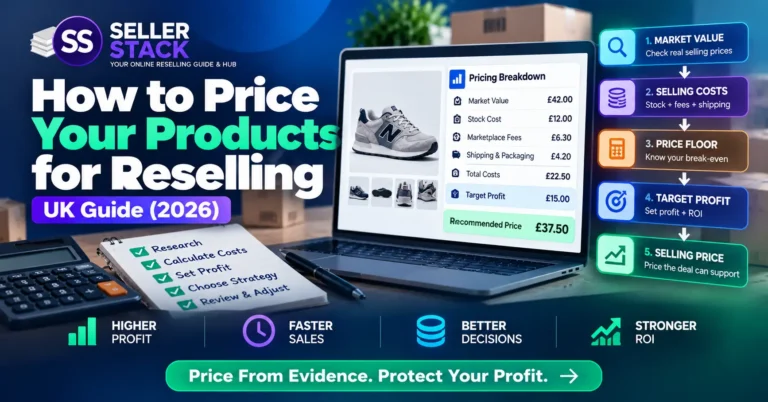
Expected Sale Price − Selling Costs − Target Profit = Maximum Buy Price
Suppose comparable sales suggest an item could realistically sell for £60.
You estimate that selling, fulfilment and packaging costs will use £12, and you want at least £22 profit.
Your theoretical maximum buying price is:
£60 − £12 − £22 = £26
Learn How Much You Should Pay for Stock
Work backwards from realistic selling prices, costs, desired profit and ROI before committing money to inventory.
Remember That eBay Costs Depend on How You Sell
UK private and business sellers do not operate under the same fee structure.
UK-based private sellers currently receive a monthly free-listing allowance and generally do not pay final value fees on ordinary domestic sales, although exceptions and optional charges can apply.
Business sellers continue to face category-dependent selling fees and other applicable charges.
That difference can materially change whether the same item produces an acceptable profit.
Calculate Your eBay Profit Before Buying Stock
Estimate selling costs, net profit, margin and ROI using your own purchase price and expected selling price.
Profit Alone Does Not Tell You Whether Stock Is Good
Consider two possible purchases:
| Item A | Item B | |
|---|---|---|
| Purchase Price | £20 | £150 |
| Estimated Profit | £20 | £35 |
| Capital Required | Low | Much Higher |
| Financial Exposure | Lower | Higher |
Item B generates more pounds of profit, but Item A may offer a much stronger return relative to the money invested.
Compare the Return on Your Stock Investment
Use ROI alongside profit and margin when comparing different sourcing opportunities.
Do Not Ignore Selling Speed
An item can be profitable on paper and still be poor stock if it sits unsold for a very long time.
Slow inventory:
- Ties up cash
- Consumes storage space
- Creates more repricing work
- Can fall in value
- Prevents capital being used elsewhere
Check Your Dead Stock Exposure
Measure how much inventory value is trapped in slow or unsold stock and decide where recovery action may be needed.
Consider Shipping Before Sourcing the Product
The item has to reach the buyer safely and economically.
Before buying bulky or fragile inventory, think about:
- Packed dimensions
- Packed weight
- Packaging material
- Insurance or compensation requirements
- Damage risk
- Collection versus drop-off
- Return-shipping difficulty
For eligible listings from UK private sellers, eBay’s current Simple Delivery workflow can provide the prepaid delivery label and integrated tracking, subject to the programme’s eligibility and parcel limits.
Check Whether You Are Allowed to Sell the Item
A potentially profitable item is useless if it cannot legally or safely be sold through your account.
eBay has prohibited and restricted-item policies, and some product categories can have additional seller eligibility requirements.
If you are unfamiliar with a regulated, safety-critical or restricted product category, check eBay’s current selling policy before sourcing inventory.
Common Mistakes When Choosing eBay Stock
1. Buying Because Something Looks Cheap
Cheap stock with weak demand can still be expensive dead stock.
2. Researching Asking Prices Instead of Sales
Sellers can ask any amount they want. Completed transactions provide stronger evidence of what buyers have actually paid.
3. Ignoring the Exact Variation
Size, colour, capacity, model and condition can materially change demand and value.
4. Chasing Trends Too Late
By the time a product is widely described as a hot item, sourcing costs and seller competition may already have risen.
5. Spending Too Much Capital on One Item
A high-value purchase can concentrate risk unnecessarily when you are still learning the market.
6. Ignoring Returns
Faulty electronics, sizing-sensitive fashion and compatibility products can have much greater return exposure than simple goods.
7. Underestimating Shipping
Large dimensions, weight and fragile packaging can destroy an apparently attractive margin.
8. Buying Counterfeits
Brand knowledge and authentication matter. Never list an item as genuine when you cannot support that description.
9. Buying Too Much Too Soon
Test a category with a manageable quantity before committing heavily to inventory.
10. Confusing Revenue With Profit
A £100 sale does not mean you made £100. Always calculate the amount left after purchase and selling costs.
SellerStack eBay Sourcing Checklist
- Can I identify the exact product?
- Have comparable items actually sold?
- What is the realistic sold-price range?
- How much competition is there?
- How quickly does comparable stock appear to sell?
- What is my maximum sensible purchase price?
- What selling and fulfilment costs will apply?
- What profit am I targeting?
- What ROI will my capital generate?
- Can I test or authenticate the item?
- Could fit, size or compatibility create returns?
- Can I package and ship it economically?
- Do I have enough storage?
- Is the product permitted on eBay?
- What happens if it takes six months to sell?
Best Items to Sell on eBay UK: FAQs
What is the best thing to sell on eBay UK?
There is no single permanent best product. Look for products with proven demand, realistic sold prices, enough margin after costs and manageable selling risk. Branded fashion, electronics, replacement parts, collectables, gaming, cameras, tools and vehicle parts are all categories worth researching.
What should a beginner sell on eBay?
Start with products that are inexpensive to source, easy to identify, easy to photograph and simple to ship. Familiar branded clothing, straightforward games, books, household products and simple accessories can be useful learning stock when demand and margins are supported by research.
How do I know whether something sells well on eBay?
Research genuine sales rather than relying on active asking prices. eBay Product Research provides data including sales trends, sold-price ranges, average prices and applicable sell-through information.
Is selling electronics profitable?
Electronics can offer attractive selling prices, but profit depends on your sourcing cost, condition, testing, depreciation, shipping and return exposure. Research the exact model before buying.
Are clothes good to sell on eBay?
They can be. Recognisable brands, desirable styles and accurate sizing can perform well, but heavily saturated low-value clothing may sell slowly. Research the exact brand, style and size rather than treating all clothing equally.
Are collectables good for reselling?
Collectables can reward specialist knowledge, but value often depends on exact edition, condition and completeness. Avoid paying a premium until you have identified the item correctly and checked comparable sales.
How much profit should I make on an eBay item?
There is no universal minimum because capital required, selling speed, workload and risk differ. Consider pounds of profit alongside margin and ROI rather than relying on one metric.
Are UK private sellers charged eBay selling fees?
UK-based private sellers currently benefit from free ordinary domestic selling within eBay’s monthly listing allowance, but optional upgrades, international transactions and other exceptions can create charges. Business sellers operate under a separate fee structure.
Where can I find items to resell?
Charity shops, car boot sales, local marketplaces, auctions, house clearances, clearance stock and wholesalers can all produce opportunities. The important factor is whether the purchase price leaves enough room for profit after realistic selling costs and risk.
The Best eBay Item Is the One the Numbers Support
There will always be categories attracting attention, but successful sourcing is not about finding a secret list of products everyone else has missed.
It is about learning to recognise demand, understand realistic selling prices, control your purchase cost and account for the risks involved in selling that item.
Build knowledge in a few categories, use real sales evidence and establish your buying limit before you source.
That approach is far more repeatable than chasing whichever product happens to be described as “hot” this month.
Research Current Demand Before Buying Inventory
Buyer demand, market prices, fees, delivery rules, product restrictions and marketplace policies can change.
Product categories mentioned in this guide are starting points for research, not guarantees of profit.
Always check current comparable sales and calculate your own costs before committing money to inventory.
Last reviewed: October 2026
Find Better Stock — Then Protect Your Margin
Explore SellerStack sourcing guides, buying strategies and free inventory tools to make better decisions before committing money to stock.
Explore Sourcing & Stock →