SELLERSTACK LISTING SKILLS GUIDE · UPDATED FOR 2026
How to Write Product Descriptions That Sell
Write clearer product descriptions that identify the item, explain its condition, include the details buyers need and reduce uncertainty before they purchase.
Product Description Guide for UK Online Sellers
This guide explains practical product-description principles that can be used across major online marketplaces while recognising that each platform has its own listing fields, policies and search system.
Last reviewed: October 2026
How Do You Write a Good Product Description?
A strong product description helps the buyer understand exactly what the item is, its condition, the important specifications, what is included and anything that could affect the buying decision.
A useful description should normally answer five questions:
- What exactly is the product?
- What condition is it in?
- What measurements or specifications matter?
- Are there any flaws, missing parts or limitations?
- What should the buyer expect after purchase?
The goal is not to fill the description with sales language. It is to remove unnecessary uncertainty before the buyer orders.
Improve the Whole Listing, Not Just the Description
Product descriptions work alongside photography, titles, structured product details, pricing and delivery information.
What Is the Job of a Product Description?
A product description is not simply a place to repeat the title.
The title identifies the item quickly. Photographs show the product. Structured fields such as brand, size, model, colour and category help marketplaces organise the listing.
The description fills the remaining information gaps.
That may include:
- used condition;
- wear or damage;
- measurements;
- compatibility;
- technical specifications;
- included accessories;
- missing components;
- relevant handling or delivery information.
Answer the Questions the Photos Cannot
A useful description gives the buyer information needed to understand and evaluate the product rather than filling the page with vague promotional wording.
The SellerStack 5-Part Product Description Framework
You do not need a completely different writing system for every item.
Start with this five-part structure:
Identify
State clearly what the product is using the useful identifying information a buyer needs.
Condition
Describe its actual condition objectively rather than relying only on labels such as “excellent”.
Details
Add measurements, specifications, materials, compatibility or other information that affects the purchase.
Flaws & Contents
Explain important wear, damage, missing parts and exactly what is included in the sale.
Fulfilment
Where relevant, state realistic handling, collection or delivery information without promising something you cannot consistently provide.
1. Identify the Product Clearly
The opening of the description should quickly confirm what the buyer is looking at.
Useful identifying information can include:
- brand;
- model or product line;
- product type;
- size;
- colour;
- material;
- version or generation;
- part or model number where relevant.
Weak Opening
“Nice blue trainers in good condition.”
Clearer Opening
“Nike Air Max 90 men’s trainers in navy blue, UK size 10, offered in used condition.”
You do not need to copy the complete title word-for-word.
The title and description should describe the same product accurately, but the description has more room to explain the details.
Make Sure the Product Title Is Doing Its Own Job
Build the title around accurate product identifiers and buyer language, then use the description for condition, detail and context.
2. Describe the Real Condition
Condition is one of the areas where vague descriptions create unnecessary buyer uncertainty.
Instead of writing only:
“Excellent condition.”
explain what that means for the actual item.
“Used condition with light wear to the cuffs and a small mark near the lower front. No holes or tears found. Please see the close-up photographs for the areas mentioned.”
This is particularly important for second-hand stock.
eBay requires the selected condition to match the item and remain consistent across the title, description and item specifics. Vinted similarly advises sellers to select condition objectively and clearly show and describe flaws.
If a mark, fault or piece of wear could affect the buyer’s decision, mention it in the description and show it clearly in the photos.
3. Add Measurements and Specifications That Matter
Buyers do not need every possible fact about every item.
They need the facts that affect whether the product is right for them.
Clothing
Depending on the garment, useful measurements may include:
- pit-to-pit or chest width;
- overall length;
- waist;
- inseam;
- sleeve length.
Electronics
Useful information can include:
- model number;
- storage or memory capacity;
- connectivity;
- power requirements;
- tested functions;
- battery or charging information where relevant;
- compatibility.
Furniture and Homeware
Dimensions can determine whether the buyer can use, transport or collect the item.
Include measurements such as:
- height;
- width;
- depth;
- assembled or packed size where useful.
Do not add specifications simply to make the description longer. Add the information that helps the buyer decide whether this exact product meets their needs.
4. Explain Flaws and Exactly What Is Included
A buyer should not have to guess whether an accessory shown in a photograph comes with the product.
State clearly what is included.
Included: console, controller, power cable and HDMI cable.
Not included: original box, manual or additional controller.
Apply the same principle to:
- chargers;
- cases;
- manuals;
- remote controls;
- attachments;
- replacement parts;
- original packaging;
- bundled accessories.
Do Not Hide Defects in General Wording
“Used with signs of wear” may not be enough if the item has a specific crack, stain, broken zip or missing component.
Name the relevant problem.
“Small 8mm chip to the lower rear corner. It does not affect normal use. Shown clearly in photos 7 and 8.”
Your Description and Photographs Should Support Each Other
Written disclosure is stronger when the buyer can also see the relevant detail.
If you mention:
- a stain;
- a scratch;
- a size label;
- a model number;
- a repaired section;
- a missing component;
photograph it where practical.
Vinted specifically recommends photographing individual flaws, while eBay recommends actual-item photographs for used, refurbished or flawed products.
Show Buyers What the Description Is Explaining
Use clear light, useful angles, labels, measurements and close-ups of condition rather than relying on words alone.
5. Give Relevant Fulfilment Information
Shipping information can be useful when it answers a genuine buyer question.
Examples might include:
- expected dispatch time;
- whether tracking is normally used;
- collection arrangements for large items;
- how fragile items will be packed;
- whether an item will be dismantled for delivery.
Only state a dispatch time, courier service or delivery commitment that matches the actual listing and that you can reasonably meet.
If the marketplace already displays the delivery service and dispatch information clearly, you do not need to repeat it simply to make the description look longer.
Keep the Whole Listing Consistent
Product descriptions should not be treated as an isolated SEO field.
The strongest listing gives the marketplace and the buyer consistent information across:
- title;
- category;
- condition;
- item specifics or attributes;
- description;
- photographs;
- variations where applicable.
If you are selling a Levi’s 501 in waist 32, leg 30:
- the title should identify the correct product;
- the size fields should use the correct size;
- the description should not contradict those fields;
- the photographs should show the actual garment and labels.
That is more useful than repeating “Levi’s 501” several times in an attempt to influence search.
Use Relevant Product Terms — Not Keyword Stuffing
Relevant search language can help marketplaces and buyers understand the listing.
But adding a block of loosely related phrases at the bottom of every description is not a good universal strategy.
Use words such as:
- brand;
- model;
- product type;
- material;
- style;
- colour;
- size;
- technical specification;
- compatible product;
when they genuinely describe the item.
Would This Word Help a Buyer Correctly Identify the Product?
If yes, it may belong in the listing. If it describes a different brand, product or style simply to attract traffic, leave it out.
Make Descriptions Easy to Scan on a Phone
Buyers should not need to work through one dense paragraph to find the condition or size.
Use:
- short paragraphs;
- simple labels;
- bullets where the marketplace supports them;
- clear spacing;
- the most important facts early.
Item: Patagonia Better Sweater Fleece
Size: Men’s Large
Condition: Good used condition
Measurements: Pit-to-pit 58cm; length 71cm
Notes: Light wear to cuffs; no holes found
Included: Fleece only
Product Descriptions Work Differently Across Marketplaces
The underlying principle is the same: describe the product accurately and give the buyer useful information.
But the listing systems are different.
| Marketplace | Description Approach | Also Pay Attention To |
|---|---|---|
| eBay | Describe the actual item accurately and keep condition information consistent throughout the listing. | Category, item specifics, product identifiers and condition fields. |
| Vinted | Be clear about used condition, fit, measurements where useful and any visible flaws. | Condition selection, category, brand, size and clear photographs of defects. |
| Depop | Keep descriptions concise but informative. Depop specifically recommends measurements, fit notes, condition and relevant product terms. | Category, brand, colour, style and relevant tags. |
| Etsy | Clearly identify the item early, then explain materials, variations, personalisation and other useful details. | Tags, attributes, category, materials, variations and natural search terms. |
| Amazon | Treat the description as part of a structured product detail page rather than a personal classified advert. | Catalogue data, attributes, bullet points, compliance information and the correct ASIN/product record. |
| TikTok Shop | Give complete and accurate product characteristics, package contents and required product information. | Product name, category, attributes, safety information, claims and package details. |
| Facebook Marketplace | Keep the description practical: identity, condition, dimensions where useful, what is included and any collection or delivery details. | Location, price, condition and collection arrangements. |
Adapt the Listing to the Platform
The product facts should remain accurate everywhere, but the listing format, structured fields and buyer expectations differ between marketplaces.
Product Description Examples
Vintage Nike Fleece Hoodie
Vintage Nike Swoosh fleece hoodie in dark grey, men’s size Large.
Condition: Good used condition. Light wear to the cuffs and slight fading consistent with previous use. No holes found.
Measurements:
Pit-to-pit: 58cm
Length: 72cm
Details: Embroidered Nike chest logo, front pouch pocket and drawstring hood.
Please review the photographs for the overall condition and the cuff wear mentioned above.
Nintendo Switch 32GB Console
Nintendo Switch 32GB console with grey Joy-Con controllers.
Condition: Used and tested. Console powers on, connects to Wi-Fi and has been tested with both Joy-Con controllers.
Cosmetic condition: Light surface marks from normal use. Small scratch to the rear casing shown in photo 6.
Included: console, left and right Joy-Con, dock, power supply and HDMI cable.
Not included: original retail box or game software.
Boxed Die-Cast Model Car
Boxed 1:43 scale die-cast model in its original display packaging.
Model condition: Very good with no obvious damage found during inspection.
Packaging condition: Original box has edge wear and a small crease to one corner. Please see photos 5–7.
Sale includes the model, plastic display base and original outer box shown in the photographs.
Be Careful With “No Returns” and “Sold as Seen”
A description should not try to remove rights that apply to the buyer.
This is particularly important if you are acting as a business seller rather than simply disposing of your own unwanted possessions.
UK consumer law gives consumers statutory rights when buying from traders. Goods must, among other things, be as described, and a business cannot simply write those responsibilities away with wording such as “no returns” or “sold as seen”.
Marketplace return settings and statutory consumer rights are not the same thing. If you trade as a business, make sure your listing terms and returns practices reflect the rules that apply to you.
Can You Use AI to Write Product Descriptions?
Yes — but use AI as a drafting tool, not as the source of product facts.
AI cannot inspect the item sitting in front of you.
It should not invent:
- condition;
- measurements;
- materials;
- compatibility;
- accessories;
- technical specifications;
- authenticity claims;
- dispatch promises.
Give the AI Facts First
Use something like:
“Write a concise product description for an online marketplace using only the facts below. Do not invent missing information. Start by identifying the product, then organise condition, measurements/specifications, flaws and included items clearly. Use natural language and short sections suitable for mobile.”
Then provide your verified information:
- product name;
- brand/model;
- condition;
- measurements;
- specifications;
- flaws;
- included items;
- relevant fulfilment information.
Before publishing, compare every factual statement in the draft against the actual item. Delete anything you have not verified.
A Better Description Cannot Fix a Bad Product Decision
Listing quality matters, but it is only one part of the selling decision.
A well-written description cannot compensate for:
- weak demand;
- an unrealistic asking price;
- poor photographs;
- the wrong marketplace;
- expensive fulfilment;
- stock purchased at too high a price.
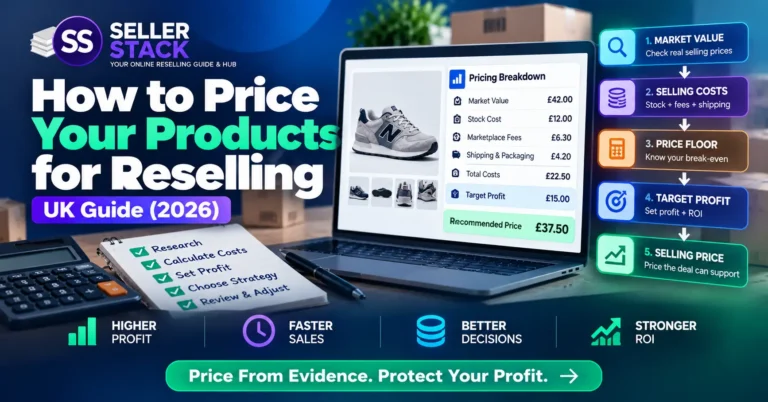
Before publishing, make sure the expected selling price still works after purchase cost, marketplace fees, shipping, packaging and other selling expenses.
What Should You Charge?
Work backwards from your costs and desired profit instead of choosing a price without checking the numbers.
Calculate a Selling Price →What Could the Sale Leave?
Add your purchase cost, marketplace fees, fulfilment and other expenses to estimate the result.
Calculate Reseller Profit →For the wider decision process, use the SellerStack Pricing & Profit Hub .
Common Product Description Mistakes
1. Repeating the Title Word-for-Word
Use the description to add information rather than simply duplicating the title.
2. Writing Only “Good Condition”
Explain the actual wear, faults or relevant cosmetic condition.
3. Hiding Flaws in the Photos
Disclose important damage clearly in both the description and images where practical.
4. Forgetting Measurements
Clothing, furniture and other size-sensitive products often need more than the manufacturer’s size label.
5. Not Saying What Is Included
Buyers should know whether cables, accessories, packaging or other components form part of the sale.
6. Filling the Description With Unrelated Keywords
Keep search terms accurate and directly relevant to the actual product.
7. Copying Third-Party Marketing Copy Blindly
The description should match your exact item, and third-party text or images may also involve intellectual-property rights.
8. Letting AI Invent Details
AI can organise verified facts but cannot inspect condition, contents or measurements for you.
9. Over-Promising Dispatch
Do not promise same-day or 24-hour handling unless that is the service you can actually provide.
10. Treating the Description as the Entire Listing
Titles, photographs, attributes, price and marketplace choice still affect whether the item sells.
The 60-Second Product Description Audit
Before publishing, read the description once as though you were the buyer.
✓ Can I tell exactly what the item is?
✓ Is the condition described accurately?
✓ Are important measurements or specifications included?
✓ Are flaws or faults disclosed?
✓ Is it clear what is included?
✓ Does the description agree with the title and structured fields?
✓ Do the photos support the written condition?
✓ Have I removed irrelevant keywords and exaggerated claims?
✓ Are any dispatch or delivery statements realistic?
✓ Does it still make sense when viewed quickly on a phone?
Put the Description Into the Full Selling Process
Follow the complete beginner journey through sourcing, marketplace choice, pricing, listings, shipping and records.
Product Description FAQs
How long should a product description be?
Long enough to give the buyer the important information, but not padded for the sake of word count. A straightforward used clothing item may need only a short structured description, while technical equipment may require much more detail.
Should I repeat my product title in the description?
You do not need to duplicate it word-for-word. Clearly identify the product in the opening, then use the rest of the description for condition, measurements, specifications, contents and other useful information.
Should I add keywords to product descriptions?
Use relevant product language naturally. Accurate brand, model, style, material, size and specification terms can be useful. Avoid unrelated brands, repeated phrases or blocks of keywords that do not accurately describe the item.
Should I copy the manufacturer’s product description?
Use manufacturer information as a factual reference where appropriate, but write a description that accurately reflects the exact item you are selling. Avoid copying third-party marketing text or images unless you have the right to use them. Some marketplaces, such as Amazon, also use shared catalogue information rather than treating every seller description as an independent listing.
How should I describe flaws?
Be specific. State what the flaw is, where it is and whether it affects use. Add a clear photograph where practical. Avoid hiding a significant problem behind general phrases such as “usual wear”.
Should I include shipping information?
Include it when it genuinely helps the buyer, particularly for unusual handling, collection or large-item arrangements. Do not repeat information unnecessarily if the marketplace already displays it clearly, and never promise a service you cannot reliably provide.
Can AI write my product descriptions?
AI can help structure and rewrite information you provide, but you should verify every factual statement before publishing. Never allow an AI tool to guess condition, measurements, compatibility, contents or product claims.
Do better descriptions prevent returns?
Clear descriptions can reduce misunderstandings by setting better expectations, but they cannot guarantee that a buyer will never return an item. Returns can occur for many reasons, and marketplace rules or statutory rights may also apply.
Is “no returns” enough to stop a buyer returning an item?
Not necessarily. Marketplace policies and UK consumer rights can apply independently of wording placed in a listing. This is especially important for business sellers dealing with consumers.
Make the Product Easier to Understand
Good product descriptions do not need exaggerated sales language.
Identify the item accurately, explain its real condition, add the measurements or specifications that matter, disclose flaws and make it clear what the buyer will receive.
Then check that the description agrees with the title, photographs, condition selection and structured marketplace fields.
The objective is simple: give the right buyer enough accurate information to make a confident decision without creating expectations the product cannot meet.
Check Current Listing Rules Before Publishing
Marketplace description rules, required attributes, catalogue fields, prohibited content and listing formats can change.
SellerStack reviews this guide periodically, but the current rules shown by the marketplace when you create a listing should take priority.
Useful official references:
- eBay Item Description Policy
- Vinted Item Condition Guidance
- Depop Description Guidance
- Etsy Listing Description & SEO Guidance
- Amazon Product Detail Page Rules
- TikTok Shop Product Listing Guidance
- GOV.UK Consumer Statutory Rights
Last reviewed: October 2026
Build a Stronger Listing From Start to Finish
Connect product photography, titles, descriptions, pricing and marketplace choice instead of trying to improve one field in isolation.
Explore Listings & Selling Skills →