
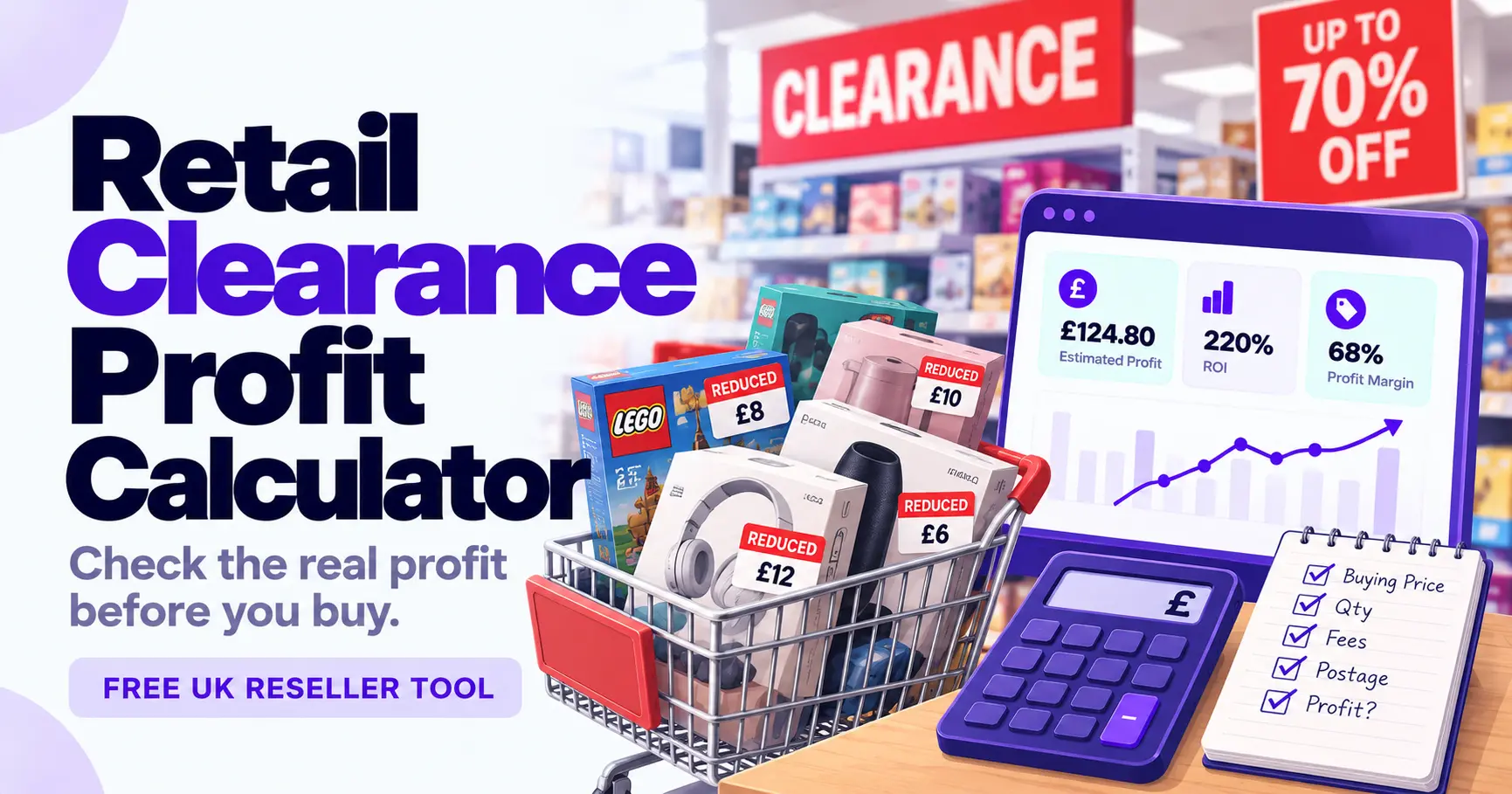
FREE UK RETAIL ARBITRAGE TOOL
Retail Clearance Profit Calculator UK
Calculate the potential profit, ROI and profit margin from discounted retail stock before committing your sourcing budget.
Include quantity, clearance price, extra discounts, expected sell-through, marketplace fees, postage and other costs to see whether the deal is worth buying — and how much you can safely pay per unit.
Retail Clearance Profit Calculator
Check whether discounted retail stock is likely to generate enough profit before buying multiple units.
Enter the quantity, original retail price and reduced purchase price.
Enter the total number of clearance units you plan to buy.
The retailer’s original price before the clearance reduction.
Enter the actual reduced price you will pay for each unit.
Include loyalty, staff, voucher or promotional discounts.
Use realistic sold prices rather than the product’s original RRP.
Use an achievable selling price based on recent sold listings.
Estimate the percentage of purchased units likely to sell.
Enter zero when offering free postage or selling locally.
Enter the estimated percentage charged on sale revenue.
Include the costs attached to each successful sale.
The amount you expect to pay the courier for each order.
Include boxes, mailers, labels, tape and protective materials.
Include labels, cleaning, testing, removal of stickers or repairs.
Include fuel, parking, storage, advertising or listing upgrades.
Optional allowance for returns, damage and failed deliveries.
Usually leave at zero when the shelf price already includes VAT.
Set the minimum return required before committing to the stock.
The minimum total profit that makes the clearance purchase worthwhile.
Compare your estimated profit with the money invested.
Does the Deal Meet Your Targets?
The estimated maximum price you could pay per unit while still meeting both your profit and ROI targets.
The estimated average selling price needed to recover all expected costs at your selected sell-through rate.
Check product restrictions, expiry dates, damaged packaging, recalls, brand gating, marketplace eligibility and current demand before purchasing clearance inventory.
What Does the Retail Clearance Profit Calculator Do?
The Retail Clearance Profit Calculator helps you decide whether discounted retail stock is genuinely worth buying for resale before you commit money to several units.
Enter the quantity, clearance price, any additional discount, expected selling price, likely sell-through and selling costs. The calculator then estimates your revenue, net profit, ROI, profit margin and overall quality of the deal.
It is designed for retail-arbitrage decisions where an impressive discount can look attractive but the real question is whether the stock can still produce enough profit after fees, fulfilment costs and unsold inventory are considered.
Why Retail Clearance Can Create Reselling Opportunities
Retailers reduce stock for many reasons. A product may be seasonal, discontinued, overstocked, replaced by a newer range or simply taking up shelf space that the retailer wants to use elsewhere.
That can create opportunities for resellers when the clearance price falls faster than the product’s actual resale demand.
📦 Excess Stock
A retailer may reduce products simply because it is holding more stock than it wants.
🗓️ Seasonal Clearance
Seasonal products can be reduced heavily when stores need space for the next selling period.
🔄 Product Changes
Older packaging, discontinued ranges and previous models can be cleared when new inventory arrives.
🏷️ Damaged Packaging
Some products are reduced because the outer packaging is damaged even though the product itself may still be usable.
A retailer’s reason for discounting is not the same as buyer demand
A clearance sticker tells you what the retailer wants to charge. It does not tell you what online buyers are willing to pay.
Products You May Find in Retail Clearance
Clearance opportunities can appear across many categories. The product type alone does not make an opportunity profitable, so always research the specific item.
🧸 Toys & Games
Toys, board games, collectables and seasonal gift products.
🏠 Homeware
Household products, storage, kitchenware and small appliances.
💄 Beauty & Personal Care
Selected beauty, grooming and personal-care products.
🐾 Pet Products
Accessories, equipment and selected pet-care items.
🔧 DIY & Electrical
Tools, accessories, electrical products and household equipment.
🏃 Fitness & Seasonal
Fitness accessories, outdoor products and seasonal inventory.
A Big Discount Does Not Automatically Mean Big Profit
One of the biggest traps in retail clearance sourcing is judging a deal by the percentage reduction instead of the resale economics.
| Example | Original Retail Price | Clearance Price | Online Selling Price | Profit After Costs |
|---|---|---|---|---|
| Product A | £40 | £8 | £14 | £2 |
| Product B | £25 | £12 | £35 | £14 |
Product A has the larger discount. Product B has the better economics.
The original retail price can provide context, but your resale decision should be based on the realistic selling price, actual buying cost, fees, fulfilment expenses and likely demand.
RRP is not resale value
A product marked down from £50 to £10 is not automatically worth £50 to an online buyer. Research the current market before using the size of the discount as a reason to buy.
What Makes This Retail Clearance Calculator Different?
Retail clearance decisions become more complicated when you are buying several units rather than one product.
This calculator is built around that sourcing decision rather than treating every purchase as a simple single-item flip.
Quantity Purchased
Model the total capital being committed when buying several units of the same clearance item.
Clearance Price
Base the calculation on what you actually pay rather than the original shelf price.
Extra Discounts
Include additional promotional discounts or vouchers that reduce your final buying cost.
Expected Sell-Through
Avoid assuming that every unit purchased will automatically become a sale.
Selling & Fulfilment Costs
Include marketplace fees, postage, packaging, preparation and other relevant costs.
SellerStack Deal Verdict
Assess the overall opportunity against the profitability and sourcing assumptions entered.
What Costs Should You Include?
A clearance deal can look very different once all of the costs between the checkout and the completed sale are included.
Stock & Preparation Costs
- Clearance purchase price
- Quantity purchased
- Additional discounts or vouchers
- Cleaning or preparation
- Replacement packaging where required
- Fuel and parking allocation
- Storage costs where relevant
Selling & Fulfilment Costs
- Marketplace fees
- Payment charges where applicable
- Advertising costs
- Actual postage
- Packaging materials
- Returns allowance
- VAT where applicable
Small per-unit costs multiply across bulk purchases
A £1 cost may seem minor on one product. Across 30 units, that same assumption can change the expected deal profit by £30.
Why Sell-Through Rate Matters in Retail Clearance
Buying twenty units does not guarantee that twenty units will sell.
Sell-through gives you a way to test the purchase using a more realistic sales assumption rather than automatically treating every unit as future revenue.
Buying 20 units does not mean selling 20 units
If you buy 20 clearance products and expect an 80% sell-through rate, your planning assumption is that approximately 16 units will generate sales.
The remaining stock still consumed capital, storage space and potentially your time even if it has not yet produced revenue.
Don’t clear the shelf just because the unit economics look good
A strong margin on one unit does not guarantee that buying every available unit is the right decision. Quantity should reflect realistic demand and your available capital.
Understanding Your Retail Clearance Results
Look at the complete result rather than focusing only on the discount percentage.
Estimated Net Profit
Shows the amount expected to remain after the stock and selling costs included in the calculation.
Expected Revenue
Estimates the sales revenue based on your selling-price and sell-through assumptions.
ROI
Measures the expected return relative to the money invested in the clearance stock.
Profit Margin
Shows how much of the expected sales revenue remains as profit after the included costs.
Maximum Safe Buy Price
Helps identify how much you can afford to pay per unit while protecting your sourcing targets.
Deal Verdict
Provides an overall assessment based on the assumptions and targets entered.
Understanding the SellerStack Deal Verdict
The Deal Verdict looks beyond the headline discount and considers the wider strength of the sourcing opportunity.
It uses factors including estimated profit, ROI, margin, discount, expected sell-through and your sourcing targets.
How to read the Deal Verdict
| Verdict | What It Suggests |
|---|---|
| 🏆 Excellent Clearance Find | The opportunity performs strongly against the assumptions and targets entered. |
| ✅ Good Retail Arbitrage Deal | The expected economics look healthy, subject to demand and marketplace research. |
| ⚖️ Borderline Clearance Deal | The opportunity is close to one or more of your target limits. |
| ⚠️ Weak Clearance Opportunity | Purchase price, costs, sell-through or expected resale value are putting the return under pressure. |
| ⛔ Avoid This Clearance Deal | The current assumptions do not support a strong enough opportunity for the targets entered. |
Check Demand Before Buying Multiple Units
Heavily discounted stock can create urgency, especially when only a few units appear to be left. That is exactly when research matters most.
Before buying larger quantities, check whether real buyer demand supports the resale price you are planning to use.
Check Market Demand
- Recent sold listings
- Current competition
- Realistic selling prices
- Likely selling speed
- Seasonal demand
- Price history where available
Check Product Risk
- Product condition
- Packaging damage
- Product reviews
- Brand demand
- Marketplace restrictions
- Category approval requirements where relevant
Start with demand, then decide quantity
Buying five units of stock with healthy demand can be a better use of capital than buying thirty units simply because the discount looks exceptional.
Useful Tools for Retail Clearance Sourcing
SellerAmp SAS
Analyse potential Amazon clearance purchases using estimated profit, ROI, sales-rank information, competition and selling restrictions.
AutoDS
Explore tools for managing listings, stock information and repetitive ecommerce tasks across supported selling channels.
Affiliate disclosure: Some links above are affiliate links. SellerStack may earn a commission if you purchase through them, at no additional cost to you.
Choose the Marketplace That Fits the Product
The same clearance product can produce different results depending on where it is sold. Marketplace fees, buyer audience, competition and restrictions all affect the opportunity.
| Product Type | Marketplace Worth Researching |
|---|---|
| General homeware and second-hand goods | eBay |
| Selected new branded products | Amazon / eBay |
| Fashion and accessories | Vinted / Depop / eBay |
| Vintage or specialist products | Etsy / eBay |
| Large household products | Facebook Marketplace |
Before buying stock specifically for one platform, confirm that the product and category can be sold through that marketplace and that your account meets any relevant requirements.
Worked Example: 12 Clearance Kitchen Products
Assessing a multi-unit clearance purchase
| Input | Example |
|---|---|
| Quantity | 12 units |
| Original retail price | £24.99 each |
| Clearance price | £6.00 each |
| Additional discount | 10% |
| Expected selling price | £17.99 each |
| Expected sell-through | 80% |
The headline discount looks strong, but it is only the start of the decision.
The calculator can then factor in your selling costs and expected sell-through to estimate revenue, net profit, ROI, margin and the maximum buying price that fits your targets.
You can then change the quantity, selling price or sell-through assumption to see how sensitive the opportunity is before buying all twelve units.
Common Retail Clearance Sourcing Mistakes
Avoid these before filling your trolley
Buying because the discount looks impressive
The size of the markdown does not tell you whether the current resale market is profitable.
Ignoring marketplace fees
Fees can materially reduce the profit left from lower-priced clearance stock.
Overestimating the selling price
Base your assumption on realistic market evidence rather than the original RRP.
Forgetting fulfilment costs
Postage and packaging can significantly change the return on heavier or lower-value products.
Buying too many units
A profitable unit can still become poor inventory when demand cannot support the quantity purchased.
Ignoring seasonal demand
A product can lose momentum quickly after its peak selling period passes.
Ignoring marketplace restrictions
Confirm that you can actually sell the product on the marketplace you intend to use.
Assuming every unit will sell
Use a realistic sell-through assumption when buying stock in quantity.
Build a Smarter Retail Clearance Strategy
Successful clearance sourcing is not about buying everything with a red sticker. It is about allocating capital to opportunities that have realistic demand and acceptable risk.
Before buying several units:
- Research recent selling prices.
- Check current marketplace competition.
- Confirm any selling restrictions.
- Estimate a realistic sell-through rate.
- Include all selling and fulfilment costs.
- Decide how much capital you are prepared to commit.
- Check how much storage the stock will require.
- Know your maximum acceptable buying price.
- Leave the deal if the figures do not work.
Know your maximum buying price
Use the Maximum Buy Price Calculator to work backwards from the expected selling price and calculate the highest amount you should consider paying while protecting your targets.
Could Slow Clearance Stock Work Better as a Bundle?
Some low-value or complementary products may be more practical to sell together rather than individually.
Bundling can reduce the number of separate listings and fulfilment tasks, but the combined price still needs to protect your profit, ROI and margin.
Test a profitable bundle price
Use the Bundle Pricing Calculator to compare a bundle with individual sales and see how much discount you can safely offer.
Watch the Risk of Dead Stock
Bulk clearance purchases can become expensive when unsold units remain in storage long after the original opportunity looked attractive.
Capital tied up in slow stock cannot be used for newer sourcing opportunities.
Already holding slow clearance stock?
Use the SellerStack Dead Stock Calculator to measure how much of your inventory value is tied up in products that are no longer moving as expected.
Check Dead Stock →Retail Arbitrage, Records and HMRC
If you are buying retail products specifically with the intention of reselling them for profit, keep clear records of stock purchases, sales income and relevant business expenses.
Your tax position depends on your circumstances, so use current HMRC information when determining the requirements that apply to you.
Understand the UK rules
Read our HMRC guide for a practical overview of trading, records and tax considerations for UK online sellers.
Read the HMRC Guide →Source Smarter. Protect Your Profit.
Download the UK Reseller Profit Toolkit for sourcing checks, profit worksheets, marketplace fee references, pricing guidance and links to SellerStack calculators.
Related SellerStack Calculators
Use these tools as you move from clearance sourcing to pricing, marketplace selection and inventory management.
Maximum Buy Price Calculator
Work backwards from expected selling value to calculate your maximum stock-buying price.
Calculate Buying Limit →Bundle Pricing Calculator
Test bundle discounts while protecting profit, ROI and margin.
Calculate Bundle Price →Resale Profit Calculator
Calculate net profit after stock, marketplace and fulfilment costs.
Calculate Resale Profit →Reseller ROI Calculator
Compare the return generated by different stock investments.
Calculate ROI →Dead Stock Calculator
Measure how much inventory value is tied up in slow-moving stock.
Analyse Dead Stock →UK Shipping Cost Comparison
Compare delivery costs before buying heavier or bulkier clearance products.
Compare Shipping Costs →Need Marketplace-Specific Profit Calculations?
Once you know where you intend to sell the clearance stock, use the relevant SellerStack marketplace calculator for more platform-specific fee and profit analysis.
eBay Calculator
Open eBay Calculator →Amazon FBA Calculator
Open Amazon Calculator →Vinted Calculator
Open Vinted Calculator →Etsy Calculator
Open Etsy Calculator →Depop Calculator
Open Depop Calculator →TikTok Shop Calculator
Open TikTok Calculator →Retail Clearance Profit Calculator FAQs
What is retail clearance sourcing?
Retail clearance sourcing involves buying discounted products from retailers with the intention of reselling them through online marketplaces or other sales channels.
Is retail clearance the same as retail arbitrage?
Retail clearance is one form of retail arbitrage. Retail arbitrage can also include products bought using promotions, vouchers, loyalty offers or other price reductions.
Does a larger discount mean a better resale deal?
No. The resale opportunity depends on the actual selling price, buying cost, fees, fulfilment expenses, demand and likely sell-through rather than the discount percentage alone.
What ROI should I aim for?
There is no single ROI target that suits every reseller. Consider cash profit, margin, selling speed, competition, risk and the amount of capital required alongside ROI.
Why does the calculator ask for sell-through rate?
Because buying several units does not guarantee that every unit will sell. A realistic sell-through assumption gives you a more cautious estimate of likely revenue and profit.
Should I use the original RRP to estimate resale value?
No. Use current market evidence to estimate the likely selling price. The original retail price does not guarantee what buyers will pay today.
Should I buy every unit when a clearance deal looks profitable?
Not automatically. Consider demand, likely selling speed, available capital, storage space and the risk of unsold stock before deciding how many units to buy.
Should I check marketplace restrictions before buying?
Yes. Confirm that the product can be sold through your intended marketplace and that your seller account meets any relevant category or product requirements.
Can I use this calculator for wholesale purchases?
The same principles can also be useful for wholesale stock, job lots, end-of-line inventory and other bulk purchases where quantity, unit cost and sell-through matter.
Can I use this calculator for liquidation stock?
It can help model the basic economics, but liquidation stock may contain additional condition, quantity and inventory risks that should be researched separately.
Can the calculator tell me whether the stock will sell?
No. The calculator evaluates the financial assumptions you enter. You still need to research demand, competition, restrictions and realistic selling prices.
Buy Demand, Not Just the Discount
The biggest markdown on the shelf is not necessarily the best resale opportunity.
Research realistic selling prices, understand the marketplace, include every meaningful cost and think carefully about how many units are likely to sell before committing your capital.
A strong clearance purchase is one where the demand, quantity and final numbers still make sense after the red discount sticker has been removed from the equation.
Check the Numbers Before You Clear the Shelf
Explore SellerStack’s free UK reseller calculators for sourcing, pricing, profit, marketplace fees, shipping and inventory decisions.
Explore All SellerStack Tools →