
FREE RESELLER INVESTMENT TOOL
Reseller ROI Calculator
Calculate the return generated by the money you invest in resale stock, alongside estimated profit, profit margin and break-even price.
Use realistic selling prices and costs before buying inventory to compare sourcing opportunities and decide whether the potential return justifies your capital, time and selling risk.
📈 Reseller ROI Calculator
Calculate your estimated profit and return on investment before buying stock.
Include costs such as cleaning, repairs, promoted listings, sourcing charges or other expenses.
Enter Your Figures
Your personalised ROI assessment will appear here.
See how efficiently your purchase cost could generate profit.
Total revenue includes your expected selling price plus any shipping or delivery charge collected from the buyer.
ROI measures the projected profit generated relative to the amount invested in purchasing the item.
Also consider demand, item condition, competition, expected selling time and the possibility of returns.
What Does Reseller ROI Tell You?
Return on Investment measures how much estimated profit a resale opportunity could generate compared with the money invested in buying the item.
A product that makes more cash profit does not automatically deliver the better ROI. ROI helps you compare how efficiently different stock purchases use your available capital.
How Reseller ROI Is Calculated
SellerStack first calculates the estimated net profit after the costs you enter. It then compares that profit with the item’s purchase cost.
ROI formula
Net profit ÷ item purchase cost × 100 = ROI %
If an item costs £20 to buy and produces £20 of estimated net profit:
£20 profit ÷ £20 purchase cost × 100 = 100% ROI
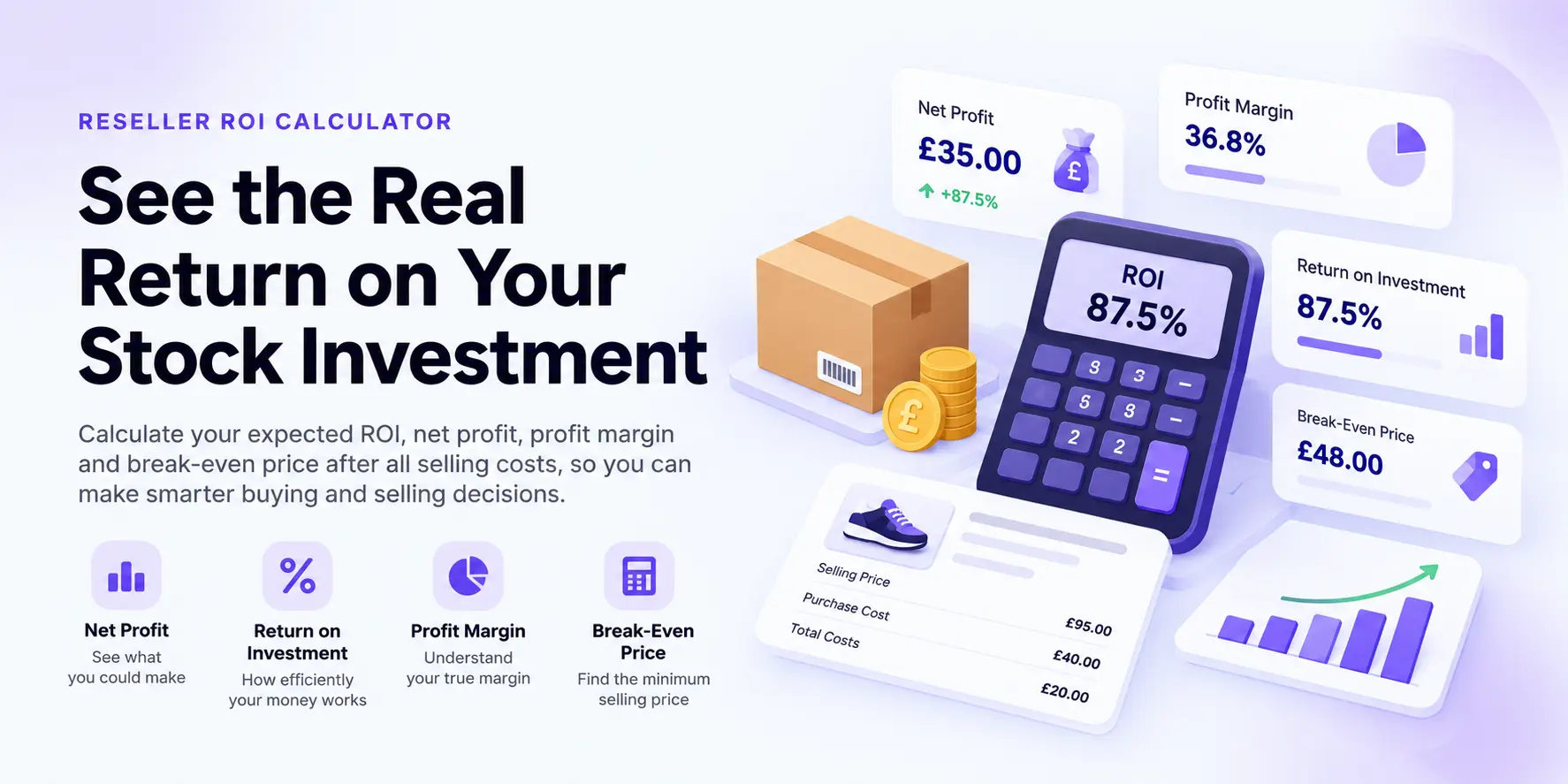
£40 Stock Cost With £35 Estimated Profit
Purchase cost: £40
Selling price: £95
Marketplace fees: £12
Shipping: £5
Packaging: £2
Other costs: £1
Estimated net profit: £35
ROI: £35 ÷ £40 × 100 = 87.5%
That means every £1 invested in purchasing the stock generates approximately 87.5p of estimated profit.
Understanding Your ROI Calculator Results
ROI is the headline measure, but the calculator deliberately shows several other figures because investment efficiency is only one part of a sourcing decision.
📈 Return on Investment
ROI measures estimated profit relative to the money spent acquiring the stock.
This answers: “How efficiently could my buying capital generate profit?”
💰 Net Profit
Net profit shows the estimated cash result after the costs entered into the calculator have been deducted.
A high ROI with only a very small cash profit may still be unattractive for some sellers.
📊 Profit Margin
Profit margin measures how much of total order revenue remains as estimated profit.
Net profit ÷ total revenue × 100
⚖️ Break-Even Selling Price
This estimates the minimum item price needed to cover the costs and fee assumptions entered.
💷 Profit per £1 Invested
This expresses ROI as a cash figure rather than a percentage.
For example, 75% ROI is equivalent to approximately 75p estimated profit for every £1 invested in stock.
🎯 SellerStack Deal Score
The Deal Score provides a quick SellerStack assessment based on the profit, margin and ROI produced by the figures you enter.
Treat it as a planning aid rather than a prediction of demand or whether the product will actually sell.
What Does the SellerStack ROI Verdict Mean?
The calculator combines your entered numbers into a simple verdict so you can interpret the financial result more quickly.
More Profit Does Not Always Mean Better ROI
ROI becomes especially useful when comparing products with very different purchase prices.
Item A
Purchase cost: £10
Estimated profit: £15
ROI: 150%
Item B
Purchase cost: £100
Estimated profit: £30
ROI: 30%
Item B produces twice as much cash profit, but Item A generates a substantially stronger return on the money invested.
That does not automatically make Item A the better product. Selling speed, sourcing effort, demand and the absolute cash profit still matter.
ROI vs Profit Margin: What Is the Difference?
| Measure | What It Compares | Main Question |
|---|---|---|
| ROI | Profit vs purchase cost | How efficiently is my stock investment working? |
| Profit Margin | Profit vs order revenue | How much of the sale remains as profit? |
| Net Profit | Revenue vs total entered costs | How much could I actually make? |
Strong sourcing decisions usually consider all three rather than optimising one number in isolation.
What Is a Good ROI for Reselling?
There is no universal ROI percentage that makes every item a good or bad purchase.
The return needed depends on the amount of money invested, likely selling speed, workload, product risk and how consistently you can source similar opportunities.
Judge ROI in Context
Before buying, consider:
- the actual cash profit expected from the sale;
- how long your money may remain tied up;
- how much sourcing and preparation work is required;
- whether the expected selling price is supported by demand;
- the risk of returns, repairs or price reductions;
- whether the opportunity can be repeated at useful scale.
Costs to Include in a Reseller ROI Calculation
ROI can look artificially strong when costs are missing.
- Item purchase cost
- Marketplace selling fees
- Payment-processing charges
- Postage or courier costs you pay
- Packaging materials
- Cleaning and preparation
- Repairs or replacement parts
- Promoted-listing or advertising charges
- Other direct selling expenses
If the buyer pays a separate shipping charge, enter both the amount collected from the buyer and your actual shipping expense so the calculation reflects the whole order.
Use ROI Before You Commit Money to Stock
ROI is particularly useful during sourcing because it gives you a way to compare opportunities before the money leaves your business.
🏪 Charity Shop Stock
Compare the purchase price with realistic sold prices and the likely costs of completing the sale.
🚗 Car Boot Purchases
Test the deal before negotiating rather than relying on the size of the apparent markup.
🏬 Retail Clearance
A large retail discount does not guarantee a strong resale return. Calculate the economics from your actual buying cost.
Turn Your ROI Target Into a Maximum Buying Price
Sometimes the better question is not:
“What ROI does this buying price produce?”
but:
“What is the most I can pay and still achieve the return I want?”
The Maximum Buy Price Calculator works backwards from your expected sale, costs and financial targets to estimate a buying ceiling before you negotiate.
ROI Does Not Measure Selling Speed
Two products can show exactly the same projected ROI while producing very different business outcomes.
If one sells in a week and another takes six months, the same money may be available to reinvest many more times in the faster-moving product.
Use the Stock Turnover Calculator when you want to examine how efficiently inventory is moving through the wider business.
ROI Does Not Measure Your Time Either
A high-return product may still require substantial research, cleaning, repairs, photography, listing and customer service.
Use the Reseller Hourly Earnings Calculator to compare profit with the time required to generate it.
How Can a Reseller Improve ROI?
Increasing the selling price is only one possible route.
- Source inventory at a lower purchase price.
- Research realistic sold prices before buying.
- Compare marketplace selling costs.
- Reduce unnecessary shipping and packaging expenses.
- Avoid overpaying because an item appears heavily discounted.
- Reduce preparation or repair costs where practical.
- Focus more capital on stock with proven demand.
Research Demand Before Trusting the ROI
The calculator can analyse the financial assumptions you enter, but those assumptions still need to be realistic.
SellerAmp SAS
SellerAmp can help Amazon sellers research estimated profitability, sales rank, competition and selling restrictions before purchasing stock.
ZIK Analytics
Use marketplace research to investigate demand, competitor pricing and recent sales before relying on an expected selling price in your ROI calculation.
Continue With the Numbers Behind the Purchase
💷 Maximum Buy Price Calculator
Turn an expected selling price and target return into a clear maximum purchase price.
💰 Reseller Profit Calculator
Focus on the complete cash profit, margin and costs behind the sale.
⚖️ Break-Even Calculator
Estimate the minimum selling price required to cover your entered costs.
🏷️ Product Pricing Calculator
Work forwards from costs and profit targets to estimate a selling price.
🏪 Charity Shop ROI Calculator
Analyse a charity-shop sourcing opportunity using costs, expected sale value and projected return.
🧰 All SellerStack Tools
Explore sourcing, pricing, marketplace, shipping and business-growth calculators.
For the wider process of sourcing, pricing and return analysis, explore the SellerStack Pricing & Profit Hub .
Reseller ROI Calculation Mistakes to Avoid
- Using the markup as ROI. ROI should use estimated net profit after relevant selling costs, not simply the difference between purchase price and selling price.
- Ignoring fulfilment costs. Shipping, packaging and preparation reduce the return.
- Using an unrealistic selling price. Strong ROI built on an unrealistic sale estimate is not useful.
- Looking only at the percentage. A very high ROI can still produce too little cash profit to justify the work.
- Ignoring selling speed. Capital tied up for months cannot be reinvested elsewhere.
- Ignoring time and effort. Cleaning, repairs, listing and customer service still have an opportunity cost.
- Assuming the Deal Score predicts demand. It assesses the financial figures entered, not future buyer behaviour.
ROI Helps You Decide Where Your Buying Capital Works Hardest
Profit tells you how much money a sale could make. ROI adds another question: how efficiently did the money invested in the stock generate that profit?
Use ROI alongside net profit, margin, demand, selling speed and workload before deciding whether a sourcing opportunity deserves your capital.
Reseller ROI Calculator Methodology
The SellerStack Reseller ROI Calculator first estimates net profit from the selling price, buyer shipping income and the stock, marketplace, fulfilment and other costs entered by the user.
ROI is calculated by dividing estimated net profit by the item purchase cost and multiplying the result by 100.
Profit margin compares estimated net profit with total order revenue.
Break-even selling price estimates the item price required to cover the entered costs under the fee assumptions supplied.
The SellerStack Deal Score and ROI Verdict are planning aids based on the financial figures entered. They do not assess product demand, authenticity, condition, competition, likely selling time or future marketplace performance.
Marketplace fee inputs are planning assumptions rather than a live fee feed. Check the current fees for your marketplace, category and seller account before making a buying decision.
Last reviewed: October 2026
Frequently Asked Questions
What does ROI mean in reselling?
ROI stands for Return on Investment. It measures estimated profit relative to the amount invested in purchasing the resale stock.
How do I calculate reseller ROI?
Divide estimated net profit by the item purchase cost and multiply the result by 100.
Is ROI the same as profit margin?
No. ROI compares estimated profit with the purchase cost of the stock. Profit margin compares estimated profit with total order revenue.
What is a good ROI for reselling?
There is no single percentage that suits every resale business. Consider the cash profit, purchase cost, likely selling speed, workload, risk and repeatability alongside the ROI percentage.
Should shipping and packaging be included in ROI?
Yes. Include the selling and fulfilment costs that are relevant to the transaction so the estimated profit used in the ROI calculation is realistic.
Can a high-ROI product still be a bad purchase?
Yes. An item may show a strong percentage return but have weak demand, low cash profit, high preparation time or take too long to sell.
Can I use the ROI Calculator for different marketplaces?
Yes. You can enter the selling fees and costs relevant to the marketplace you are analysing. For more detailed platform-specific modelling, use SellerStack’s dedicated marketplace calculators.
What does the SellerStack Deal Score mean?
It is a SellerStack planning indicator based on the profit, margin and ROI produced by the figures entered. It should not be treated as a prediction that the item will sell.
Is the Reseller ROI Calculator free?
Yes. The SellerStack Reseller ROI Calculator is free to use and does not require a SellerStack account.