
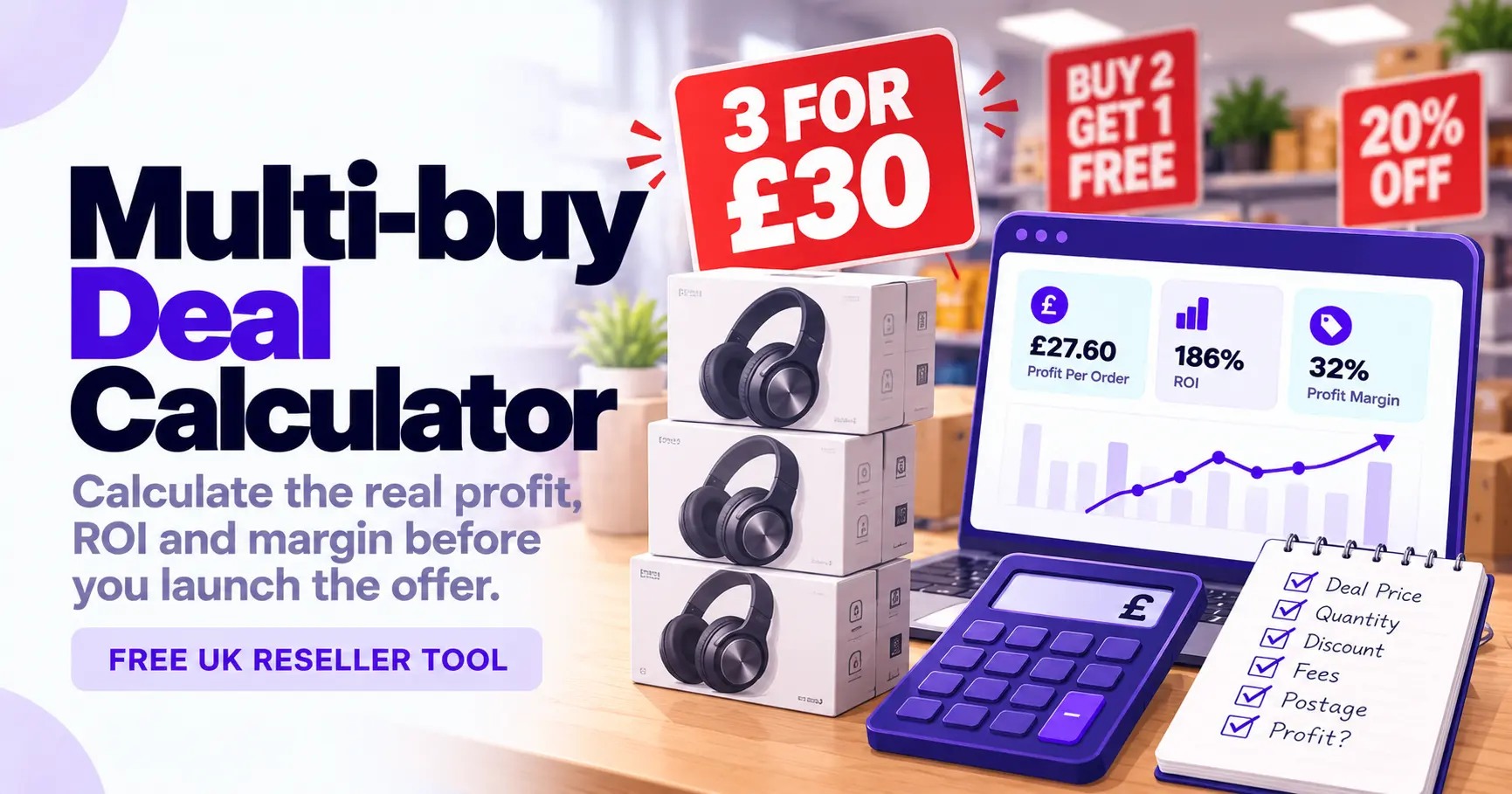
FREE UK RESELLER PRICING TOOL
Multi-buy Deal Calculator UK
Calculate the real profit, ROI and margin behind multi-buy promotions before you launch the offer.
Test fixed-price deals, percentage discounts and Buy X Get Y Free promotions to see the customer saving, effective unit price, campaign profit and maximum discount you can safely offer.
Multi-buy Deal Calculator
Test multi-buy promotions, calculate the real profit per order and find the maximum discount you can safely offer.
Deal Structure
Choose the type of multi-buy promotion you want to evaluate.
Expected Sales Volume
Estimate the number of completed multi-buy orders.
Marketplace and Selling Costs
Include charges deducted from each completed transaction.
Fulfilment Costs Per Order
Enter the costs required to prepare and dispatch one order.
Your Profit Targets
Set the minimum return each order should achieve.
Enter Your Deal Figures
Deal Score: —Your deal price, customer saving, estimated profit and SellerStack verdict will appear here.
The total product price charged for one qualifying order.
Deal Price vs Normal Price
Projected Promotion Performance
The minimum product price estimated to meet your selected targets.
The largest estimated discount you can offer while meeting all targets.
Does the Deal Meet Your Targets?
The estimated price required to recover product, selling and fulfilment costs without making a profit.
Multi-buy offers can increase order value, but they may also reduce your profit per unit. Check demand, stock availability and marketplace rules before launching a promotion.
What Does the Multi-buy Deal Calculator Do?
The Multi-buy Deal Calculator helps you test whether a promotion still produces enough profit after the discount and selling costs are included.
You can compare fixed multi-buy prices, percentage discounts and Buy X Get Y Free offers, then see the customer saving, effective price per item, profit per order, ROI and profit margin.
The calculator can also estimate the wider performance of the promotion using your expected number of orders, including projected campaign revenue and campaign profit.
Why Offer Multi-buy Deals?
A multi-buy promotion gives customers a reason to purchase more than one item in the same order by offering better value when they increase the quantity.
For the seller, the goal is not simply to increase the number of units sold. The promotion needs to increase order value while still protecting the profit generated by each transaction.
🛒 Higher Order Value
Encourage buyers who were considering one item to purchase two, three or more in the same transaction.
📦 More Units Per Order
Move several items through one customer order rather than relying on separate future transactions.
🔄 Faster Stock Movement
A well-priced offer can help move inventory that you want to sell more quickly.
💷 Shared Fulfilment Costs
Some postage, packaging and transaction costs may be spread across several units in one order.
More units sold does not automatically mean more profit
A promotion can increase revenue while reducing the amount you earn from each order. Always check the deal after costs rather than judging it by sales volume alone.
Why Multi-buy Pricing Can Be Misleading
A multi-buy discount can look modest until you calculate the cost of supplying every item in the order and completing the sale.
Three items normally worth £36
Standard price: 3 × £12 = £36
Multi-buy offer: 3 for £30
Customer saving: £6
The offer looks straightforward, but the real profit still depends on product cost, marketplace fees, payment charges, advertising, postage, packaging and other selling expenses.
The discount comes directly out of the order economics
Reducing a £36 order to £30 removes £6 of revenue immediately. The promotion only makes sense if the remaining revenue still produces an acceptable profit after every relevant cost.
Three Ways to Structure a Multi-buy Promotion
The calculator supports the three main promotion structures shown on the current tool.
Fixed Multi-buy Price
Set one clear price for a specified quantity.
Examples:
2 for £20
3 for £25
5 for £50
This format gives the buyer a simple total price that is easy to understand.
Percentage Discount
Reduce the normal combined value by a percentage once the customer buys the required quantity.
Examples:
Buy 3 and save 15%
Buy 4 and save 20%
The discount scales automatically with the normal selling price.
Buy X Get Y Free
Give the customer additional units without increasing the price by the full normal value.
Examples:
Buy 1, Get 1 Free
Buy 2, Get 1 Free
Remember that the free unit still has a stock cost and may also increase fulfilment costs.
No promotion type is automatically best. The right structure depends on the product cost, normal selling price, customer saving, fulfilment economics and the profit you need from the order.
What Makes the SellerStack Multi-buy Calculator Different?
A basic discount calculator tells you how much money is taken off the normal selling price. That is only one part of the decision.
The SellerStack calculator is designed to model the full resale order and the wider promotion.
Normal Selling Price
Establish the full value of the products before the promotion.
Product Cost
Include the cost of every unit supplied in the deal.
Promotion Structure
Test fixed prices, percentage discounts or Buy X Get Y Free.
Selling Costs
Include fees, advertising, postage, packaging and preparation.
Profit Targets
Compare the promotion against your profit, ROI and margin goals.
Campaign Performance
Estimate projected revenue and profit across multiple orders.
What Costs Should You Include?
The more units contained in the offer, the more important it becomes to account for the full cost of fulfilling the order.
Product & Promotion Costs
- Product cost for every unit
- Preparation costs
- Discount given to the customer
- Free units in Buy X Get Y offers
- Returns reserve
Selling & Fulfilment Costs
- Marketplace percentage fees
- Fixed transaction fees
- Payment charges where applicable
- Advertising or promoted listing costs
- Actual postage
- Packaging
- Other expected order costs
Recheck postage when quantity increases
Two or three products may require a larger parcel or different shipping service than one item. Do not automatically reuse the single-item postage cost.
Understanding Your Multi-buy Results
Each result answers a different pricing question.
Profit Per Order
Shows the expected amount remaining from one multi-buy order after the costs included in your calculation.
Customer Saving
Shows how much the buyer saves compared with purchasing the same quantity at the normal individual price.
Effective Price Per Item
Divides the promotional order price across the units supplied, making it easier to see the real discounted unit value.
ROI
Measures the expected return relative to the money invested in the products supplied in the deal.
Profit Margin
Shows how much of the order revenue remains as profit after the included costs.
Break-even Deal Price
Helps identify the minimum promotion price required to recover the costs included in the calculation.
How Much Discount Can You Safely Offer?
There is no universal percentage that makes a multi-buy promotion profitable.
A safe discount depends on your normal selling price, product cost, marketplace fees, fulfilment costs and the minimum profit, ROI and margin you want to protect.
Use the maximum safe discount as your boundary
The calculator estimates how far you can reduce the deal before the promotion stops meeting the targets you entered.
This gives you a more useful pricing limit than choosing a discount simply because 10%, 20% or 30% looks attractive to buyers.
A 20% discount may be comfortable for one product and unprofitable for another. Test the actual economics instead of relying on a generic discount range.
Look Beyond One Order: Estimate Campaign Performance
A useful feature of this calculator is the ability to enter an expected number of orders and model the promotion beyond a single transaction.
Projected Campaign Revenue
Estimates the total sales revenue if the promotion generates the number of orders you expect.
Projected Campaign Profit
Estimates the total profit generated across those promotional orders after the included costs.
A lower profit per order may still make commercial sense if the offer creates enough additional profitable orders. But higher revenue alone is not evidence that the promotion is working.
Understanding the SellerStack Multi-buy Verdict
The Multi-buy Verdict looks at the promotion as a complete pricing decision rather than showing only the discount or revenue.
It considers profit per order, ROI, profit margin, customer saving, discount level and the targets selected in the calculator.
How to read the Multi-buy Verdict
| Verdict | What It Suggests |
|---|---|
| 🏆 Excellent Multi-buy Deal | The promotion performs strongly against the pricing assumptions and targets entered. |
| ✅ Good Multi-buy Opportunity | The deal offers customer value while maintaining healthy profitability under the current assumptions. |
| ⚖️ Borderline Multi-buy Deal | The promotion is close to one or more of your profitability limits. |
| ⚠️ Weak Multi-buy Deal | The discount or selling costs are putting too much pressure on the expected return. |
| ⛔ Rework the Promotion | Adjust the quantity, deal price or discount before launching the offer. |
Worked Example: 3 for £30
Testing a fixed-price multi-buy offer
| Input | Example |
|---|---|
| Normal selling price | £12 each |
| Product cost | £4 each |
| Normal value of 3 items | £36 |
| Multi-buy offer | 3 for £30 |
| Customer saving | £6 |
| Effective price per item | £10 |
The customer receives a £6 saving and effectively pays £10 per item instead of £12.
But the £30 order also contains £12 of product cost before marketplace fees, postage, packaging, advertising and any other selling expenses are considered.
Enter those costs into the calculator to see the real profit, ROI, margin and Multi-buy Verdict before publishing the promotion.
When Do Multi-buy Promotions Work Best?
Multi-buy deals tend to make more sense when buyers have a natural reason to want several units in one transaction.
Lower-value Products
Multiple units can create a more worthwhile order value than selling each product separately.
Repeat-use Products
Customers may already have a practical reason to purchase more than one.
Complementary Products
Related products can make sense together when the buyer sees a clear combined benefit.
Inventory Reduction
A controlled discount may help move stock faster while still protecting an acceptable return.
Shared Fulfilment
Several items can sometimes be packed and dispatched more efficiently in one order.
Frequent Multi-item Buyers
Existing buying behaviour may indicate that customers already want more than one unit.
Products That Can Suit Multi-buy Offers
👕 Clothing
Children’s clothing, basics and similar-size items.
📚 Books & Media
Books, DVDs, Blu-rays and related collections.
🎮 Games & Toys
Lower-value games, toys, figures and collectable ranges.
📱 Accessories
Phone accessories, cables and other repeat-use products.
🎨 Craft Supplies
Materials that buyers naturally use in multiple quantities.
🏠 Home & Kitchen
Small household products and complementary kitchen items.
Multi-buy Deal vs Product Bundle
These pricing strategies are related, but they are not identical.
| Multi-buy Deal | Product Bundle | |
|---|---|---|
| Main idea | Reward the buyer for purchasing a quantity | Sell several products together as one offer |
| Typical example | 3 for £30 | Camera + case + memory card for £60 |
| Products | Often identical or closely related | Can be different complementary products |
| Main pricing question | How much discount can I safely offer? | What should the combined bundle price be? |
Selling different products together?
Use the Bundle Pricing Calculator when you are combining several products into one package and want to compare the bundle with selling them separately.
Common Multi-buy Pricing Mistakes
Avoid these before launching the promotion
Offering too much discount
A promotion can look attractive to buyers while leaving too little profit for the seller.
Ignoring marketplace fees
Percentage and fixed charges still apply to promotional orders where relevant.
Using single-item postage
Several units may require a different parcel size or delivery service.
Forgetting packaging
Larger orders can require stronger or larger packaging.
Ignoring advertising costs
Promoted listings and other paid acquisition costs can reduce the profit left from the deal.
Looking only at revenue
Higher order values are useful only when the resulting orders remain sufficiently profitable.
Copying a competitor’s deal
Another seller may have very different stock costs, fee rates and profit requirements.
Ignoring campaign performance
Evaluate the promotion across the expected number of orders, not only one ideal transaction.
Related SellerStack Pricing Tools
Product Pricing Calculator
Calculate a profitable normal selling price before deciding how much room you have for a promotion.
Calculate Selling Price →Bundle Pricing Calculator
Price several different products together and compare the bundle with individual sales.
Calculate Bundle Price →Resale Profit Calculator
Calculate take-home profit after product, marketplace and fulfilment costs.
Calculate Resale Profit →Break-Even Calculator
Find the selling price required to recover your included costs.
Calculate Break-Even →Reseller ROI Calculator
Compare the return generated by different pricing and stock decisions.
Calculate ROI →Maximum Buy Price Calculator
Work backwards from the selling price to calculate how much you can afford to invest in stock.
Calculate Buying Limit →Check the Promotion Against Marketplace-Specific Fees
Once you know where the offer will run, use the relevant SellerStack marketplace calculator when you need more detailed platform-specific fee assumptions.
eBay Calculator
Open eBay Calculator →Amazon FBA Calculator
Open Amazon Calculator →Vinted Calculator
Open Vinted Calculator →Etsy Calculator
Open Etsy Calculator →Depop Calculator
Open Depop Calculator →TikTok Shop Calculator
Open TikTok Calculator →Price Smarter. Protect Your Profit.
Download the UK Reseller Profit Toolkit for profit worksheets, pricing checks, marketplace fee references and links to SellerStack calculators.
Multi-buy Deal Calculator FAQs
What is a multi-buy deal?
A multi-buy deal gives customers an incentive to purchase a specified quantity, usually through a fixed promotional price, percentage discount or free additional units.
Is a bigger multi-buy discount always better?
No. A larger discount can increase customer savings while reducing your profit per order. Test the full costs and your target return before increasing the discount.
Which multi-buy offer is best?
It depends on your product, selling price, costs and customer behaviour. Compare fixed-price, percentage and Buy X Get Y Free structures using the same profitability targets.
What is the difference between a multi-buy and a bundle?
A multi-buy normally rewards the customer for buying a certain quantity, while a bundle combines several products into one packaged offer. SellerStack provides a separate Bundle Pricing Calculator for that pricing decision.
Does Buy One Get One Free really mean the second item costs nothing?
It may be free to the customer, but it is not free to the seller. You still need to account for the stock cost of both units plus the costs of fulfilling the order.
Why does the calculator ask for expected orders?
Expected orders allow the calculator to estimate projected campaign revenue and campaign profit instead of analysing only one transaction.
What is effective price per item?
It is the promotional order price divided across the number of units supplied. It shows the real selling value of each item after the multi-buy discount.
What is the maximum safe discount?
It is an estimate of how much discount you can offer before the promotion stops meeting the profit, ROI or margin targets used in the calculation.
Should I include postage and packaging?
Yes. Multi-item orders may require different packaging or postage from a single-item sale, so use the expected cost of fulfilling the actual promotion.
Can I use the calculator for any marketplace?
The calculator can be used wherever you can reasonably estimate the selling costs. Use SellerStack’s dedicated marketplace calculators when you need more platform-specific fee analysis.
Can a multi-buy promotion increase revenue but reduce profit?
Yes. Selling more units can increase total revenue while a deep discount or higher fulfilment cost reduces the profit generated by each order.
How should I choose between a fixed price and percentage discount?
Test both structures against the same product costs and profit targets. Choose the option that gives customers a clear reason to buy more while still protecting an acceptable return.
A Good Multi-buy Deal Should Reward the Buyer Without Punishing the Seller
The purpose of a multi-buy promotion is not simply to sell more units. It is to create a stronger order while keeping enough profit in the transaction.
Compare the customer saving with your product cost, marketplace fees and fulfilment expenses, then check the resulting profit, ROI and margin before launching the offer.
If the promotion only works when you ignore part of the cost, the deal needs to be reworked.
Build Promotions Around Profit, Not Guesswork
Explore SellerStack’s free UK reseller calculators for pricing, profit, sourcing, marketplace fees, shipping and inventory decisions.
Explore All SellerStack Tools →