
FREE UK RESELLER SOURCING TOOL
Maximum Buy Price Calculator UK
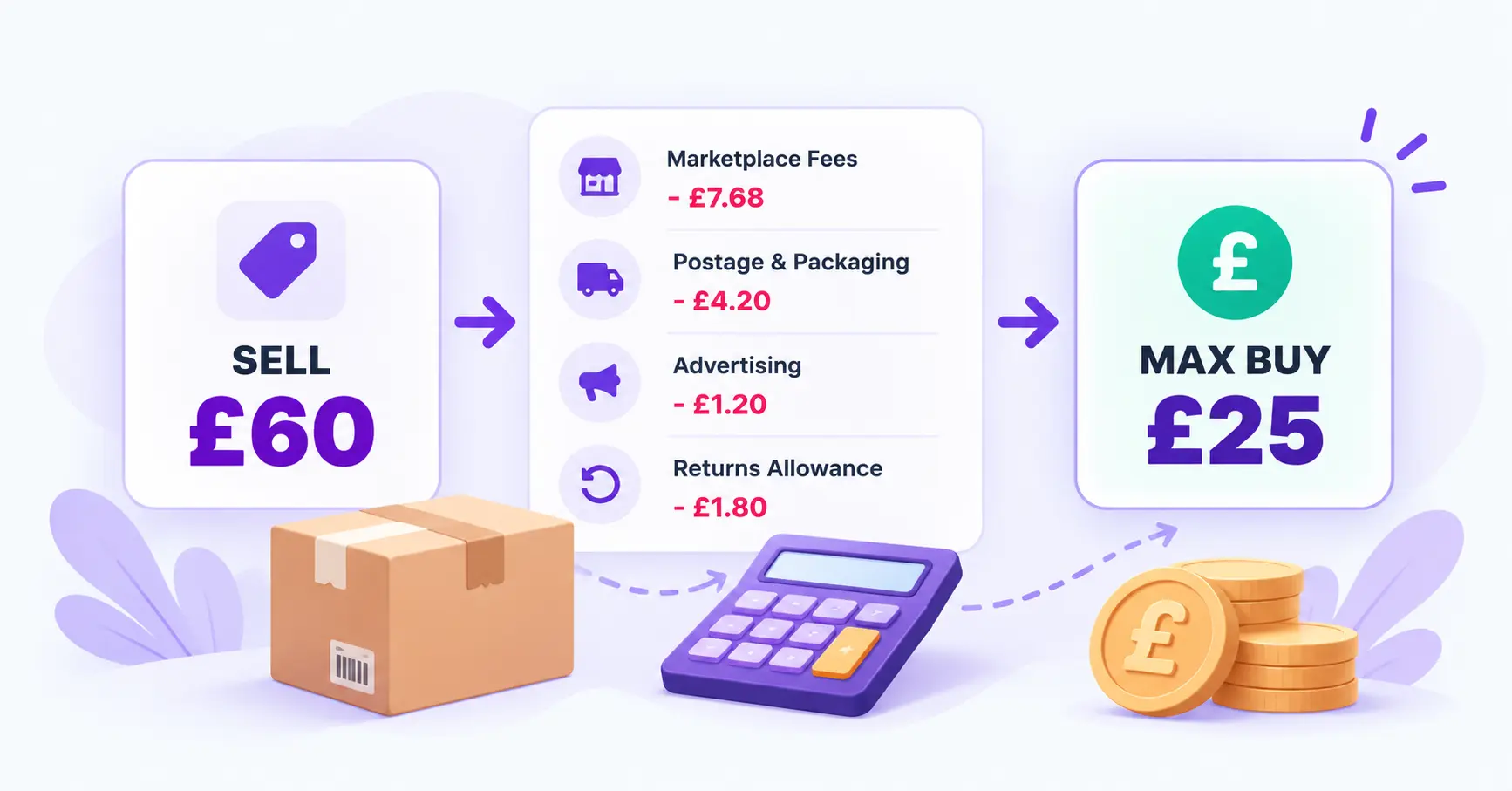
Work backwards from your expected selling price to calculate the most you can pay for stock while still protecting your minimum profit, target ROI and profit margin.
Include marketplace fees, postage, fulfilment costs and an optional safety buffer to set a clear buying limit before you negotiate, bid or commit money to inventory.
Maximum Buy Price Calculator
Work backwards from your expected selling price to calculate the highest amount you should pay while protecting your profit, ROI and margin.
Enter the realistic selling price and any delivery charge collected from the buyer.
Include the selling fees, advertising costs and expected returns allowance deducted from the order.
Include every cost required to prepare, pack and dispatch the item to the customer.
Set the minimum financial results the purchase must achieve. The calculator will use the strictest active target.
Optional: enter the seller’s asking price to receive a buy, negotiate or walk-away verdict.
Enter Your Figures
Do not pay more than this if you want to achieve your selected targets.
Target Check
Asking Price Analysis
Your Buying Price Limits
How This Result Is Calculated
The calculator subtracts marketplace fees, advertising, returns, fulfilment costs and your required profit targets from the expected order revenue. It then uses the lowest qualifying purchase price as your maximum.
What Does the Maximum Buy Price Calculator Do?
The Maximum Buy Price Calculator works backwards from your expected selling price to estimate the highest amount you can pay for stock while still protecting the financial targets you set.
Instead of buying an item first and checking the profit afterwards, you can account for marketplace fees, postage, packaging, preparation costs, advertising, returns and your required profit before committing any money.
The result gives you a clear maximum buying price, a more conservative recommended buying price and, when you enter the seller’s asking price, a practical buying verdict.
Why Your Maximum Buy Price Matters
Reselling profit starts at the point of purchase. A strong selling price cannot fully compensate for paying too much for stock, especially once marketplace fees, postage and other expenses are deducted.
Setting a buying limit before you negotiate, bid or place an order makes the decision much more objective.
Remove Emotion from Buying
A promising item can make it tempting to stretch your budget. A calculated maximum gives you a number to work from before excitement influences the decision.
Protect Your Profit
Every extra pound paid for inventory reduces the money left after the sale. Buying within a defined limit helps protect your intended return.
Negotiate with a Clear Target
When you know your recommended price and absolute ceiling, you can negotiate around the numbers rather than guessing how far you should go.
Know When to Walk Away
Not every potentially profitable item is a good purchase. If the price no longer meets your targets, preserving your capital for another opportunity can be the better decision.
Calculate before you negotiate
Research the likely selling price first, enter realistic costs and decide your buying limit before discussing price with the seller. That gives you a clear negotiating range from the start.
How the Maximum Buy Price Is Calculated
The calculator starts with the revenue you expect from the sale and works backwards through the costs and profitability requirements that affect the purchase.
-
Estimate the selling price.
Use a realistic expected sale price based on comparable products and actual market demand. -
Add buyer postage where applicable.
If the buyer pays a separate delivery charge, include it so the calculator can assess the full order revenue. -
Account for marketplace costs.
Include percentage fees, fixed transaction charges, promoted listings or advertising and any returns allowance you want to use. -
Add fulfilment and preparation costs.
Include the postage you pay, packaging, cleaning, testing, repairs and other per-item expenses. -
Set your profit targets.
Enter the minimum profit, ROI and profit margin you want the purchase to achieve. -
Compare the target limits.
The calculator evaluates your active financial targets and uses the strictest qualifying buying limit. -
Apply your safety buffer.
The optional buffer reduces the maximum figure to create a more conservative recommended buying price.
Work backwards from the money coming in
Expected order revenue − selling costs − fulfilment costs − required profitability allowance = buying limit
Profit, ROI and profit margin measure the opportunity differently, so the calculator checks the active targets rather than relying on one profitability measure alone.
What Costs Should You Include?
The calculation is only as useful as the figures entered. Small costs can look insignificant individually but become meaningful when several are combined.
Revenue and Marketplace Costs
- Expected selling price
- Buyer postage charged
- Marketplace percentage fee
- Fixed transaction fee
- Advertising or promoted listing rate
- Returns reserve
Fulfilment and Profit Targets
- Actual postage cost
- Packaging materials
- Cleaning or preparation
- Other selling expenses
- Minimum profit
- Target ROI
- Target profit margin
- Safety buffer
Understanding Your Maximum Buy Price Results
The calculator gives you several numbers because each one answers a different buying question.
Maximum Buy Price
This is the highest purchase price that satisfies the strictest of the profit, ROI and margin targets you entered.
Treat it as your absolute target-based ceiling, not automatically as the price you should offer.
Recommended Buy Price
This reduces the maximum buying price by your selected safety buffer.
It gives you more protection against a lower selling price, unexpected costs or a deal that takes longer to sell.
Break-even Buy Price
This represents the point at which the projected sale no longer produces a profit after the selling and fulfilment costs included in the calculation.
It is useful as a risk reference, but it should not normally be confused with a sensible sourcing target.
Maximum Safe Bid
For auctions or competitive bidding, this gives you a practical ceiling to keep in mind before bidding starts.
Decide the number beforehand and avoid increasing it simply because another bidder is still active.
Maximum does not mean recommended
The maximum buying price is the highest figure that still meets the selected financial targets. The recommended buying price gives you additional breathing room through the safety buffer.
When possible, sourcing below the recommended figure gives you more flexibility if the eventual sale does not go exactly to plan.
Understanding the SellerStack Buy Verdict
Entering the seller’s current asking price allows the calculator to compare the deal with your buying limits and give you a more practical sourcing assessment.
How to read the verdict
| Verdict | What It Means | Typical Action |
|---|---|---|
| 🏆 Excellent Buying Opportunity | The asking price sits comfortably within your safer buying range. | Verify the item and market evidence, then consider acting while the numbers remain attractive. |
| ✅ Good Buying Opportunity | The purchase fits your targets with a useful amount of room remaining. | Check condition, demand and recent prices before committing. |
| ⚖️ Safe Buy Price | The deal remains within your limits but offers less protection against unexpected changes. | Consider negotiating lower where possible. |
| ⚠️ Only Buy If Negotiated | The asking price is above the safer recommended level and closer to your maximum. | Negotiate rather than accepting the asking price immediately. |
| ⛔ Walk Away | The asking price exceeds the buying limit generated from your selected targets. | Walk away unless the price, selling assumptions or other circumstances materially change. |
Profit, ROI and Profit Margin: Why Check All Three?
A sourcing opportunity can look strong under one measurement and much weaker under another. That is why the calculator lets you set more than one type of profitability target.
| Measure | What It Focuses On | Why It Matters When Buying Stock |
|---|---|---|
| Net Profit | The cash left after the purchase cost and other included selling expenses. | Helps ensure an item produces enough actual pounds of profit to justify the sale. |
| ROI | The profit generated in relation to the money invested in the stock. | Useful when comparing how efficiently different sourcing opportunities use your buying capital. |
| Profit Margin | The proportion of sales revenue that remains as profit. | Helps judge the profitability of the sale relative to its revenue. |
A high percentage does not always mean a strong deal
A low-cost item can produce a very high ROI while generating only a small amount of cash profit. Equally, a higher-cost item may produce a lower ROI but considerably more pounds of profit.
Consider the cash profit, return on capital, margin, selling speed and risk together rather than judging the purchase from one percentage alone.
Worked Example: Buying a Console to Resell
Imagine you are considering a video game console advertised locally. Your market research suggests an achievable selling price of around £120.
Example figures
| Input | Example |
|---|---|
| Expected selling price | £120.00 |
| Buyer postage | £5.99 |
| Marketplace fee | 12.8% |
| Fixed transaction fee | £0.30 |
| Advertising rate | 2% |
| Returns reserve | 3% |
| Actual postage cost | £6.00 |
| Packaging | £1.20 |
| Preparation cost | £2.00 |
| Minimum profit | £35.00 |
| Target ROI | 80% |
| Target margin | 30% |
| Safety buffer | 10% |
The calculator evaluates these figures and identifies which of your profit, ROI or margin requirements creates the lowest qualifying purchase price.
The 10% safety buffer then lowers that maximum to produce a more conservative recommended buying price.
If the seller’s asking price sits below the recommended figure, the deal has more room to absorb changes. If the asking price approaches or exceeds the maximum, your negotiating decision becomes much more important.
Common Buying Mistakes That Reduce Reseller Profit
Most poor sourcing decisions do not come from one dramatic error. They usually come from several small assumptions being too optimistic.
Watch for these before buying
Pricing from active listings
An asking price shows what another seller wants. It does not automatically show what buyers are actually paying.
Forgetting selling fees
Marketplace charges and advertising costs can materially change an opportunity that initially looks profitable.
Underestimating postage
Large, heavy or awkward parcels can cost more to send than expected and quickly reduce profit.
Ignoring preparation costs
Cleaning products, replacement parts, batteries, repairs and packaging all affect the real cost of the item.
Using an unrealistic selling price
A buying limit based on an optimistic resale estimate can give you a false sense of profitability.
Buying emotionally
Scarcity, excitement and competitive bidding can encourage you to exceed a limit that made sense before the purchase.
Why Use a Safety Buffer?
A resale calculation is based on estimates. Your final selling price, postage, advertising costs, returns or preparation requirements may differ from what you expected when sourcing the item.
The safety buffer reduces your calculated maximum buying price to create extra room between what you could pay and what you would ideally like to pay.
A safety buffer cannot fix unrealistic inputs
If the expected selling price is too optimistic or important costs have been omitted, adding a buffer does not make the underlying calculation reliable.
Start with realistic figures first, then use the buffer as an additional layer of protection.
How to Use Your Buying Limit When Negotiating
Knowing the maximum price is useful, but you do not need to reveal that number to the seller. Your recommended price can instead become an internal target around which you negotiate.
-
Research the item before negotiating.
Check realistic selling prices, condition and likely demand first. -
Calculate your recommended and maximum prices.
Decide your preferred purchase price and your absolute limit before making an offer. -
Leave room for discussion.
Where appropriate, begin below the price you are ultimately prepared to accept. -
Use genuine defects in your calculation.
Repairs, missing accessories or condition issues can reduce the item’s resale value or increase preparation costs. -
Consider multi-item purchases carefully.
A bundle discount can improve the economics, provided the additional inventory is stock you actually want. -
Be prepared to stop.
Once the price moves beyond the level supported by your numbers, walking away protects your capital.
Where Can You Use the Maximum Buy Price Calculator?
The calculator is not tied to one marketplace. You can adjust the fee, advertising and fulfilment inputs to reflect the selling route you plan to use.
| Marketplace / Selling Route | How the Calculator Can Help |
|---|---|
| eBay UK | Work backwards from your expected sale while accounting for relevant selling and promoted listing costs. |
| Amazon | Assess sourcing opportunities after entering the Amazon selling and fulfilment costs relevant to your offer. |
| Vinted | Set a stock-buying limit using the costs that apply to your particular selling arrangement. |
| Depop | Compare fashion sourcing opportunities after allowing for applicable selling, advertising and delivery costs. |
| Etsy | Evaluate vintage or resale inventory using your expected selling price and relevant transaction costs. |
| Facebook Marketplace | Particularly useful when negotiating purchases directly with local sellers. |
| TikTok Shop | Include selling and advertising assumptions before deciding how much stock capital to commit. |
| Shopify / Own Store | Use your own payment, advertising and fulfilment costs when assessing inventory purchases. |
Product Research Tools to Use Before You Buy
A maximum buying price depends heavily on the expected selling price. Researching demand and realistic market prices before entering your figures can therefore improve the quality of the decision.
SellerAmp SAS
Analyse Amazon sourcing opportunities using profitability, sales-rank, competition and restriction information before committing money to inventory.
ZIK Analytics
Research demand, competitor pricing and marketplace sales data before deciding what selling price to use in your sourcing calculation.
Affiliate disclosure: Some links above are affiliate links. SellerStack may earn a commission if you purchase through them, at no additional cost to you.
Already know what you’re paying for the item?
Use the Resale Profit Calculator to enter the actual purchase price and calculate your estimated profit, ROI and margin after selling costs.
Related SellerStack Calculators
Use the Maximum Buy Price Calculator before purchasing stock, then move to the appropriate tool as your pricing or sourcing decision develops.
Reseller ROI Calculator
Measure the return generated by the money invested in a resale opportunity.
Open ROI Calculator →Break-Even Calculator
Find the selling price needed to recover your purchase and selling costs without making a loss.
Calculate Break-Even →Product Pricing Calculator
Work out a selling price based on your costs and profitability targets.
Calculate Selling Price →Retail Clearance Profit Calculator
Assess discounted retail stock before committing capital to a clearance sourcing opportunity.
Analyse Clearance Stock →Charity Shop ROI Calculator
Check the potential return from charity-shop sourcing opportunities.
Analyse Charity Shop Find →Bundle Pricing Calculator
Price multi-item bundles while protecting the profit you need from the combined sale.
Price a Bundle →Maximum Buy Price Calculator FAQs
What is a maximum buy price?
It is the highest stock purchase price that still satisfies the active profit, ROI and profit-margin targets entered into the calculator.
What is the difference between maximum and recommended buy price?
The maximum buy price is the target-based ceiling generated by the calculation. The recommended buy price reduces that figure using your selected safety buffer.
Do I need to enter all three profit targets?
Use the targets that matter to your buying decision. When multiple targets are active, the calculator compares them and uses the strictest qualifying buying limit.
Why include a safety buffer?
It creates additional room for changes such as a lower selling price, unexpected preparation costs or other expenses that were not fully anticipated when sourcing.
Should I include buyer postage?
If you charge the buyer separately for delivery, include that amount in the Buyer Postage Charged field so the calculator can account for the full expected order revenue.
Should I use active listings to estimate the selling price?
Active listings can provide context, but an asking price does not prove that buyers are paying that amount. Use the strongest realistic market evidence available when estimating the likely selling price.
Can I use the calculator for auctions?
Yes. Calculate your limit before bidding and use the Maximum Safe Bid result as a reference so competitive bidding does not push you beyond the price supported by your numbers.
Can I use it for Amazon sourcing?
Yes, provided you enter the relevant selling, advertising, fulfilment and other per-item costs that apply to the opportunity you are assessing.
Does the calculator include VAT?
VAT is not calculated automatically by this tool. If VAT applies to your circumstances, account for it separately when assessing the transaction.
What should I do if the seller’s asking price is above my maximum?
You can try to negotiate the price down. If the seller will not move and your assumptions have not changed, walking away avoids accepting a purchase that falls outside the targets you set.
What if the expected selling price changes?
Run the calculation again using the new estimate. The buying limit depends directly on the revenue and costs you expect from the eventual sale.
Is this calculator suitable for beginners?
Yes. It can be particularly useful when you are learning to consider the full cost of a purchase rather than comparing only the buying price and selling price.
Profit Starts with the Buying Decision
Knowing what an item might sell for is only half of a sourcing decision. The other half is knowing how much you can afford to invest in it after fees, fulfilment costs and your required return are taken into account.
Use the recommended buy price as your preferred target and the maximum buy price as the point you do not want to cross under the assumptions entered.
If the numbers stop working, another sourcing opportunity will come along. Protecting your capital is part of profitable reselling too.
Make the Next Decision with the Numbers
Explore SellerStack’s free UK reseller calculators for sourcing, pricing, profit, marketplace fees, shipping and inventory decisions.
Explore All SellerStack Tools →