SELLERSTACK MARKETPLACE COMPARISON · UPDATED FOR 2026
eBay vs Amazon UK: Which Is Better for Resellers?
Compare product fit, fees, fulfilment, competition, stock investment and operating workload before deciding whether your resale inventory belongs on eBay, Amazon or both.
eBay vs Amazon for UK Resellers
eBay and Amazon regularly change selling fees, fulfilment programmes, account requirements and marketplace policies. This guide compares the current UK position while focusing on the longer-term business decisions that determine which marketplace fits a particular type of stock.
Last reviewed: October 2026
Is eBay or Amazon Better for UK Resellers?
Neither marketplace is automatically better.
eBay is often the more natural starting point for one-off products, used goods, collectables, liquidation, specialist inventory and stock where condition varies between individual units.
Amazon can become more attractive when you have repeatable inventory, reliable replenishment, standardised products and enough margin to support Amazon’s marketplace and fulfilment costs.
Serious sellers should compare the economics before committing stock. SellerStack’s UK Marketplace Profit Comparison Calculator lets you test the same product across eBay, Amazon FBA and other marketplaces using one set of figures.
The stronger marketplace is the one that gives the product the best combination of achievable price, demand, profit, capital efficiency, fulfilment practicality and manageable risk.
This Is a Business-Model Comparison, Not Just a Fee Comparison
eBay and Amazon do not simply charge different percentages for doing the same job.
The marketplaces can encourage very different ways of sourcing, listing, storing, fulfilling and replenishing inventory.
If your main question is specifically how the selling costs compare, read our separate Amazon FBA vs eBay selling-cost comparison .
This guide goes further and asks which marketplace model makes more sense for the stock and business you actually want to run.
The SellerStack eBay vs Amazon Decision Framework
Marketplace choice should start with the stock rather than with a personal preference for one selling platform.
Compare these seven areas.
Product Repeatability
Can you replenish the same product repeatedly, or is every unit different?
Demand
Is there enough genuine buyer demand to move the inventory at the price you need?
Margin
What remains after stock, marketplace, fulfilment, advertising and operational costs?
Capital Requirement
How much money needs to be committed before you can produce meaningful sales?
Fulfilment Load
Will you store, pick, pack and dispatch orders yourself, or pay a fulfilment network to do more of that work?
Competition
Are you competing through an individual listing or against other sellers offering the same catalogue product?
Inventory Risk
What happens if the product does not sell at the expected price or speed?
The Marketplace Should Fit the Inventory Model
A one-off £150 vintage camera and 200 identical household products should not automatically be routed through the same selling system.
Start with the economics and characteristics of the stock, then choose the marketplace.
eBay vs Amazon UK: Quick Comparison
| Area | eBay UK | Amazon UK |
|---|---|---|
| Strong Stock Fit | Unique, used, specialist and varied inventory | Repeatable, standardised and replenishable inventory |
| Listing Structure | Seller creates individual listings | Seller often joins an existing catalogue product page |
| Fulfilment | Primarily seller managed | FBM or Fulfilment by Amazon |
| Used / One-Off Stock | Strong fit across many categories | Possible in eligible categories and conditions |
| Repeatable SKUs | Possible | Potentially very strong fit |
| Seller Costs | Seller-type and category dependent | Plan, category and fulfilment dependent |
| Storage Model | Normally controlled by seller | Seller storage or FBA storage |
| Scaling Fulfilment | Usually requires seller systems or external fulfilment | FBA can take over significant fulfilment workload |
| Brand Infrastructure | Seller/shop focused | Strong Amazon brand and catalogue infrastructure |
eBay: Flexible Inventory and Individual Listings
eBay works particularly well when each unit needs to be presented as an individual product.
A seller can photograph the exact item, describe its condition, specify what is included and set a price based on the individual characteristics of that unit.
That flexibility makes eBay useful for stock such as:
- used products
- collectables
- vintage stock
- replacement parts
- open-box goods
- graded or condition-sensitive inventory
- liquidation stock
- one-off sourcing finds
If eBay is likely to become your primary marketplace, our complete eBay UK selling guide goes deeper into product research, listings, seller type, pricing, fees and fulfilment.
eBay Strengths
- Flexible individual listings
- Broad category coverage
- Used and pre-owned inventory
- Auctions and fixed-price listings
- Product Research data
- Detailed condition descriptions
- Strong long-tail search potential
eBay Trade-Offs
- More individual listing work
- Seller normally manages physical inventory
- Seller handles more fulfilment activity
- Business fees vary by category
- Offers and customer messages add workload
- Scaling unique stock can become labour intensive
Research the Product, Then Calculate the Deal
Our guide to the best items to sell on eBay UK explains how to evaluate categories without assuming that every popular product is automatically profitable.
Amazon: Repeatable Products, Catalogue Selling and Fulfilment Scale
Amazon frequently becomes more attractive when the seller can source the same product repeatedly.
Instead of creating an entirely separate product page for every identical unit, sellers commonly offer inventory against an existing catalogue product detail page.
That changes the business model.
Rather than asking:
How can I make this individual listing stand out?
the seller may need to ask:
Can I buy this SKU repeatedly, remain competitive and still make enough profit after Amazon’s costs?
Our complete guide to selling on Amazon UK covers FBA, FBM, seller plans, referral fees, sourcing and profitability in more detail.
Amazon Strengths
- Strong model for repeatable inventory
- Established catalogue structure
- FBA can handle major fulfilment tasks
- Potential access to Prime fulfilment
- Advertising infrastructure
- Brand-building tools for eligible sellers
- Detailed account and inventory reporting
Amazon Trade-Offs
- More product and category restrictions
- Competition can occur on the same product page
- FBA adds fulfilment and storage costs
- Inventory may require more upfront capital
- Account-health requirements matter
- Poor stock selection can create expensive inventory
Model FBA or FBM Before Buying Inventory
Enter your selling price, stock cost, referral fee, fulfilment expenses and other relevant costs before committing cash.
Seller Type Matters Before You Compare the Fees
One of the easiest ways to create a misleading eBay-versus-Amazon comparison is to compare the wrong account structures.
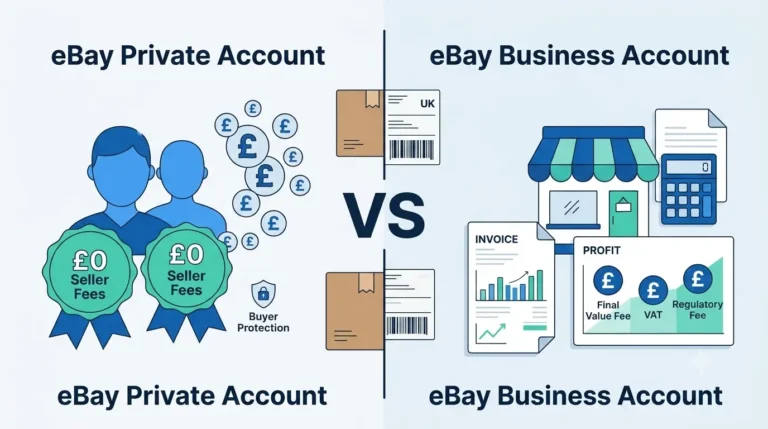
eBay Private Sellers
UK-based private sellers currently receive 300 free listings per month and normally pay no standard final value fee or Regulatory Operating Fee on eligible domestic sales, excluding relevant exceptions.
That does not mean a business buying products deliberately for resale should model its economics using private seller terms.
If you are unsure how the distinction affects your activity, read our guide to eBay private vs business seller accounts and fees .
eBay Business Sellers
Business sellers use a category-dependent final value fee structure, a per-order charge and the Regulatory Operating Fee, with other charges possible depending on the transaction and services used.
Amazon Individual Plan
Amazon’s Individual selling plan currently costs £0.75 per unit sold excluding VAT, in addition to the applicable referral fee and any other relevant costs.
Amazon Professional Plan
The Professional plan currently costs £25 per month excluding VAT, with referral and other relevant fees applying separately.
Amazon suggests that sellers expecting to sell more than around 35 units per month may find the Professional plan more appropriate, although plan features should also influence the decision.
If you are building a resale business, compare the eBay business structure with the Amazon selling plan and fulfilment model that would actually apply to your operation.
eBay vs Amazon Fees: Compare the Whole Cost Stack
There is no useful single percentage that answers: “Which marketplace is cheaper?”
The answer depends on the product, seller type, category, fulfilment method, advertising and other transaction-specific costs.
| Cost | eBay Business | Amazon |
|---|---|---|
| Core Selling Fee | Category-based final value fee | Category-based referral fee |
| Seller Plan | Shop optional | Individual or Professional plan |
| Per-Order / Per-Unit Cost | Per-order fee applies to business sales | Individual plan charges per unit |
| Regulatory Fee | 0.35% Regulatory Operating Fee | Not structured as an equivalent standalone fee |
| Fulfilment | Normally seller cost | FBM seller cost or FBA fees |
| Storage | Seller-controlled storage | Seller storage or FBA storage fees |
| Advertising | Optional Promoted Listings | Optional Amazon Ads |
Amazon states that most referral fees currently fall between 8% and 15%, but the actual rate depends on the product category and sometimes the selling-price band.
Do not apply one generic Amazon percentage to every sourcing opportunity.
eBay business final value fees also vary by category. Orders of £10 or less currently carry a 30p per-order fee, while orders above £10 carry a 40p per-order fee.
The current Regulatory Operating Fee is 0.35% of the total amount of the sale.
For the detailed cost question, use our Amazon FBA vs eBay fee comparison and then put your own product numbers into the dedicated eBay Fee & Profit Calculator and Amazon FBA & FBM Calculator .
Fulfilment May Be the Biggest Operational Difference
Marketplace fees are only part of the comparison.
The way inventory reaches the customer can change how much time, space and infrastructure the business requires.
eBay Seller Fulfilment
eBay business sellers usually retain direct control over stock, packaging, dispatch and courier selection.
This can be useful when products vary substantially in size, condition and value, because the seller can choose the fulfilment method for each order.
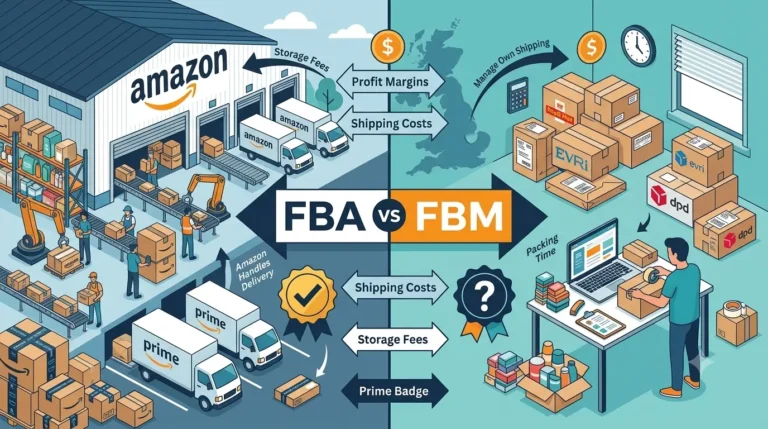
SellerStack’s Shipping & Fulfilment Hub connects the main guides and tools for controlling these costs.
You can also test delivery scenarios using our UK Shipping Cost Comparison Calculator .
Amazon FBM
Fulfilled by Merchant keeps the physical inventory and fulfilment process with the seller.
FBM can make sense when the seller already has an efficient dispatch operation, when a product is unsuitable for FBA or when the economics of sending inventory into Amazon’s network do not work.
Amazon FBA
Fulfilment by Amazon allows eligible inventory to be stored within Amazon’s fulfilment network. Amazon can then handle picking, packing, shipping and significant parts of the customer-service and returns process.
That convenience is not free.
FBA economics can include:
- fulfilment fees
- storage fees
- inbound shipping and preparation
- removal or disposal costs where relevant
- aged-inventory exposure
- advertising
- other programme-specific charges
Most qualifying products priced at or below £20 can now access Amazon’s Low-Price FBA rates, subject to the relevant eligibility conditions.
Amazon also introduced a 1.5% fuel and logistics-related surcharge on UK FBA fulfilment fees from 17 April 2026.
Do Not Compare FBA With Home Fulfilment as Though They Provide the Same Service
FBA may cost more because Amazon is performing work that an eBay or FBM seller may otherwise perform internally.
Compare both the financial cost and the operational time being transferred away from your business.
Which Products Fit eBay or Amazon Better?
| Inventory | Research First | Reason |
|---|---|---|
| One-off vintage camera | eBay | Individual condition and scarcity matter |
| 100 identical branded household items | Amazon | Repeatable catalogue inventory |
| Used games console | Compare Both | Condition, eligibility and selling price all matter |
| Wholesale consumable | Amazon | Potential replenishment and volume model |
| Charity-shop find | eBay | Unique inventory with uncertain replenishment |
| Own-brand product | Amazon | Brand and catalogue infrastructure may be valuable |
| Mixed liquidation returns | eBay | Individual condition varies between units |
| Fast-moving repeatable SKU | Amazon | Potential benefit from FBA and replenishment |
| Rare replacement component | eBay | Long-tail product search can be valuable |
These are research starting points, not permanent platform rules.
Check demand, selling price, competition, restrictions and actual costs for the specific product before buying inventory.
Marketplace Choice Should Influence How You Source Stock
The right sourcing strategy for eBay may look very different from a sourcing strategy designed around Amazon.
eBay Sourcing
eBay can accommodate inventory with irregular supply.
That makes sourcing channels such as charity shops, car boot sales, clearance, auctions and liquidation potentially useful when the economics work.
Amazon Sourcing
Amazon can reward repeatability more heavily.
Retail arbitrage, online arbitrage, wholesale, direct supplier relationships and private-label models can all depend on the ability to replenish a profitable SKU consistently.
Whichever route you take, start with our Sourcing & Stock Hub rather than treating the purchase price as the only sourcing decision.
The guide on how much to pay for resale stock explains how to work backwards from the realistic sale instead of buying first and trying to make the numbers work afterwards.
Know Your Buying Ceiling Before You Purchase
Work backwards from the expected sale price, costs, required profit, margin and ROI to calculate the maximum amount you should consider paying.
Product Research Works Differently on eBay and Amazon
Researching eBay Demand
eBay’s Product Research tool can provide historical sales and pricing information that helps sellers analyse comparable products rather than relying on active asking prices.
This is particularly useful when assessing one-off or condition-sensitive stock.
Researching Amazon Opportunities
Amazon research usually needs to consider more than the current selling price.
Important questions can include:
- Is the product eligible for your account?
- Can you sell the brand?
- What referral fee applies?
- What would FBA or FBM cost?
- How many sellers compete on the product?
- Can you replenish it?
- How much inventory would you need?
- How stable is the selling price?
- Could advertising be required?
Demand Without Margin Is Not an Opportunity
A fast-selling product can still be a poor purchase if the competition, fee load or buying price leaves too little profit.
eBay Listing Competition vs Amazon Featured Offer Competition
The competitive environment is structurally different.
On eBay
Your listing generally competes against other listings.
Photography, title, item specifics, condition, seller reputation, price, delivery and the overall offer can influence whether buyers choose your particular listing.
On Amazon
Multiple sellers may offer the same catalogue product.
For eligible products, competing for the Featured Offer can make price, fulfilment, availability and seller performance especially important.
On eBay you may be trying to make your individual listing the best offer. On Amazon you may be competing to become the preferred seller of a product page shared with other sellers.
Pricing: Revenue Is Not Profit
A £40 Amazon sale and a £40 eBay sale can produce very different financial results.
Your calculation should account for the costs that actually apply to the route you intend to use.
At minimum, consider:
- stock purchase cost
- selling fees
- fulfilment
- packaging
- inbound shipping
- storage where relevant
- advertising
- returns and expected losses
- preparation or labelling
- VAT treatment where relevant
Our Pricing & Profit Hub connects SellerStack’s main pricing and profitability resources.
If you know the profit you want but not the price required to achieve it, use the Product Pricing Calculator .
For a platform-independent view of the sale, use the Reseller Profit Calculator .
Compare ROI as Well as Cash Profit
Amazon and eBay opportunities can use capital very differently.
Imagine:
- Product A generates £10 profit from £5 of stock.
- Product B generates £25 profit from £100 of stock.
Product B produces more cash profit from one sale, but Product A uses purchasing capital much more efficiently.
That is why net profit should be considered alongside return on investment.
SellerStack’s Reseller ROI Calculator lets you compare the return generated by the money committed to inventory.
Inventory Capital Can Change Which Marketplace Makes Sense
Amazon strategies involving repeatable inventory can require the seller to buy multiple units at once.
That can make supplier pricing more attractive and create replenishment opportunities, but it also increases the amount of cash exposed to one sourcing decision.
eBay one-off sourcing can distribute that risk across many different individual products, although managing a large catalogue of unique SKUs creates its own operational cost.
£1,000 Can Be Deployed Very Differently
One reseller might spend £1,000 buying 50 different one-off eBay items.
Another might invest the same £1,000 in 100 units of one Amazon SKU.
The cash commitment is identical, but the concentration risk, inventory management and potential replenishment strategy are completely different.
See What New Inventory Does to Your Available Cash
Forecast sales, operating costs and planned stock purchases while separating business cash from money still invested in unsold inventory.
Stock Turnover Matters as Much as the Margin on One Sale
A product with excellent theoretical profit can still weaken a business if inventory remains unsold for too long.
The issue is particularly important when buying repeatable stock in quantity.
Measure Stock Turnover
Use the Stock Turnover Calculator to estimate how quickly inventory is cycling back into sales and how long purchasing capital is being held in stock.
Watch Dead Stock
Slow products can absorb cash that could have been invested in better opportunities.
The Dead Stock Calculator helps measure how much inventory cost is tied up in ageing or inactive products.
Do not increase order quantities simply because one SKU produced a profitable first sale. Confirm that demand, price and turnover remain strong enough to justify tying up more capital.
Amazon FBA Adds a Storage Decision That eBay Sellers Often Control Themselves
Sending products to FBA transfers fulfilment work to Amazon, but it also places inventory inside a fee-based fulfilment network.
A slow product can therefore create two problems:
- your purchasing capital remains tied up;
- storage-related costs can continue accumulating.
An eBay seller storing products at home or in an existing premises may not see a direct per-unit storage invoice, but the space still has an economic value.
Neither model makes slow stock harmless.
Returns and Customer Service
eBay
Business sellers generally manage their own returns workflow and remain responsible for applicable UK consumer obligations.
The flexibility can be useful, but customer messages, return inspection and refund administration require seller time.
Amazon FBA
FBA transfers significant fulfilment and customer-service activity to Amazon, including parts of the returns process.
The seller still needs to monitor return economics, reimbursements, inventory condition and the profitability impact of returned units.
Two marketplaces producing the same net profit may not be equally attractive if one requires substantially more seller labour.
As the business grows, operational time becomes part of the marketplace decision.
Payout Timing and Working Capital
Profit on paper is not the same as cash available to purchase the next batch of stock.
Marketplace settlement schedules, delivery confirmation, account history, reserves, returns and other circumstances can influence when funds become available.
This becomes increasingly important as order volume grows.
How Much Inventory Can the Business Support Before the Previous Sales Return as Cash?
Use your real payout cycle alongside the Inventory Cashflow Planner instead of assuming revenue immediately becomes reusable cash.
Advertising: eBay Promoted Listings vs Amazon Ads
Paid visibility can improve exposure, but it should not be treated as automatically profitable.
eBay Promoted Listings
eBay sellers can use advertising options including percentage-based and cost-per-click campaign structures depending on the programme.
Before increasing promotion, calculate what the additional advertising cost does to the profit remaining from the sale.
SellerStack’s eBay Promoted Listings Calculator can help model the effect on margin.
Amazon Ads
Advertising can be important for some competitive Amazon products, particularly where several sellers or brands are competing for visibility.
But advertising spend does not rescue a fundamentally weak product.
Start by proving that the base economics work before relying on paid traffic to generate the sale.
Which Platform Is Better for Building a Brand?
Sellers developing their own branded products should evaluate the two marketplaces differently from resellers flipping individual items.
Amazon
Eligible brand owners can use Amazon Brand Registry and related brand tools to develop a more structured catalogue presence.
eBay
eBay Shops and seller identity can still support a recognisable business, particularly where the business sells specialist, collectible or differentiated inventory.
The wider question is whether you are primarily building:
- a product brand;
- a specialist reseller identity;
- or a marketplace-led trading operation.
Those are different business objectives.
Amazon Restrictions Can Change a Good-Looking Deal
A product can look profitable and still be unusable if your Amazon account is not eligible to sell the brand, category or product.
This makes eligibility checking an important part of Amazon sourcing.
eBay also maintains prohibited and restricted-item policies, so neither platform should be treated as unrestricted.
Confirm that you are permitted to sell the exact product before investing significant capital. A profitable spreadsheet cannot compensate for inventory that your account cannot list.
What About Used and Refurbished Products?
eBay’s individual-listing model makes it naturally flexible for used and condition-sensitive inventory.
Sellers can photograph the exact unit and explain scratches, accessories, missing packaging or other condition details.
Amazon also supports used and refurbished products in eligible circumstances, but condition guidelines, category eligibility and product-page structure need to be considered carefully.
For highly individualised used stock, eBay will often be the simpler marketplace to research first.
Three Practical eBay vs Amazon Scenarios
One Used Vintage Camera
Purchase price: £80.
You have one unit with specific cosmetic wear, a battery, non-original strap and no retail box.
Research eBay first.
The ability to photograph and describe the exact item makes the individual-listing format particularly useful.
100 Identical Branded Household Products
You have a legitimate repeatable supplier and can replenish the stock if the first batch performs.
Research Amazon carefully.
Check the referral fee, FBA or FBM economics, competition, eligibility, price stability and inventory turnover.
eBay can still provide an additional sales channel, but the repeatability makes Amazon’s catalogue and fulfilment infrastructure especially relevant.
Mixed Liquidation Returns
The pallet contains products in different conditions with missing accessories and damaged packaging.
eBay may be the more natural starting marketplace.
Each product can be inspected, photographed and sold according to its individual condition rather than forcing highly variable stock into a repeatable catalogue model.
Do You Have to Choose Between eBay and Amazon?
No.
A mature resale business may use both marketplaces for different inventory.
Repeatable Inventory
Profitable products with stable supply, suitable eligibility and manageable competition can be routed towards Amazon.
Variable Inventory
One-offs, used stock, clearance, imperfect items and specialist inventory can be routed towards eBay.
The important point is that multi-channel selling should be intentional.
Do not list everywhere merely because the marketplaces exist.
Compare the expected economics and operational workload first.
Put the Same Product Through Multiple Marketplace Models
Compare estimated fees, net profit, profit margin and ROI using the same product scenario.
The SellerStack 90-Day Marketplace Test
If your products could genuinely work on both marketplaces, collect evidence instead of arguing about which platform should win.
1. Choose Suitable Test Products
Select inventory that can legitimately be sold through both routes.
2. Record Your Full Cost
Include stock, marketplace costs, fulfilment, packaging, advertising and preparation.
3. Record the Achievable Selling Price
Do not assume the same product must achieve the same selling price on both marketplaces.
4. Track Selling Speed
Record how many days inventory remains unsold.
5. Track Actual Profit
Use the final transaction rather than the profit you expected before listing.
6. Track Returns and Problems
Include refunds, damaged parcels, customer-service time and unsellable returns.
7. Measure Seller Time
Listing, packing, customer messages, stock preparation and administration all matter.
8. Review After 90 Days
Look for repeatable evidence across a meaningful number of transactions.
Metrics Worth Comparing
| Metric | What It Tells You |
|---|---|
| Average Selling Price | Which marketplace supports stronger realised pricing |
| Net Profit | What actually remains from each sale |
| ROI | How efficiently stock capital generates profit |
| Days to Sale | How quickly inventory returns to cash |
| Return Rate | How much profit and time returns consume |
| Advertising Cost | How much paid visibility reduces margin |
| Time per Order | How much labour the marketplace requires |
| Stock Turnover | How efficiently inventory is moving |
SellerStack eBay vs Amazon Decision Matrix
| Your Situation | Research First |
|---|---|
| You source mostly one-off products | eBay |
| You can replenish profitable SKUs consistently | Amazon |
| You sell pre-owned or condition-sensitive stock | eBay |
| You want to outsource significant fulfilment work | Amazon FBA |
| You already have an efficient warehouse operation | Compare eBay and Amazon FBM |
| You buy mixed liquidation stock | eBay |
| You are developing an own-brand repeatable product | Amazon |
| You sell both repeatable and one-off inventory | Use both strategically |
| You are unsure which is more profitable | Compare the same product numerically |
Common eBay vs Amazon Comparison Mistakes
1. Choosing the Marketplace Before Choosing the Stock
Start with the characteristics and economics of the product.
2. Comparing Only Headline Fees
Fulfilment, storage, advertising and seller time can change the final result substantially.
3. Using eBay Private Fees for a Resale Business
Compare the seller structure that genuinely applies to your activity.
4. Treating Every Amazon Category as 15%
Amazon referral fees vary by category and, in some cases, price band.
5. Ignoring Amazon Eligibility
Check product, category and brand restrictions before buying inventory.
6. Treating FBA as Free Labour
FBA can remove substantial operational work, but that service needs to be included in the product economics.
7. Buying Too Much Too Early
One profitable sale is not enough evidence to justify a major inventory commitment.
8. Ignoring Stock Turnover
A profitable product can still damage cashflow if it sells too slowly.
9. Assuming Higher Revenue Means a Better Business
Compare net profit, ROI, cashflow and workload—not revenue alone.
10. Refusing to Use Both Platforms
Different inventory can justify different selling channels.
Tax, VAT and Marketplace Reporting
Marketplace choice does not remove the need to understand your UK tax and record-keeping responsibilities.
Sellers operating commercially should keep appropriate records of purchases, sales, fees and other business costs.
SellerStack’s Tax, Records & Business Hub provides a starting point for the main UK reseller considerations.
You can also use the HMRC Sales & Tax Threshold Checker for general guidance around important figures, and the UK VAT Calculator when you need to add, remove or identify VAT within an amount.
Your Next Step Depends on the Decision You Are Making
| If You Need To… | Continue Here |
|---|---|
| Learn the complete eBay process | eBay UK Selling Guide |
| Learn the complete Amazon process | Amazon UK Selling Guide |
| Compare marketplace profit | Marketplace Profit Comparison Calculator |
| Calculate eBay profit | eBay Fee & Profit Calculator |
| Calculate Amazon FBA or FBM profit | Amazon FBA & FBM Calculator |
| Set a maximum stock buying price | Maximum Buy Price Calculator |
| Compare ROI | Reseller ROI Calculator |
| Plan inventory cashflow | Inventory Cashflow Planner |
| Measure slow inventory | Dead Stock Calculator |
eBay vs Amazon UK: FAQs
Is eBay or Amazon cheaper for UK sellers?
There is no universal winner. eBay business fees vary by category and transaction, while Amazon costs depend on the selling plan, referral category and whether you use FBA or fulfil orders yourself. Compare the complete cost of the individual product rather than one headline percentage.
Is eBay better than Amazon for beginners?
eBay can be easier to test with individual and one-off products because the seller can create a unique listing for each item. Amazon can also be suitable for beginners, but product eligibility, catalogue structure, referral fees and fulfilment choices need to be understood before buying inventory.
Is Amazon better for scaling a resale business?
Amazon can be particularly useful when a seller has repeatable inventory and can use systems such as FBA to reduce direct fulfilment workload. That does not guarantee better profitability. Margin, demand, competition, stock investment and inventory risk still need to work.
Which is better for used products?
eBay is often the natural marketplace to research first for used, one-off and condition-sensitive products because the exact unit can be photographed and described individually. Amazon also permits used products in eligible categories and conditions.
Which is better for wholesale products?
Amazon can be especially relevant when wholesale inventory is repeatable and replenishable. However, eBay can also be a profitable channel. Compare demand, achievable price, marketplace costs and fulfilment before deciding.
Can I sell the same products on eBay and Amazon?
Yes, where the product and your account are eligible on both marketplaces. You need accurate inventory control so that a unit sold through one marketplace is not accidentally sold again elsewhere.
Is Amazon FBA more profitable than eBay?
Not automatically. FBA can reduce fulfilment workload and may support a highly scalable model, but referral, fulfilment, storage, advertising and inventory costs all affect the final return. Test the specific product rather than assuming FBA produces more profit.
How much does Amazon charge UK sellers?
Amazon currently charges £0.75 per unit excluding VAT on the Individual selling plan or £25 per month excluding VAT on the Professional plan, plus the applicable referral fee and other relevant costs. Most referral rates currently sit between 8% and 15%, but category-specific rates should always be checked.
Is eBay free for UK private sellers?
UK-based private sellers currently receive 300 free listings per month and normally pay no final value or Regulatory Operating Fee on eligible domestic sales, excluding relevant categories and other charges. Someone buying products deliberately to resell should not assume that private seller terms apply to their business activity.
Should I use eBay and Amazon together?
That can make sense when different parts of your inventory suit different marketplace models. Repeatable catalogue stock may fit Amazon while unique, used or irregular stock may fit eBay. Use each marketplace because it improves the economics or operation of the stock—not simply because another sales channel is available.
eBay vs Amazon Is Really a Question About What Kind of Reseller You Want to Build
eBay is extremely flexible.
It can accommodate unique products, used inventory, specialist goods, clearance, collectables and sourcing opportunities where no two units are exactly the same.
Amazon becomes particularly interesting when inventory is repeatable.
A reliable SKU with genuine demand, sufficient margin and consistent supply can benefit from Amazon’s catalogue, fulfilment and scaling infrastructure.
Neither platform removes the need to understand the numbers.
Before increasing inventory, calculate the realistic selling price, marketplace costs, fulfilment, required capital, stock turnover and potential downside if demand is weaker than expected.
The best long-term answer may be eBay for some stock, Amazon for other stock, and neither platform for a product whose economics do not work.
Check Current Fees and Eligibility Before Buying Inventory
eBay and Amazon can change seller fees, fulfilment charges, advertising programmes, account requirements, product restrictions and marketplace policies.
SellerStack reviews important marketplace information periodically, but the current information shown within your own seller account and the marketplace’s official documentation should take priority before an important sourcing or pricing decision.
Useful official references:
- eBay UK Business Seller Fees
- eBay UK Private Seller Fees
- Amazon UK Seller Pricing
- Amazon UK Fulfilment by Amazon
Last reviewed: October 2026
Choose the Marketplace That Fits the Stock
Explore marketplace guides, fee information and free profit calculators for eBay, Amazon, Vinted, Depop, Etsy, TikTok Shop, Facebook Marketplace and Shopify.
Explore Marketplace Resources →